


Potemkin Palace in Krichev
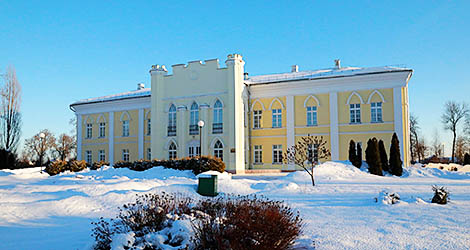
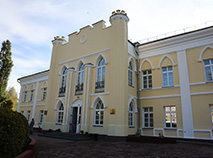
Potemkin Palace in Krichev is one of the architectural gems of eastern Belarus, a fine example of a provincial palace ensemble from the 18th century. Built on theorders of Grigory Potemkin, the favorite of Catherine II, it combines features of classicism and later Neo-Gothic architecture, preserving memories of luxurious estate life and fascinating stories associated with the Empress.
Today, you can stroll through the elegant chambers accompanied by “heroes| from the palace's past – Catherine II and her ladies-in-waiting, and Prince Potemkin of Tauride himself. However, despite the famous name of the first owner, to which the palace owes its wide renown, for much longer – 130 years! – it was owned by the ancient Holynski (also spelled as Golynsky) family. Their destinies, deeds, and mystical family legends are also of interest to travelers.
History of the palace in Krichev:
Residence of Grigory Potemkin and later a property of the Holynski family
In 1772, with the first partition of Rzeczpospolita, Krichev Starostwo came under the jurisdiction of the Russian Empire. It is known that some of the gentry in the annexed lands refused to swear allegiance to Catherine II, thereby losing their estates. This is how the previous Starosta of Krichev, Jerzy August Mniszech, lost his property.
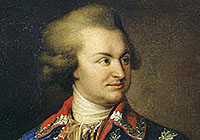
Consolidating her power in the new territories, the Empress gave cities and districts to those close to her – especially those who distinguished themselves in the Crimean campaign. Gomel was given by Field Marshal Peter Rumyantsev-Zadunaisky (1775), the favorite Semyon Zorich was granted ancient Shklov (1777), after the third partition of Rzeczpospolita, the Kobrin Kliuch estate was given to the famous commander Alexander Suvorov (1795). And on 11 January 1776, Catherine II awarded Krichev Starostwo, with a population of more than 14,000 serfs, to General-in-Chief Count Grigory Potemkin.
Active and enterprising, Grigory Potemkin understood the importance of industry and, upon becoming the owner of Krichev, organized a whole series of manufactories. The first one, a canvas factory – produced more than 800 pieces of sailcloth in 1783. In addition, there was also a tannery, rope factory, copper foundry, and glassworks. In a neighboring village, the Count had a large brick factory built.
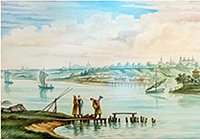
But perhaps the main Krichev project for the founder and first commander-in-chief of the Black Sea Military Fleet became the shipyard.
Shipbuilding in Krichev, located on the major Sozh River, had been practiced for a long time. However, under His Serene Highness Prince Potemkin, this industry reached a new level – due to increased volumes of raw material and product transportation to the lower reaches of the Dnieper for the needs of the Black Sea Fleet and foreign trade.
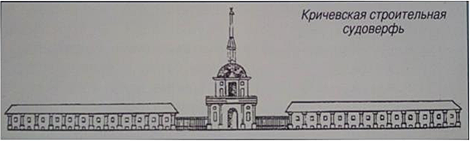
The Krichev shipyard opened in 1785. Extensive work was carried out: the Sozh River in the area of the shipyard was widened and deepened, berths and slipways for assembling hulls were built, and canals were dug through the meadows from a pine forest to deliver timber. On the shore, two production buildings and a two-tiered tower with a high spire between them were built.
Specialists who arrived from St. Petersburg, Moscow, and other cities participated in the construction of the shipyard and vessels in Krichev. Among them were Colonel Nefedyev, engineer Felenberg, and Samuel Bentham, a renowned English shipbuilder, mechanic, and engineer who managed the shipyard and factories in 1784–1787. The construction of ships at the Krichev branch of the Black Sea Admiralty was also directed by General-in-Chief Ivan Hannibal, Alexander Pushkin's grand-uncle. Interestingly, decades later, the famous poet visited Krichev and stayed at the local post station.
In Krichev, they built cargo ships (baydaks), small galleys, and other types of vessels. In 1786, The Desna was launched. It was a yacht intended for Catherine II's journey to the Crimea along the Dnieper and by sea to Sevastopol. Due to a shortage of warships, the vessel was rebuilt, and as part of the Liman Flotilla, The Desna participated in a number of successful operations: naval support for the Kinburn fortress, the capture of the Khadjibey fortress (Odessa), and the storming of Izmail... Later, 13 more sailing ships and 12 rowing vessels were built at the shipyard. At that time, Krichev was the cradle of the Russian fleet, and the town was known far beyond the borders of the Russian Empire.
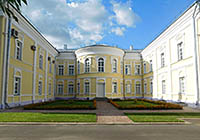
Simultaneously with the rapid development of Krichev, construction began on a new residence for Potemkin, one befitting the status of His Serene Highness and his wishes for a level of comfort. Potemkin turned to the renowned architect Ivan Starov. One of the conditions was to build a palace fit to receive the Empress herself. Incidentally, the Tauride Palace in St. Petersburg, the main residence of Grigory Potemkin, was also designed by Ivan Starov a little later.
The construction of the Krichev residence lasted from 1778 to 1787. In form, the palace resembled the letters P and E, which corresponded to the initials of the Prince-Favorite and the Empress.
The architectural ensemble in the style of Classicism included elements that referred to ancient Greece and the Crimea (Tauride), creating a mythological image associated with Potemkin's successes in the Crimean campaigns. Next to the palace, a park and an orchard were laid out according to the design by English master of landscape gardening William Gould.
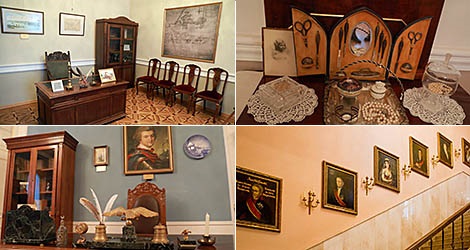
The two-story palace had more than 60 spacious chambers. Each room was richly decorated with stucco and frescoes, the fireplaces were tiled, and the floor was skillfully laid with mosaic. The dining room was stunning with tis furniture made of black oak, fine table silver, and porcelain of the finest quality. The interior fully corresponded to the tastes and status of the owner.
On 19 (30) January 1787, the year the construction was completed, Catherine II visited the palace while traveling from St. Petersburg to Crimea (the Taurida Voyage).
The Empress was accompanied by courtiers and foreign ambassadors, ladies-in-waiting, and servants. The palace managed to accommodate all the guests. Catherine the Great “deigned to dine and spend the night.” Sterlet from Astrakhan, grapes and lemons from Palermo, game from Belovezhskaya Pushcha, and chocolate from Riga were brought for the reception. The Empress also strolled through the newly established park. To mark the exceptional occasion, the palace complex’s illuminations remained lit until the early morning.
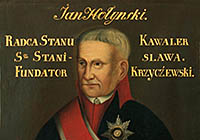
On the day of the Empress’s visit to Mogilev Viceroyalty, State Councilor Jan Holynski also paid her respects. The Marshal of the Nobility met Catherine at the border with Smolensk Viceroyalty and escorted her to the border of the Chernigov lands. Soon, he became the new owner of Krichev Palace.
Grigory Potemkin rarely visited his Belarusian estate. His focus was on the Southern Palmyra and the Black Sea, therefore the remoteness of the Belarusian estate from Crimea made regular visits impossible. There are also theories that Potemkin gambled away the residence or gave it away in exchange for keeping some secret. However, it is known that in 1787, Krichev Starostwo and the palace were transferred to Jan Holynski for 900,000 Polish zlotys.
For 130 years, the palace became the Holynski family seat. Legend has it that when Jan passed away, his wife Barbara mourned her late husband for a whole year. And when she herself was gone, people began to notice the image of a lady in white moving through the palace suite after dark...
In 1849, Jan’s grandson, Stefan Holynski, decided to rebuild the residence in the neo-Gothic style, in keeping with the architectural trends of the time. He wanted the palace to feel more like a residence than a venue for grand balls. Swiss architect Bernhard Simon was invited to undertake the project. After the renovation, the classical window frame decoration was gone, and the main entrance was redesigned. A little later, stone entrance gates in the shape of four Egyptian pyramids were added (they have not survived to this day).
In 1898, the palace was severely damaged by fire. Stefan Holynski repeatedly attempted to restore its former grandeur, but his plans were interrupted by World War I and subsequent events in the country.
After the 1917 revolution, the Holynskis left the palace. In the summer of 1918, Yevdokia Gordeyeva, a native of the neighboring town of Cherikov, funded the building’s renovation and established a private gymnasium on the premises, which was subsequently reorganized into Krichev Vocational School. From 1932 to 1941, the building also housed a pedagogical college.
During the Great Patriotic War, the building housed Nazi occupiers. In 1943, after Krichev’s liberation, the school and the pedagogical college reopened. In the 1960s, boarding school students lived and studied within the residence until the building fell into disrepair.
Restoration of the palace began in the late 1980s, but the process was intermittent. The façade and interiors were restored using 18th-century designs. In 2003, the building was included in the State List of Historical and Cultural Values, and on 16 February 2008, the renovated palace opened its doors to visitors.
Potemkin Palace today
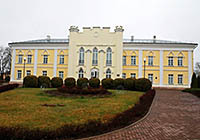
Potemkin Palace is an architectural, historical, and tourist gem of Krichev District, the heart of the town’s cultural life. Incidentally, the residence’s location, chosen centuries ago, was so convenient that even today all major public transportation routes lead to it.
The palace houses the Krichev Historical Museum and the Civil Registry Office with a wedding hall.
The museum, one of the most popular in Mogilev Oblast, features the following thematic halls:
-
“History of the Palace” (in the style of a winter garden);
-
“Estate Manager’s Room”;
-
“Buffet” and “Dining Room”;
-
“Study Library”, which is dedicated to the history of Krichev County and the town of Krichev from 1772 to the early 20th century, with interior elements from the 18th and 19th centuries;
-
“Knight’s Hall” that offers a glimpse at the history of the Krichev land from ancient times to 1772, with interior elements from the 17th to the first half of the 18th century;
-
“Boudoir,” “Sofa Room,” and “Living Room”;
-
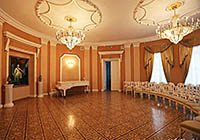
“State Hall” that features individual interior elements evoking the grand atmosphere of a Catherine-era ballroom; it also serves as a concert and lecture venue.
The museum’s furniture and interior exhibits reflect the style of Catherine the Great’s period: they were acquired in antique shops and auctions, made to order, and some rarities were donated by customs services. For example, two original chairs from the Potemkin estate survived, leading to the creation of several dozen more replicas for the State Hall. A beautiful early 19th-century Meissen porcelain set adorns the dining room.
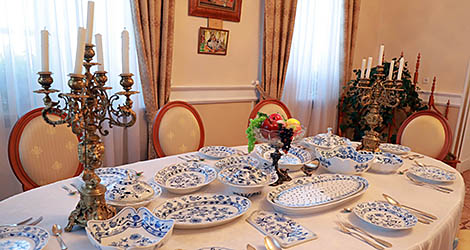
Philanthropists also contribute. A guest from France once donated 17 rarities to the museum: ancient ladies’ kid gloves and jewelry, a 19th-century jug, ceramic vases, and playing cards.
The Krichev Museum collection includes numerous items of historical significance. Among them are a coin hoard from the 16th–18th centuries, a copy of Simeon of Polotsk’s The Nourishment of the Soul published in 1681, elements of body armor, old seals... In 1959, a pot containing documents from a family archive was discovered in the palace attic. Preserved materials include personal letters, receipts, a service contract “for eternal remembrance”, and other papers dating from 1719 to 1905.
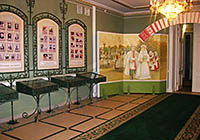
A special thematic exhibition is the Museum of the Mother. It tells the stories of women-mothers of the war years, female laborers honored with state awards, and mothers of soldiers who fought in international conflicts. At the center is a painted icon of the Mother of God with the Christ Child, consecrated on the feast of the Intercession. Additionally, the exhibition traces the history of weddings, from authentic traditions and rituals practiced centuries ago.
A separate building of the Krichev History Museum houses exhibits dedicated to the events of the October Revolution and the history of the Great Patriotic War in the region.
Potemkin Palace is a vibrant hub of cultural life today. For guests and residents of the city, it hosts engaging events – some of them theatrical, transporting visitors back several centuries. These include:
-
Potemkin Amusements
-
New Year’s Tree at the Palace
-
The Potemkin Ball
-
Museum Night
-
The Music Salon and more.
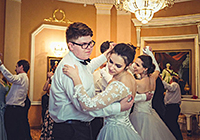
At the palace, you can have an 18th-century style wedding. In the opulent halls, newlyweds and their guests are greeted by “Catherine II” and “Prince Grigory Potemkin”, along with “the Empress’s ladies-in-waiting” and a “valet”. A chamber orchestra performs during the ceremony, accompanied by a dance ensemble.
Full immersion into the Catherinean era is also offered through theatrical guided tours, ballroom dancing workshops, and themed quests.
In partnership with Russian partners, the museum has developed a tour called Along Potemkin’s Roads, which traces a route through Russia and Belarus. A virtual version is also available.
How to get there and where to stay
From Minsk:
• By car: 310–380 km depending on the route. Take the M4 highway (Minsk–Mogilev), then continue via the R122 and R43 roads; travel time is about four hours.
• By train: Minsk and Krichev are connected by the Grodno-Kommunary interregional train service; the journey takes around nine hours.
• By bus: Departures from Tsentralny Bus Station, with a transfer in Mogilev.
From Mogilev: 110–140 km by car depending on the route — via Cherikov or Mstislavl. You can also take a bus, train, or commuter train.
It is convenient to stay at one of the hotels in Mogilev. There are also hotels in Krichev if you prefer to stay overnight there.
Sights near Potemkin Palace
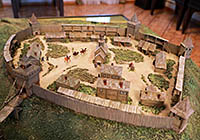
Krichev is one of the three oldest towns in Mogilev Oblast. It was first mentioned in written sources (under the name Krechut) in 1136, just one year after Mstislavl and around the same time as Propoisk (now Slavgorod).
The town lies on the banks of the picturesque Sozh River, the second largest and most abundant left tributary of the Dnieper. Much of its historical heritage has not survived, but today Krichev still offers more to see than just its gem – Potemkin Palace. Notable sights include:
-
Zamkovaya Gora settlement site: from the late 12th century, Krichev Castle stood here until it was destroyed during the Great Northern War of 1700–1721.
-
Wooden St. Nicholas Church (1945) on Zamkovaya Gora.
-
Remains of a brick icehouse (presumably 18th century) on Zamkovaya Gora.
-
The posting station (mid-19th century), which once served the Moscow–Brest–Warsaw route.
-
Krichev railway station, which welcomed its first train in 1921.
-
Memorials to those who perished during the Great Patriotic War.
A well-known industrial brand (now Krichevcementnoshifer) and decades of open-pit mining have given rise to unique man-made natural attractions that continue to draw travelers, despite access restrictions.
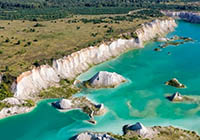
The flooded chalk quarries near Krichev and neighboring Klimovichi in Mogilev Oblast are called “Belarusian Maldives” – a nickname shared with similar artificial reservoirs near Volkovysk (Krasnoselsk chalk quarries), Grodno (Sinka and Zelenka, Pyshki), Lyuban, and elsewhere. The association with tropical islands comes from the turquoise and azure waters framed by snow-white shores. The quarries are closed to visitors and swimming due to safety hazards: the risk of shoreline collapses, unpredictable depths, and the temperature and composition of the water. However, it is possible to admire the picturesque landscapes and capture striking photos from a safe distance.
Near the village of Kamenka are active sections of the namesake deposit, where Krichevcementnoshifer conducts mining operations. Walking excavators and other machinery operate within the vast quarry, appearing toy-like against the immense scale and capable of impressing passing tourists.
The Krichev area can become a destination for a day trip or part of an engaging multi-day route. Forty kilometers north of Krichev lies Mstislavl, a city with a rich history, while to the southwest you can visit Cherikov (28 km) and Slavgorod (62 km), both equally fascinating.
Of course, travelers should make time for the region’s main city – Mogilev – which once nearly became... the capital of Belarus. Among its iconic landmarks are Buinichi Field and the Mogilev Oblast Glory Museum, St. Nicholas Monastery, the Church of St. Stanislaus, the Mogilev Town Hall, Star Square, and others.
 print version
 make home page
 add to bookmarks