



Buinichi Field Memorial Complex and Mogilev Oblast Glory museum
The Buinichi Field Memorial is a symbol of the resilience and courage of the defenders of Mogilev, a landmark heroic site in Belarus that entered the history of the Great Patriotic War alongside the legendary Brest Fortress.
In July 1941, fierce and bloody battles were fought on the approaches to Mogilev between Soviet and German troops. For over three weeks, Red Army units held the defensive line, thwarting the fascist plan for a blitzkrieg, a swift advance on Moscow and a lightning-fast conquest of the Soviet Union. This feat later earned Mogilev the name “father of Stalingrad” as the experience gained here in anti-tank defense was applied in one of the key battles of World War II on the Eastern Front.
History of Buinichi Field
In the summer of 1941, when Hitler's Germany attacked the Soviet Union, Wehrmacht troops advanced swiftly deep into the country. The Red Army soldiers were not able to hold back the enemy's onslaught everywhere. But in July 1941 near Mogilev, the city's defenders managed to hold out for 23 days.
German units attempted to enter Mogilev from the direction of Bobruisk. The forward defense line at Buinichi was held by the 172nd Rifle Division and the city's militia. The road and railway routes leading to the regional center were blocked by the 388th Rifle Regiment under the command of Colonel Semyon Kutepov. They were supported by militia fighters and artillery. Local residents worked alongside the soldiers to build the defensive fortifications. The work continued day and night. Approximately 20 kilometers of trenches and communication trenches were dug, and anti-tank ditches stretched all the way to the Dnieper River. Within a week, a deeply layered defense system was created from scratch around and within Mogilev itself.
On 11 July, a German tank division attempted to break through to Mogilev from the southern direction. Soviet units repelled the attack. Following a stubborn 14-hour battle on 12 July, the German forces retreated with significant losses. Thirty-nine tanks and armored vehicles lay destroyed on the field. The city's defenders also suffered heavy casualties but held their positions. The attacks resumed the following day but were once again repelled. ...The anti-tank defense experience gained at Mogilev was later used in the Battle of Stalingrad.
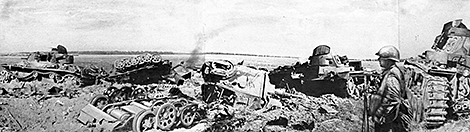
One of the first successes of the Soviet forces could not go unnoticed. Journalists from national publications arrived in Buinichi. Among them were the war correspondent Konstantin Simonov and photographer Pavel Troshkin. Photos of destroyed German vehicles and the article “A Hot Day” were published in the Izvestia newspaper on 20 July. People gathered around bulletin boards displaying the publication, reading intently about the fighters who did not retreat under enemy pressure but offered determined resistance.
What Konstantin Simonov witnessed on the battlefield was later described in his novel “The Living and the Dead”. He also described the events of July 1941 in his diary and a book of memoirs. After the war, the writer returned to Buinichi many times, meeting with participants in the defense of Mogilev.
Unfortunately, the defenders did not have the strength to completely halt the Wehrmacht's advance. On 26 July, the encircled Mogilev was captured by the German army. However, the Soviet forces succeeded in tying down significant German forces and delaying their further offensive, ultimately shattering the blitzkrieg plan.
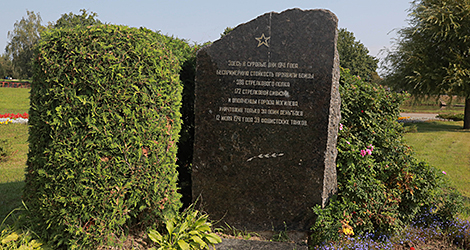
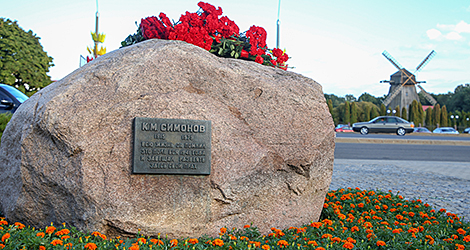
The decision to immortalize the heroism of the Soviet soldiers was made as early as 1962. At that time, a stele honoring the fighters of the 172nd Rifle Division was erected on the outskirts of Buinichi. In 1980, the Konstantin Simonov Stone was put here. The writer wished to return to Buinichi Field and rest there forever. Fulfilling his last wish, Simonov's family scattered his ashes at this very location after his death in 1979. The 15-tonne boulder was brought to the area near Mogilev from the Museum of Stones in Minsk.
The first part of the Buinichi Field Memorial Complex was solemnly opened on 9 May 1995, on the 50th anniversary of Victory. Its construction had begun a year earlier. The project's authors were architects V. Chalenko and O. Baranovsky, along with sculptor V. Boitsun. Work on the memorial was fully completed in 2003. That same year, the complex received an award at the National Festival of Architecture.
Buinichi Field today
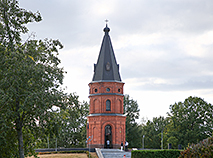
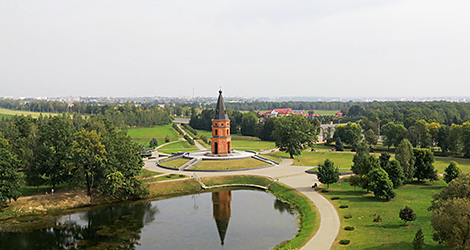
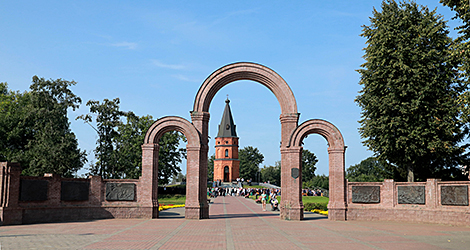
The Buinichi Field Memorial Complex is a park spanning approximately 19 hectares. At the heart of the ensemble stands a chapel, atop an artificial hill. Four avenues radiate from it like rays: the central avenue (leading to the entrance arch), the Avenue of Memory and Glory (also known as Simonov Avenue, leading to the Simonov Stone), the Avenue of the Defenders of the City of Mogilev (with a capsule with a message to future generations buried at its start), and the avenue named The Living and the Dead. Additionally, there is Lake of Tears, a symbol of mothers’ sorrow, with a small island, two groves, an exhibition of military equipment, and a relatively well-preserved anti-tank ditch.
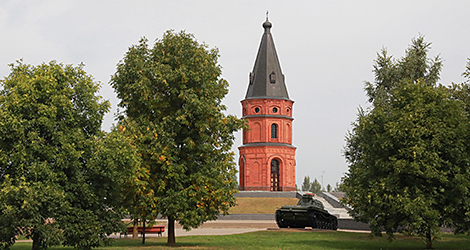
The red brick chapel, standing over 24.5 meters tall, features a retrospective-Russian style. This octagonal, three-tiered building is topped with a tented roof, which is crowned by a dome with a cross. Inside, the chapel is finished with white marble and adorned with frescoes; its niches contain metal plaques bearing the names of the defenders of Mogilev. At the center of the chapel, a Foucault's pendulum swings as a symbol of eternal memory for the soldiers who perished defending the Motherland. Beneath the chapel there is a crypt holding the remains of Red Army soldiers, discovered on the fields of past battles.
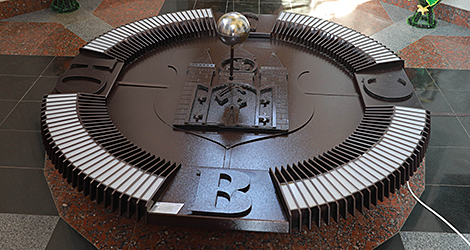
The wings of the entrance arched gate are decorated with metal high-reliefs (six in total). They depict a map of the defense of Mogilev, a list of the units and formations that defended the Dnieper line, lines from the Buinichi Field Ballad by A. Pysin, the decree awarding the regional center the Order of the Patriotic War First Class and an excerpt from the memoirs of Marshal of the Soviet Union Georgy Zhukov. Another metal panel is dedicated to the militia of Mogilev.
The military equipment exhibition features both Soviet-era and modern combat vehicles: anti-tank and anti-aircraft guns, howitzers, the heavy IS-2 tank, T-72 and T-80 tanks, a self-propelled artillery unit, as well as airborne and reconnaissance vehicles. The display also includes a rare trophy: a German Pz.Kpfw. III (Panzer III) tank. It was recovered from the Drut River in 1994 and subsequently restored. Experts believe it to be the best-preserved specimen of this modification (PanzerBefehlswagen III Ausf E). Metal anti-tank hedgehogs have been placed in front of the destroyed enemy vehicle.
In 2017, construction began on an Orthodox church at the Buinichi Field in memory of the soldiers who defended the approaches to Mogilev. In 2019, the church was consecrated in honor of the Nativity of John the Baptist.
Mogilev Oblast Glory Museum
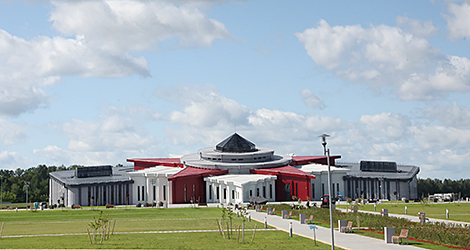
In 2021, a proposal was made to reconstruct the Buinichi Field memorial complex and organize a museum on its grounds. The initiative was put forward by public organizations, veterans of the Great Patriotic War and the Armed Forces of Belarus, the Mogilev public, and search and recovery teams. Construction began in 2023, and on 5 July 2025, the Mogilev Oblast Glory Museum opened its doors to visitors.
The museum building is designed in the shape of the Order of the Patriotic War, an award bestowed upon the regional center. To better display the facade, which is stylized after this award, the structure is tilted at a 10-degree angle relative to the ground. This unique project combines exhibition halls, display areas, assembly and conference halls, as well as museum classrooms.
Across 16 halls on two floors, the museum narrates not only the military past but also the history of Mogilev Oblast, its successes, and its people. Visitors can also learn about contemporary achievements. The Glory Museum is a branch of the Mogilev Oblast Museum of Local History.
The exhibits include authentic artifacts unearthed by search teams at Buinichi Field. Visitors can also view the uniform and documents of Ivan Yakubovsky, twice Hero of the Soviet Union; the smoking pipe of Konstantin Simonov; and a copy of the trilogy The Living and the Dead with a personal inscription from the author to the widow of Colonel Semyon Kutepov. Incidentally, Kutepov served as one of the prototypes for the novel’s protagonist - Colonel General Serpilin.
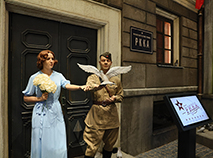
The Mogilev Oblast Glory Museum was established as a high-tech historical, cultural, and educational center. It employs modern multimedia solutions, augmented reality, and virtual reality technologies, making the dive into history interactive and immersive. For example, you can purchase a ticket to a 1939 film screening at the Rodina cinema in Mogilev. Minutes later, you can become a participant in the Battle on Buinichi Field on 12 July 1941 – “shoot down” an enemy tank using a replica cannon or, in virtual reality, help a soldier reload his weapon or assist a nurse in bandaging a wounded soldier. A VR headset lets you step into the shoes of Izvestia photojournalist Pavel Troshkin and “approach” a destroyed German vehicle to capture the legendary photograph.
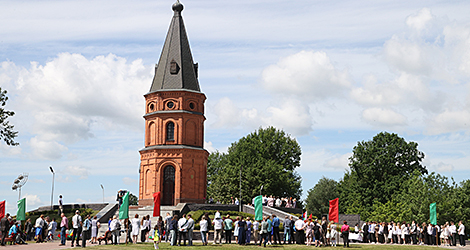
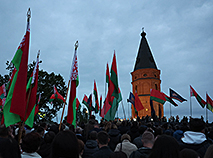
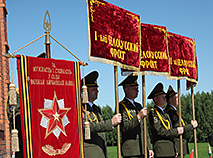
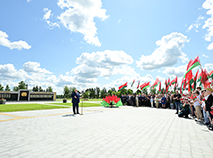
Today, Buinichi Field serves as a place of memory, mourning, and valor, as well as a center for instilling patriotism in youth. The site hosts solemn Victory Day and Mogilev Liberation Day commemorations, educational sessions, veteran meet-and-greets, and inductions into children’s and youth groups. The regional Roll of Honor has also been placed on the memorial site, close to the museum.
Getting to Buinichi Field and accommodation options
The memorial complex is located near Mogilev in the agro-town of Buinichi, at the 6th kilometer of the R93 highway in the direction of Bobruisk. From the city, you can get there by car or by public transport to the Buinichi stop.
From Minsk by car, take the M4 motorway toward Mogilev, then turn right onto the ring road encircling the regional center, and turn left at the interchange with highway P93. Alternatively, you can drive through the regional center along the P93 road toward Bobruisk.
Accommodation is available in Mogilev.
Address: Buinichi, Mogilev District
Coordinates: 53.867135, 30.251316
Sights to see around Buinichi Field
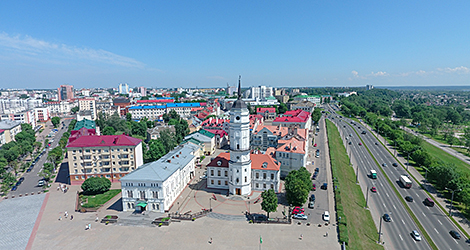
The main attraction not far from Buinichi Field is, of course, Mogilev. In this city, renowned for its rich history, you can visit the Town Hall, St. Nicholas Monastery, Orthodox and Catholic churches, the drama theater, museums, parks, and more.
Directly opposite the memorial are the Mogilev Zoo and the 19th Century Belarusian Ethnographic Village complex. There, visitors can learn about folk traditions, rituals, ceremonies, and crafts. In the open-air area are a windmill, a well with a shadoof, Korchma (tavern), and an Artisans Town featuring working pottery, weaving, and carpentry workshops, a bakery, a forge, and cottages of a moonshiner and embroidery and weaving masters.
 print version
 make home page
 add to bookmarks