



Trostenets Memorial Complex
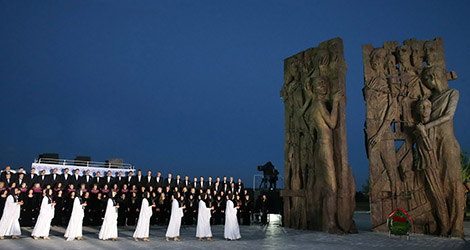
Trostenets was the largest Nazi death camp on the territory of Belarus and the entire Soviet Union. Today, it is a memorial complex commemorating over half a million people exterminated by the Nazis during World War II.
During the occupation of Minsk, the Nazis set up a veritable “death factory” on the outskirts of the city. For many post-war decades, it was believed to be the fourth-largest concentration camp in Europe and the world by number of victims, after Auschwitz, Treblinka, and Majdanek. Officially, the number of people killed in Trostenets was stated as 206,500. However, according to the latest data, it has been legally confirmed that in Trostenets, the fascists exterminated - tortured, shot and burned - at least 546,000 people. This makes the statistics even more horrific and elevates the death camp near Minsk to the third-largest by number of victims.
The name Trostenets encompassed several sites of mass extermination: the actual concentration camp near the village of Maly Trostenets, 12 km from the center of Minsk along the Mogilev highway; the Blagovshchina tract, a site of mass killings; and the Shashkovka tract, a site of mass incineration of victims. From autumn 1941 to June 1944, the Nazis killed Belarusian civilians, participants in the anti-fascist underground and partisan movements, prisoners of the Minsk Ghetto, Soviet prisoners of war, and Jews deported from several European countries: Austria, Germany, Czechoslovakia, and Poland.
A history that cannot be forgotten: Trostenets ‘death factory’
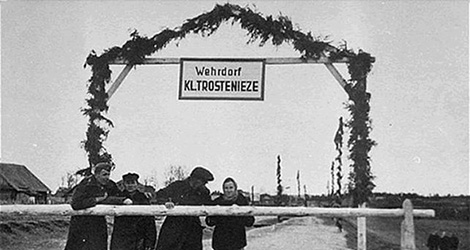 Just a few months after the start of the Great Patriotic War and the occupation of Minsk, the Nazis organized their ghastly killing conveyor. They chose the Blagovshchina tract at the 11th kilometer of the Mogilev highway near the village of Maly Trostenets as the site for the mass murder of people. As early as 10 November 1941, trains carrying Jews from Germany, Czechoslovakia, and Austria began arriving in Minsk. By the spring of 1942, the place had become a veritable hell. At a filtration point, the deportees' belongings were taken “for safekeeping”, then the people were transported to Blagovshchina and shot. The bodies were thrown into pits, compacted, and covered over...The highest single death toll during a four-day operation in July 1942 reached 18,000 people, Belarusian and foreign Jews.
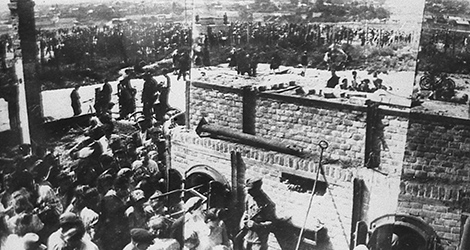 The territory of death near Minsk was expanded. To receive transports from Europe, a railway station (platform) was built. Until the autumn of 1942, it received transports twice a week, each bringing a thousand or more people. From 20 to 80 individuals (electricians, mechanics, carpenters, tailors, shoemakers, and other specialists) were carefully selected for work at Trostenets and the Minsk Ghetto. The rest were exterminated.
When the Red Army's offensive began, the Nazis launched large-scale operations in Trostenets (that lasted from October 1943 to March 1944) to destroy the evidence of their crimes.
Did you know...
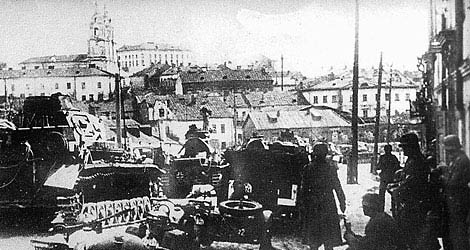 During the years of fascist occupation, Belarus was strewn with hundreds of thousands of corpses of people brutally tortured and killed. As early as 6 January 1942, Soviet People's Commissar for Foreign Affairs Vyacheslav Molotov sent a note detailing the Nazi atrocities to allied nations through diplomatic channels. At that point, the German leadership got down to swiftly destroying the evidence. The Operation 1005 initiative was mainly conducted on the territory of Belarus and was one of the most inhumane operations in world history. Participants in the operation classified as “top secret” were required to sign non-disclosure agreements: the Sonderkommandos [German for “special units”] were forced to exhume and burn the bodies and were themselves liquidated upon completion of their work.
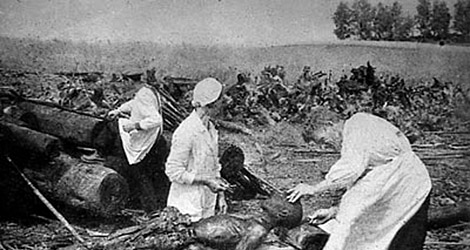
In Trostenets, the “1005” units began their operations in the autumn of 1943. In the Blagovshchina tract, with around 150,000 remains in 34 enormous pits-graves, the exhumations lasted six weeks. According to German calculations, destroying such a quantity required lighting 750 pyres, each for 200 corpses... They constructed frameworks from logs, poles, and human remains, doused them with gasoline, and set them ablaze. After a pyre had burned completely to ashes, the workers were forced to grind any surviving bones, sift through the ashes, and extract gold teeth and jewelry...To carry out these horrific tasks, the first “Sonderkommandos” teams consisted of 100 prisoners from the camp on Shirokaya Street in Minsk. The second team included representatives of “Russian” Jews (including Belarusian Jews) and also local residents held in the SS prison. All of them were subsequently liquidated.
Another brutal extermination conveyor was in operation at Shashkovka. In the autumn of 1943, an incinerator (a large, rail-lined pit covered by an iron grate) was already in useand was “loaded” each day. Victims were brought to the site in gas vans or on open trucks, executed near or within the incinerator, and some groups were torn apart with grenades. Underground fighters, partisans, and civilians from Minsk and surrounding villages captured in punitive operations were burned in the Shashkovka furnace. The ashes from the incinerator were used as fertilizer on the fields of Nazi subsidiary farms.
A concentration camp to service these farms was established by the Minsk Security Police and SD in early 1942 near Maly Trostenets on the lands of the former Karl Marx state farm. Previously, the estate of landowner Yurlov, with its orchard and mill, stood in this area on the banks of the Trostyanka River. With the arrival of the Nazis, the former estate was converted into a warehouse and bomb shelter for the camp administration. Prisoners of the concentration camp were forced to construct a new house for the commandant, guard quarters, and a garage.
The Nazis set up a large farm near Minsk, producing food and running workshops. On the camp grounds, gas vans were “cleaned” (their exhaust pipes were redirected into the sealed cargo compartments, where victims suffocated en route to extermination sites), and the belongings of the murdered were sorted. During the occupation, the prisoner population in the camp ranged from 200 to 900.
At the end of June 1944, as Soviet troops approached Minsk, the Nazis began the emergency liquidation of Trostenets. Approximately 6,500 people were shot and burned on the camp grounds. In the final mass atrocity, just three days before the Red Army’s arrival on 29–30 June 1944, the Germans murdered prisoners from the Minsk prison on Volodarsky Street and the camp on Shirokaya Street. Only two individuals, Stepanida Savinskaya and Nikolai Valakhanovich, survived. They later provided testimony detailing the horrors committed at Trostenets.
Just a few dozen people survived the camp’s entire existence.
The Nazi death conveyor at Trostenets claimed over half a million lives; those were men, women, and children, peopleof various professions, faiths, and ethnicities. Among the long list of victims were many notable figures. One was Yevgeny Klumov, a distinguished surgeon, Doctor of Medical Sciences, professor, and a courageous Minsk underground fighter (codenamed “Samarin”), who was posthumously awarded the title Hero of the Soviet Union. Refusing to collaborate with the Germans, Klumov diedalongside his wife in a gas van en route to Trostenets. Today, a street, an alley, and Minsk Clinical Hospital No. 3 bear his name. A similarly tragic fate befell Vladimir Anisimov, a professor of meteorology and Klumov’s comrade in the underground resistance.
Two months after the liberation of Minsk, on 3 September 1944, the first memorial rally was held in Trostenets in honor of the many thousands of victims. On the day the remains of the murdered were buried, approximately 10,000 residents of the capital and surrounding areas gathered at the site.
Trostenets Memorial: The creation of a symbol of sorrow and remembrance
The initial monument honoring those who perished in the largest Nazi death camp on Soviet territory was an obelisk with an eternal flame. Constructed in the 1960s, it stood in the village of Bolshoy Trostenets, distant from the camp grounds and the killing sites.
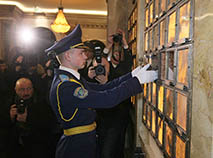
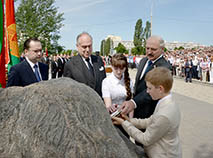
In 2002, the decision was made to create the Trostenets Memorial Complex. Construction began in 2014 following the directive of Belarusian President Aleksandr Lukashenko, preceded by a symbolic ceremony in which a time capsule containing a message to future generations was laid.
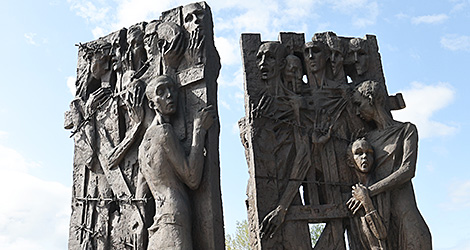
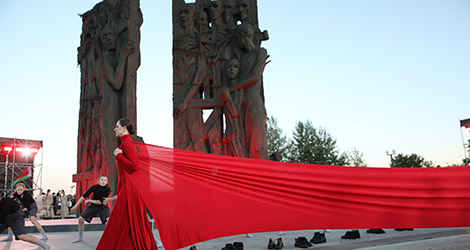
On 22 June 2015, the anniversary marking the outbreak of the Great Patriotic War, the initial stage of the memorial complex was opened to the public. Dominating the grounds where monstrous crimes were once committed is the country’s largest bronze sculpture, the Gate of Memory, standing 10 meters tall and weighing 35 tonnes. Created by Konstantin Kostyuchenko, the sculpture embodies the tragic fates of hundreds of thousands who perished: 29 emaciated figures of prisoners, seemingly fused with barbed wire, are “imprinted” upon the gates.
 Memorialization efforts continued. In June 2018, the remains of murdered prisoners discovered during excavations and construction near 34 pits were interred in a burial ditch at Trostenets. Specialists identified the remains of 41 individuals: 24 adults, 5 teenagers, and 12 children. The youngest was approximately 4 to 5 years old.
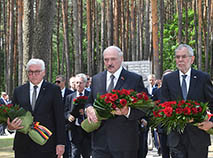
The second stage of the memorial complex at the Blagovshchina tract was opened on 29 June 2018. The event was attended by the presidents of three countries: Aleksandr Lukashenko (Belarus), Frank-Walter Steinmeier (Germany), and Alexander Van der Bellen (Austria). Also present at the ceremony were former Austrian President Heinz Fischer, as well as representatives from Poland, the Czech Republic, and Jewish organizations.
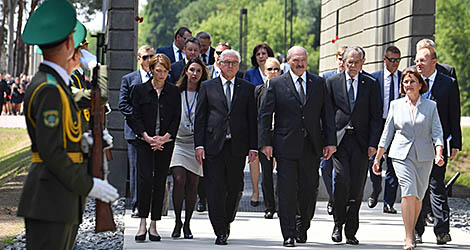
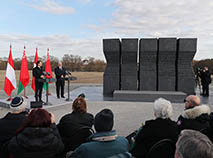
On 28 March 2019, with the participation of Aleksandr Lukashenko and Austrian Federal Chancellor Sebastian Kurz, the Array of Names monument was unveiled in memory of the Austrian citizens who perished in Trostenets. The memorial features ten columns mounted on a pedestal, symbolizing the ten train convoys that transported Austrian Jews deported from Vienna to Trostenets. The columns bear the first names of the victims (without surnames), partially blurred and partially erased.
On the eve of the Day of People’s Unity, 16 September 2025, a memorial sign commemorating the victims of genocide was opened at the site of the former Trostenets death camp. This event continued the extensive work to investigate the crimes that led to the largest extermination of the Belarusian people in history. In April 2021, the General Prosecutorэs Office of the Republic of Belarus initiated a criminal case concerning acts of genocide against the Belarusian people, committed by Nazi criminals, their accomplices, and criminal formations on the territory of the BSSR and other states during the Great Patriotic War (1941–1945) and in the post-war period.
During the investigation and the revelation of the tragedy’s true scale, the General Prosecutor’s Office, at the level of the president and the government, initiated a proposal to memorialize the victims of genocide in each region of the country. The Tree of Life unified memorial sign was installed in all regional centers. The culmination of this memorial relay was Trostenets, the site with the highest number of victims of mass extermination in Belarus and the USSR, an area of immense tragedy on a European scale. The Tree of Life memorial sign was created by Vitebsk sculptor Ivan Kazak, whose work was selected as the winner of a competition.
Monstrous truth immortalized in the Trostenets memorial: symbolic markers, memorial sites, and compositions in harmony with nature
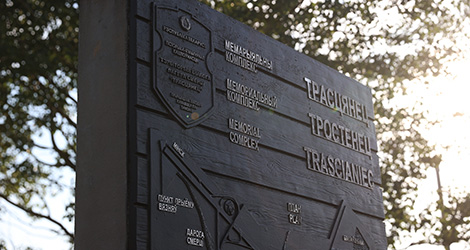 The events at Trostenets cannot be fully investigated or described in detail, with exact dates of death or even the names of many victims provided. The Nazis did too much to conceal the traces of their crimes, destroy documents, and eliminate participants of Operation 1005... For decades, the site of this monstrous tragedy remained without proper attention and reverence, and for many Europeans, it was entirely unknown. Today, the Trostenets memorial complex continues to develop and expand, welcoming visitors from around the world.
It is a symbol of remembrance for the thousands of murdered people of various nationalities, faiths, and ages, and evidence of the cruel crimes that must not be forgotten, so that such horrors can never be repeated. Today, silence and peace reign here, but the burials, plaques with the preserved names of the killed, fragments of camp structures, memorial markers, and eloquent sculptural and landscape compositions - all speak of the most inhuman and terrifying manifestation of Nazism.
The Trostenets memorial complex, spanning 112 hectares, is located on the southeastern outskirts of modern Minsk and consists of two sections situated on opposite sides of the M4 highway (Minsk-Mogilev):
-
The Trostenets Memorial Park (60 ha), the site of a concentration camp and the Shashkovka tract with its pit-furnace (near present-day Selitsky Street and Mogilev Highway);
-
The Blagovshchina Memorial Cemetery (52 ha), the location of mass shootings and the burial of victims in 34 trench graves.
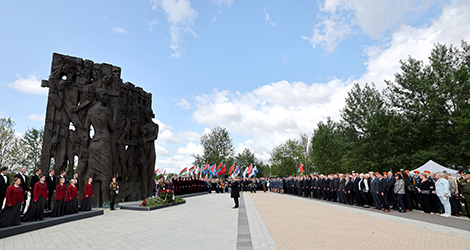 The centerpiece of the Trostenets Memorial Park is the 10-meter-high composition Gates of Memory (sculptor Konstantin Kostyuchenko, architect Antonina Aksenova), which is the largest bronze sculpture in Belarus. The emaciated figures of prisoners, seemingly intertwined with barbed wire and fused into the gates, have become the embodiment of the tragedy that lasted in Trostenets for nearly three years.
From the 9th kilometer of the Mogilev Highway, the site where prisoners were unloaded and “sorted” – the “Road of Death” leads into the depths of the memorial, recalling the sorrowful path of the victims. Further on, the “Road of Memory” leads to the main square and the large-scale sculpture Gates of Memory. This symbolic avenue immortalizes the memory of those who perished and the sites of mass extermination across the entire territory of occupied Belarus from 1941 to 1944.The granite slabs resemble upturned layers of earth, a symbol of how, during the war years, the soil of Belarus was saturated with the blood of millions of victims. The road is paved with gray tiles interspersed with black “footprints of the prisoners”, doomed to death.
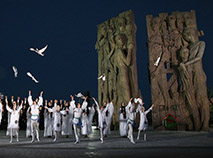
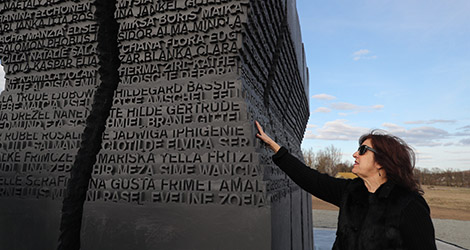 At the end of the Road of Memory stands the monument Array of Names to commemorate more than 10,000 Austrian citizens of Jewish origin. The concept was created by Austrian architect Daniel Sanwald and brought to life by Belarusian sculptor Konstantin Kostyuchenko (who is also the author of the central composition of the memorial Gates of Memory). The monument is a massive stone split into columns, each 3.5 meters high. Their number symbolizes the ten trains that carried people to Trostenets. The columns bear the names of the victims.
Nearby lies a swamp, from which gnarled stumps protrude. Dry and twisted, they resemble the “hands” of death itself reaching for the victims. A little further is the Burial Field, where the Nazis scattered the ashes of those they had burned…
In this part of the complex, based on archaeological research, the locations of camp structures from the occupation period are marked: fragments of barracks, warehouses, a sawmill, a greenhouse where flowers were grown, a water tower, and a guard post. A model of a watchtower has also been installed. Visitors can see railway wagons like those in which thousands of doomed people were brought to Trostenets.
An important element of the memorial is the Tree of Life, erected in memory of the victims of the genocide of the Belarusian people, symbolically linking Trostenets with all regions of Belarus into a single chain.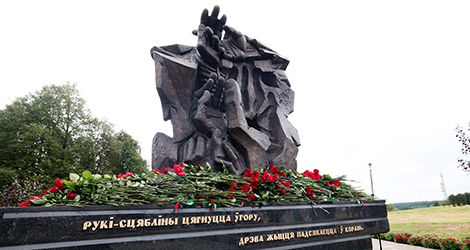 On the opposite side of the Minsk-Mogilev highway lies the second part of the complex: the Blagovshchina memorial cemetery. It consists of two symbolic sites:
-
The Last Path: the road from the Mogilev highway to the memorial cemetery (designed by the creative studio of L.M. Levin, chief architect Galina Levina);
-
The memorial cemetery itself (designed by the landscape architecture studio of the Minskproject enterprise, chief architect Anna Aksenova).
After the liberation of Belarus, investigators discovered 34 mass graves in the Blagovshchina tract: each more than 30 meters long, 5 meters wide, and 3 meters deep. The bodies were no longer there – only a mass of ash and bones remained. This was all that was left after the German operation to conceal the traces of their crimes…
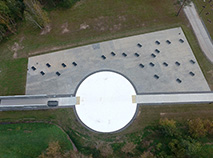
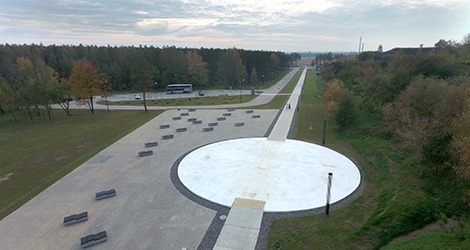
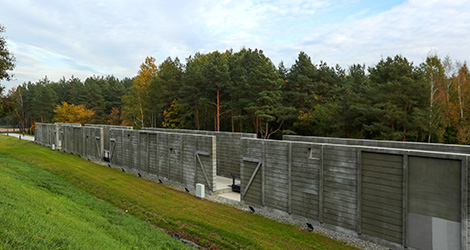 Today, the memorial Last Path of Blagovshchina passes through three symbolic squares: the white Square of Life (a circle of hopes for peace and the future, to which the prisoners clung), the red, fractured Square of Paradox, and the black Square of Death. Part of the road to the burial sites is designed as a concrete “train”: each visitor seems to walk through the “wagons” in which, during the war, people were transported to Trostenets to meet their deaths. At night, the scarlet lighting inside these structures creates an even more powerful impression, evoking the chilling horror of the bloody tragedy.
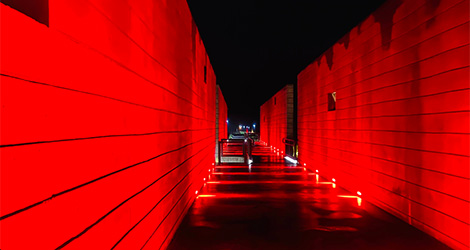 This part of the complex was created by the architects of the creative studio of L.M. Levin, under the direction of the master’s daughter, Galina Levina. The vision of Leonid Mendelevich Levin, a luminary of Belarusian architecture and one of the authors of memorials in Khatyn, Krasny Bereg, and other significant sites in the country, was also realized here in Blagovshchina.
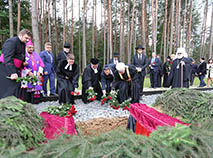
The main part of Blagovshchina is the memorial cemetery itself: the site of horrific events, where people were shot, trampled into mass graves, later exhumed, and burned, reduced to ashes in an attempt to erase the evidence of crimes… Today, the remains of the murdered rest in large graves, covered with memorial slabs.
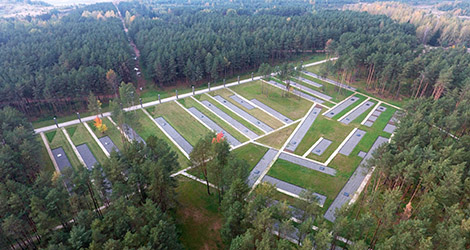 At the memorial cemetery, architects under the direction of Anna Aksenova created a unified composition of symbolic elements, landscape features, and special varieties of trees and plants, so that every detail would leave a powerful impression on visitors.
…Beeches of the Black Swan variety, with weeping branches and purple-black foliage resembling congealed blood, bow mournfully toward the ground. At the 34 graves stand rowan trees heavy with bright scarlet berries. The landscape composition Apple Orchard, during its blossoming, intensifies the tragic contrast with the dark pines that grew in the postwar years: the white apple blossoms symbolize the children whose lives were destroyed by the Nazis. The composition Lost Time, formed of twelve weeping trees, embodies the time humanity has wasted on wars and destruction…
The Trostenets memorial complex also includes a monument-obelisk and an eternal flame, installed in 1963 in the village of Bolshoi Trostenets (53.85234, 27.70651).
Information Center and Exhibition at the Trostenets Memorial Complex
 The work to identify the names of the victims of the Trostenets death camp continues. Historians, local researchers, students, schoolchildren, and public organizations are engaged in the search for information. The Belarusian Cultural Center of Spiritual Revival coordinates this large-scale effort.
It is planned that an information center with a permanent exhibition will be established on the territory of the memorial complex, not far from the Gate of Memory. The restored names of the prisoners will be entered into an electronic Book of Remembrance.
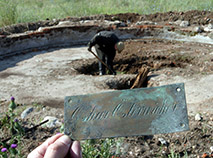
Visitors to the Trostenets Memorial Complex can see items discovered during excavations for the complex’s construction and personal belongings of the prisoners. The concept envisions the permanent multimedia exhibition “History of the Trostenets death camp. 1941–1944” as an immersive environment. Through state-of-the-art artistic and multimedia means, it will deeply engage visitors with the historical tragedy of this site.
Trostenets: Location and how to get there
The memorial complex is located approximately 15 km from downtown Minsk on the city’s southeastern outskirts. It can be reached by car or taxi.
It is also easy to reach by city public transport. The nearest metro station is Mogilevskaya, located 4.5 kilometers away. To continue your journey from the metro station, take one of these bus routes:
-
To the Trostenets Memorial Park: buses No. 9, 9д, 72 to the Alesya Bachilo stop, or No. 93 to the Maly Trostenets stop;
-
To the Blagovshchina Memorial Cemetery: buses No. 110, 110а, 160, 160a, 161, 161a, 168, 168a to the Smilovichsky trakt stop.
 print version
 make home page
 add to bookmarks