


Events
SCO enters new phase: what anniversary summit in Bishkek means for Belarus
An archive photo
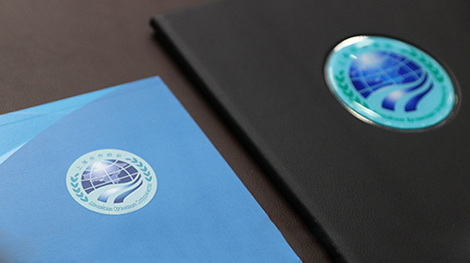
Bishkek greets autumn with an anniversary summit of the Shanghai Cooperation Organization. Marking its 25th anniversary, the SCO is taking stock of a quarter-century of work while simultaneously beginning to implement the development strategy until 2035, adopted a year earlier in Tianjin. For Belarus, this meeting allows it to assess the first results of its participation as a full member in one of Eurasia’s largest multilateral associations and, most importantly, to define its role in shaping the SCO’s future agenda.
Over a quarter of a century, the Shanghai Cooperation Organization has evolved from a relatively narrow regional security mechanism into one of the most prominent multilateral cooperation formats in Eurasia. Today, it comprises ten states with a territory of about 36 million square kilometers and a population of over 3.4 billion people. These are Belarus, India, Iran, Kazakhstan, China, Kyrgyzstan, Pakistan, Russia, Tajikistan, and Uzbekistan. Dozens more countries interact with the organization as observers and dialogue partners.
It is precisely the scale of the current SCO that largely defines the significance of the upcoming summit. The organization is celebrating its 25th anniversary in a new composition and is simultaneously transitioning to the implementation of its development strategy until 2035, adopted at last year’s meeting of heads of state in Tianjin.
From the “Shanghai Five” to a major Eurasian association
The history of the Shanghai Cooperation Organization did not begin in 2001 but somewhat earlier. The prerequisites for the SCO were laid in the 1980s, with the start of negotiations to resolve the Soviet-Chinese split. However, all accumulated issues were resolved after the collapse of the USSR. In 1996, China, Russia, Kazakhstan, Kyrgyzstan, and Tajikistan established the “Shanghai Five” mechanism. Its initial task was to build military trust and reduce tensions in border areas.
In 2001, Uzbekistan joined the five states, and on 15 June in Shanghai, a declaration on the establishment of the Shanghai Cooperation Organization was signed. The document stated that amid the dynamic development of political multipolarity and economic and information globalization, a higher level of cooperation would contribute to more effective use of emerging opportunities and countering new challenges and threats.
The declaration also clearly states that the SCO is not an alliance directed against other states and regions. The foundation of the organization became the so-called Shanghai spirit - mutual trust, mutual benefit, equality, consultation, respect for the diversity of civilizations, and a commitment to shared development.
Gradually, the organization’s agenda expanded far beyond security issues to include the economy, transport, energy, agriculture, investment, culture, education, humanitarian ties, and other areas. The next major milestone was the organization’s expansion. In 2017, India and Pakistan became full members, Iran joined in 2023, and Belarus in 2024. This was a landmark moment: by admitting Belarus, the SCO significantly expanded its geography. It was the first time a European state had joined the organization.
A 14-year journey
For Minsk, joining the SCO was not a sudden foreign policy move.
“The Chinese leadership supported us and invited us to participate in the Shanghai Cooperation Organization. It is a very dynamically developing Asian organization. A very powerful center of power is being created, and it is very important for us - even as an observer at this stage - to be present in this organization. Since this is a developing region, major events are likely to unfold here in the future, including in the economy. By participating in this regional organization, we can gain substantial dividends not only in political and foreign policy terms but also economically,” Belarusian President Aleksandr Lukashenko noted as early as 2006.
In 2010, Belarus obtained the status of SCO dialogue partner, and in 2015, it became an observer state. Over the following years, Belarus participated in the organization’s events and gradually expanded cooperation with its member states.
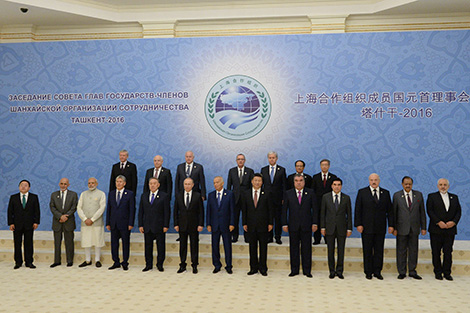
“We highly value your trust and intend to actively participate in the organization’s work in all areas of mutual interest. Our aspiration is explained by the important role the SCO plays in addressing global and regional issues, as well as by the fact that this integration body includes sincere friends of Belarus. As an observer state in the SCO, we do not intend, in sports terms, to watch the game from the bench. Belarus is ready to become an active ‘field player’ in the SCO space and make a significant contribution to its work for the benefit of our peoples and the members of the Shanghai Cooperation Organization,” Aleksandr Lukashenko said at the 2016 SCO summit in Tashkent.
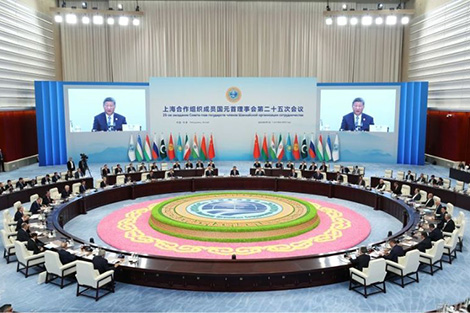
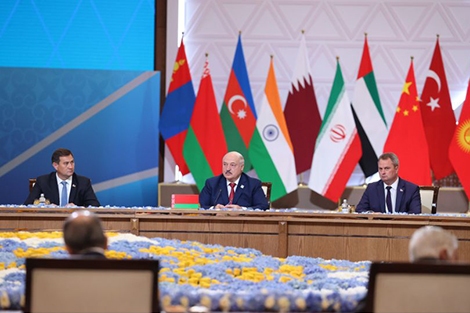
In September 2022, at the SCO summit in Samarkand, a decision was made to begin the procedure of Belarus’ accession to the organization. In July 2023, Minsk signed a memorandum of obligations required for obtaining SCO member state status. Another year was needed to complete all procedures. On 4 July 2024, at the summit in Astana, Belarus officially became the tenth SCO member state. President Aleksandr Lukashenko participated in the meeting of the Heads of State Council in his new capacity for the first time.
Thus, the current summit in Bishkek holds special significance for Belarus: if Astana was the point of formal accession, Bishkek is an opportunity to demonstrate what practical role the country intends to play within the organization.
“I have been in politics for many years (probably few here can boast of that). And I have watched very closely how, after its formation, the Shanghai Cooperation Organization fought for its leadership - regional leadership. Now, both the moment and the work of our organization, and especially world events, have led to a world that has changed significantly. We all acknowledge that this world will never be the same as before. And the views of what used to be called all progressive humanity are now turned to our organization - the Shanghai Cooperation Organization. And perhaps unexpectedly for some of us, the Shanghai Cooperation Organization is transforming from a regional organization into a global one,” the Belarusian leader emphasized.
From new member to active participant
Over two years, Belarus has integrated relatively quickly into the SCO’s mechanisms. Belarus participates in the organization’s political-diplomatic, trade-economic, cultural-humanitarian, and other areas of activity. At the same time, Minsk emphasizes that membership should not be limited to attending meetings and issuing declarations, but should translate into concrete projects.
A separate area is expert cooperation. The Belarusian Institute for Strategic Research is engaging with the so-called second track of the SCO - expert and analytical cooperation. The organization has specifically noted Belarus’ initiative to develop expert diplomacy.
There are also practical projects. In June 2026, Minsk hosted the second AgroSCO forum, dedicated to agricultural cooperation. The SCO Secretariat itself has noted that food security and sustainable agriculture are among the priorities of the organization’s strategy until 2035. This area looks particularly promising for Belarus as a major producer and exporter of agricultural products.
How the SCO is changing
According to the host country, at the current SCO summit in Kyrgyzstan, heads of state will discuss the international and regional agenda, priority areas for the organization’s further development, and prospects for deepening cooperation in political, trade-economic, transport-logistics, digital, environmental, and cultural-humanitarian sectors.
Following the meeting, the Bishkek declaration on the SCO’s 25th anniversary will be signed, along with documents and decisions aimed at further strengthening multilateral cooperation and improving the organization’s activities. A number of thematic statements by the heads of state will also be adopted.
However, the main feature of the SCO leaders’ meeting in Bishkek lies not only in its anniversary nature. In recent years, the SCO has changed noticeably in scale. The organization brings together states with different political systems, economic models, and national interests. It simultaneously includes China, Russia, India, Pakistan, Iran, and the Central Asian states.
With such diversity, the SCO cannot develop along the lines of a tightly integrated bloc. Its advantage lies elsewhere: it creates a space where states with different, and sometimes radically different, interests are able to find common ground. Now look at the behavior model of the West - most of the planet is tired of its hegemony. The SCO is, above all, a dialogue among equals. It is no coincidence that its members call themselves a family. Belarus’ place, Aleksandr Lukashenko is convinced, is right there: alongside peoples representing different cultures but united by a desire for peace and development.
“Unfortunately, not all contradictions bypass the ‘Shanghai family’ either. But it is precisely the ability to keep communication channels open and the ability to negotiate even in the face of differences that makes the SCO truly unique and viable. In an unstable global environment, unity and cohesion are our most important advantages. As Confucius said, ‘when people are united, even the weak become strong; when they are divided, even the strong grow weak’,” the Belarusian leader emphasized at last year’s SCO summit in Tianjin.
But what kind of peace and development without the economy? That is why the economic dimension is becoming increasingly important in the SCO. The organization already has mechanisms for cooperation in trade, investment, finance, transport, energy, agriculture, industry, and other areas.
At the 2025 summit in Tianjin, the member states approved the SCO Development Strategy until 2035. At the same time, agreements were launched to establish an SCO Anti-Drug Center and a Universal Center for Countering Security Challenges and Threats.
In other words, the organization is gradually trying to move from broad political dialogue to more concrete cooperation mechanisms.
“The economic balance is shifting entirely in favor of the Global East and South, and we are included in this system. The future belongs to countries and associations like BRICS and the SCO, where we are awaited and welcomed,” Aleksandr Lukashenko is convinced.
Where Belarus fits in
For Belarus, participation in the Shanghai Cooperation Organization opens several fundamentally important opportunities. The first is economic.
The SCO unites the largest markets in Eurasia. It is a tool for deeper integration into economic ties with China, India, Iran, Central Asian countries, and other states. Of particular interest are transport connectivity, logistics, industrial cooperation, agriculture, food security, energy, digitalization, and mutual investment.
For the Belarusian economy, which is focused on diversifying foreign markets, the SCO in this sense is not so much a political platform as an additional channel for accessing the vast Eurasian market.
The second is transport and logistics. Belarus is located on the western periphery of the SCO space, but at the same time it is an important element of Eurasian transport routes. That is why for Minsk, the development of connectivity between China, Russia, Central Asia, and the European part of Eurasia is of direct interest.
The more the SCO deals not only with political declarations but also with practical issues of transport corridors, digital payments, customs cooperation, and the removal of trade barriers, the higher the potential return from Belarus’ participation will be.
The third is food and agriculture. Here Belarus has an obvious specialization. That is why holding the AgroSCO forum in Minsk seems entirely natural. Belarus can act not only as a consumer of SCO opportunities but also as a supplier of technologies, food, agricultural machinery, and expertise.
The fourth is expert and political-diplomatic. Belarus gains the opportunity to participate in shaping the pan-Eurasian agenda not only through bilateral relations with individual countries but also through a multilateral mechanism.
In this context, it is notable that in October 2025, SCO Secretary General Nurlan Yermekbayev highlighted the Belarusian-Russian initiative to develop the Eurasian Charter of Diversity and Multipolarity in the 21st Century. The document is being considered by the member states.
“The SCO has become an important platform for putting forward and promoting various initiatives and proposals. For example, on the initiative of Belarus and Russia, member states are considering the conceptual idea of developing the Eurasian Charter of Diversity and Multipolarity, which could become the foundation for building an architecture of equal and indivisible security across the entire continent. Member states call on the international community to join the SCO initiative on global unity for a just peace, harmony, and development, adopted last year in Astana,” the SCO secretary general said.
This is already an example of Belarus’ participation not just in implementing an agenda set by someone else, but in shaping its own agenda within the Eurasian space.
What Belarus can gain from the next phase of the SCO
From Belarus’ perspective, the future of the SCO will depend on whether the organization can translate its political weight into practical economic and humanitarian projects.
Here, Minsk has several clear interests.
First, strengthening the economic dimension of the SCO. Belarus consistently advocates for the organization to pay more attention to trade, investment, industrial cooperation, and the development of transport links.
The second area is food and energy security. Amid global market instability, SCO states are interested in creating more resilient supply chains.
The third is the digital economy and technological cooperation. Here, the organization could potentially become a platform for joint solutions in artificial intelligence, digital payments, information security, and technology exchange.
The fourth is humanitarian cooperation. Cultural and educational contacts bind SCO states not only through economic interests. In its first year of membership, Belarus held the SCO National Cultures Day during the Slavianski Bazaar in Vitebsk, and the organization’s secretariat proposed making such an event part of the annual calendar.
The SCO and the new balance of power in Eurasia
In a broader sense, Belarus’ membership in the SCO fits into the ongoing changes in the international system.
The organization does not seek to replace the UN or create a unified political bloc. But it is becoming one of the platforms where Eurasian states discuss security, economic, and development issues without having to tailor the agenda to the interests of any single center of power.
For Belarus, this is particularly important. Minsk is interested in shaping a more multipolar system of international relations, one in which there are various centers of economic and political activity.
The SCO Secretariat itself notes that the organization’s strategy until 2035 envisages strengthening its international position and developing ties with the UN and other international and regional structures.
Therefore, the SCO’s prospects for Belarus can be viewed in two dimensions.
In the short term, it is practical economics: markets, transport, investment, industry, and agriculture. In the long term, it is the formation of a new Eurasian cooperation space, in which Belarus seeks to occupy not a peripheral but an active place.
That, perhaps, is the main significance for us of the current summit in Bishkek. Belarus is no longer participating in the SCO as an observer watching the organization from the sidelines. Minsk’s task is to use its membership to advance its own initiatives and economic interests.
If the first 25 years of the SCO were a time of formation and expansion, the next ten years should show how effectively it can translate its vast geographic and economic potential into concrete cooperation mechanisms. For Belarus, this is both an opportunity and a challenge - to become one of the participants in this process, not just an observer.
Photos by BelTA, RIA Novosti and SCO
 print version
 make home page
 add to bookmarks