



Events
New details shared on foreign investment strategies in Belarus
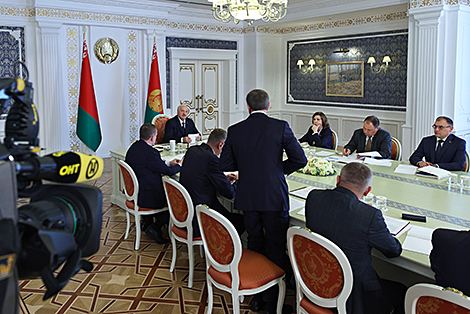
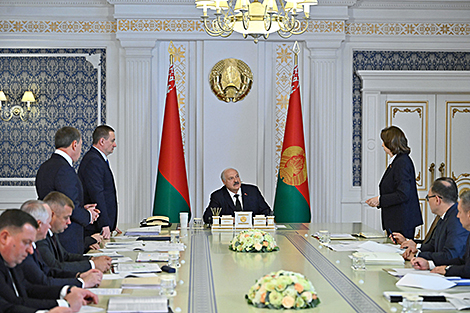
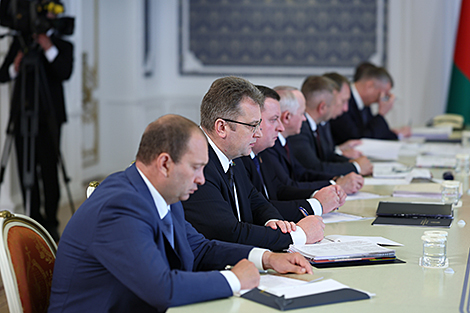
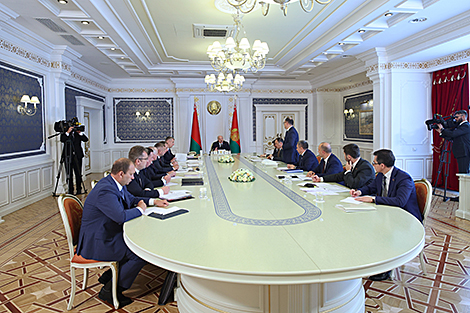
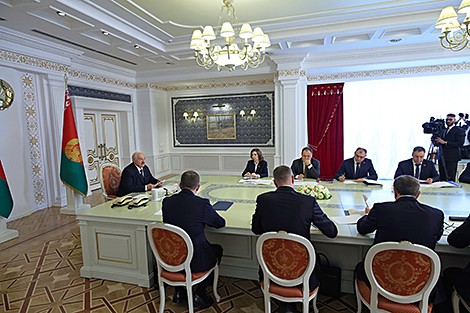
MINSK, 24 July (BelTA) – When implementing investment projects with foreign partners, it is necessary to avoid overambitious global plans and instead focus on concrete, practical results in working with countries. Moreover, this must be done quickly, without excessive bureaucracy and red tape. Belarusian President Aleksandr Lukashenko set these tasks for the participants of the meeting to discuss Belarus’ key investment projects with foreign nations on 24 July, BelTA has learned.
During the meeting, Belarusian First Deputy Prime Minister Nikolai Snopkov reported on the implementation of investment projects with China. “At present, the active investment package with China includes about 80 projects totaling $5 billion. The main emphasis in this work is placed on industrial cooperation and joint technological collaboration,” he said.
“This is where the main focus lies. Dozens of projects reported to the head of state are primarily in the industrial, automotive, machine tool, engineering, and logistics industries. This also includes tourism projects with Chinese partners – specifically, the joint development of wellness hotels for medical tourism with traditional Chinese medicine integration. This is a very promising and highly sought-after area, both within the country and for its visitors,” the first deputy prime minister told the media.
“As the president said, we must avoid overambitious global plans. We need concrete results,” Nikolai Snopkov emphasized.
According to him, the investment cooperation between Belarus and China is constantly evolving, with new projects emerging. The main criterion here is the feasibility and usefulness of such projects for the country. “So that we do not engage in cooperation for the sake of cooperation. A very strong emphasis [from the president] was that we can truly do a lot on our own. We can observe, we can consult [with foreign partners]. But when we do it ourselves, it will really last, and most importantly, with guaranteed quality. The core ideology of this meeting was quality – both of the projects and the goods we produce, especially from the perspective of export potential,” the first deputy prime minister shared the details.
During the meeting, Belarusian Deputy Prime Minister Viktor Karankevich presented information on the implementation of investment projects with a number of African countries and Indonesia, which Aleksandr Lukashenko recently visited on an official visit.
As for Indonesia, work on the implementation of the reached agreements and the approved roadmap is already actively underway. “This includes food supplies. Quite substantial contracts were signed during the visit, and work has been organized to execute them,” Viktor Karankevich said.
This involves not only the supply of machinery but also the organization of joint ventures in Indonesia, achieving a certain level of localization, and building long-term cooperation in the implementation of joint projects.
Long-term goals are also important in cooperation with the countries of the African continent. “After supplying machinery, we need to enter these markets with our competencies and technologies through maintenance services and the implementation of joint assembly plant projects,” the vice premier said. “There are examples of service centers operating in Zimbabwe, as well as plans and projects in Nigeria, Togo, and Ghana, where such centers will appear in the near future, marking a transition to establishing assembly plants using Belarusian assembly kits.”
Such cooperation also involves training local personnel so that they can subsequently operate and maintain the machinery independently. This will also contribute to building more long-term plans, expand the range of manufactured products, and allow for the production of mounted and trailed equipment.
Viktor Karankevich stated that, overall, Belarus’ relations with African countries are developing dynamically. Partners show a special interest not just in the supply of machinery or food, but in the opportunity to utilize the full range of Belarusian technologies and competencies. For example, in addressing the challenge of ensuring food security.
“At the government level, we have adopted an action plan for the development of cooperation with African countries for 2026-2030. Anchor points have been defined there. There are promising countries for boosting cooperation, and such work will be organized with them as a matter of priority. There are concrete developments and projects,” the deputy prime minister said.
Belarusian First Deputy Minister of Foreign Affairs Sergei Lukashevich reported at the meeting on investment projects with Middle Eastern and Asian states in general. He told journalists that Belarus has many good partners “who hear and understand us.”
He mentioned investment cooperation with the UAE in construction and beyond. These are top-tier projects worth billions of dollars. “Here we see the alignment of our needs and the investment capabilities of our partners, which benefit our state,” the first deputy foreign minister said.
The president is also monitoring the development of cooperation with partners from Oman, who have expressed a desire to “anchor” their economic interests in Belarus. This refers to investing in various manufacturing sectors, both in food production and wood processing, as well as unlocking the tourism potential of both countries.
In Asia as a whole, Belarus has many partners, including India, Pakistan, and Myanmar. Sergei Lukashevich mentioned major projects being implemented with India in the pharmaceutical industry, with investments worth millions of dollars. “These are monumental investments for years to come. Construction, production capacities, and job creation,” he said.
In turn, Belarus implements projects on the territories of its partners where it has strong competencies, primarily in engineering – namely, the establishment of joint ventures. Depending on the country and its market conditions, the frameworks for organizing this work may vary. The optimal level of localization for product manufacturing and financing mechanisms are determined based on these factors. “The devil is in the details. Everyone is geared towards achieving results so that we can decently represent our products on the global stage through investment projects,” the diplomat said.
Answering a question about excessive bureaucracy and delays in project implementation, which had drawn criticism from the president during the meeting, Sergei Lukashevich did not deny that such facts could occur. However, the reason is not always on the Belarusian side alone. Sometimes, the project execution is affected by the national characteristics and business traditions of a particular partner state. “In southern countries, decision-making is always a rather gradual, slow process. The president says that bureaucracy should be kept to a minimum on our side, where we can make an effort and get results,” he noted.
 print version
 make home page
 add to bookmarks