




Events
Lukashenko calls for toughest action over harvest failures
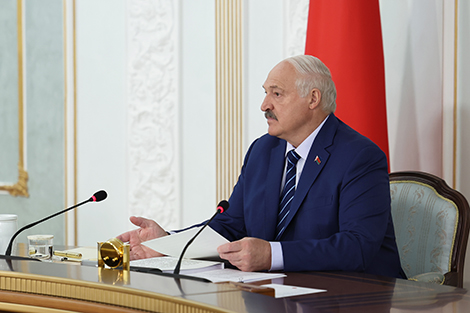
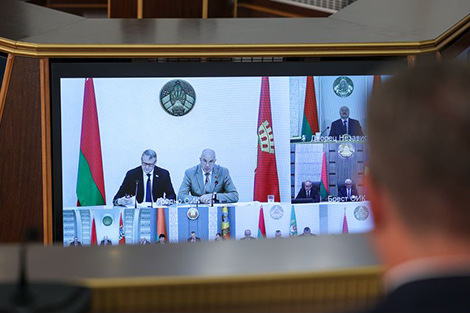
MINSK, 21 July (BelTA) – Belarusian President Aleksandr Lukashenko has instructed to take the toughest action over the shortcomings in the harvesting campaign as he hosted a nationwide video conference to discuss the 2026 harvest campaign on 21 July, BelTA has learned
Reacting to the report by Chairman of the State Control Committee Vasily Gerasimov, the president noted: “The prime minister and you are to take the toughest action against all shortcomings during this and the next week. There is no need to think that we will be left without personnel.”
The head of the State Control Committee spoke about cases of equipment not being ready and about falsified reports on the matter, insufficient availability of spare parts in some instances, downtime, and failures in providing machine operators. Not everywhere have the tasks for preparing grain drying complexes and storage facilities for the harvest been fulfilled. Cases of poor-quality harvesting and above-standard losses, as well as violations during grain transportation, have also been identified.
The auditors have also identified shortcomings in fodder procurement. In quantitative terms, the results are significantly better than last year, but violations of technical regulations during the storage of fodder are still common.
Aleksandr Lukashenko emphasized that no one will tolerate disorder, drunkenness, or theft. “This must not happen. So you have this week and the next. Take the strictest measures and report back,” he said. “I don’t need to explain to you what fuel, spare parts, and equipment cost us. Nor what it takes to ensure order and safety.”
In this regard, the head of state also drew attention to the work and responsibility of the president’s aides to the regions regarding the situation. For example, the chairman of the State Control Committee also serves as the president’s aide in Grodno Oblast. Vasily Gerasimov reported that the harvesting work in the region was last discussed on the morning of 20 July, and a special meeting had been held prior to that.
“The great poet once said about us ‘All Meetinged Out’ that we are all talk and no action,” the Belarusian leader remarked.

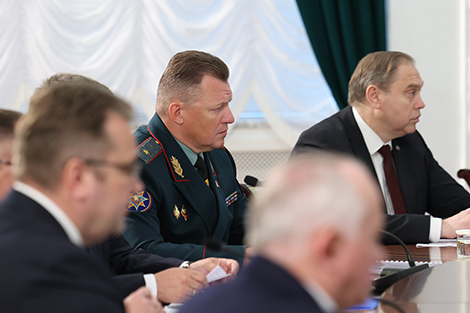

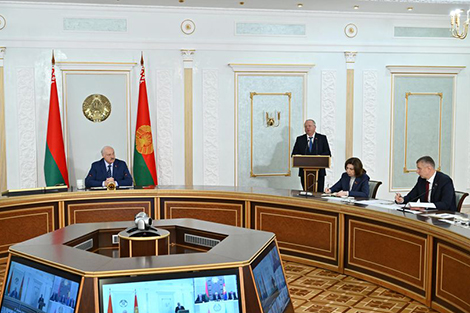
Aleksandr Lukashenko clearly laid out the responsibilities in the harvesting campaign. The organization of the harvest is the responsibility of the chairmen of the regional and district executive committees, and, naturally, the heads of agricultural enterprises. The agriculture and food minister must ensure that technology and procedures are properly followed. As for the deputy prime minister in charge of the agricultural sector, his primary task is product sales and distribution.
On the issue of staffing, the president emphasized that it is up to local leadership to decide whom and how to bring in, but the assigned tasks must be fulfilled in full. The head of state recalled that in previous years, during the peak harvesting season, not only officials from executive committees but also young people, including high school students, were asked to assist farms.
“Everyone must be brought in. Everyone wants to eat, and eat well. Better to work in the field than to go to war. This is our peaceful ‘war’. So get down to work. Let the people put in the effort. Don’t skimp on means to support them financially,” Aleksandr Lukashenko said. “I don’t interfere in your affairs, and I don’t force anyone to drive harvesters and tractors into the field. That’s up to each manager, or, at the very least, the local authorities. But if things go badly, and meanwhile harvesters or other equipment are sitting idle, that will be grounds to hold you accountable. The tasks must be completed on time.”
Agriculture and Food Minister Yuri Gorlov reported on the plans for this year’s harvesting campaign. A total of 2.4 million hectares of grain and leguminous crops, including rapeseed and corn for grain, are to be harvested. According to expert estimates, crop yields in the fields are at least at last year’s level. It is planned to harvest about 8 million tonnes of grain crops, 2.4 million tonnes of corn for grain (an increase of 500,000 tonnes compared to last year), and 1.2 million tonnes of rapeseed (an increase of 200,000 tonnes). The task is to complete flax pulling by 1 August.
The minister also reported on the readiness of equipment for the mass harvest, the delivery of new machinery, and the assignment of machine operators to them. Work is ongoing to ensure the availability of spare parts, and mobile repair teams have been set up. At the same time, Yuri Gorlov acknowledged that there were problematic cases, as reported by the chairman of the State Control Committee.
Aleksandr Lukashenko stressed that every regional agricultural service center should become a kind of dealership for the repair of all types of machinery. “This is the law,” he said.
The governors reported on the progress of the harvesting campaign in their respective regions and on the resolution of the issues raised during the video conference. Aleksandr Lukashenko highlighted key points on a number of important matters and stated that he intends to continue working in the regions in the near future to assess the situation on the ground.
 print version
 make home page
 add to bookmarks