


Events
Lukashenko and focus on stability: How the Belarusian development model was created
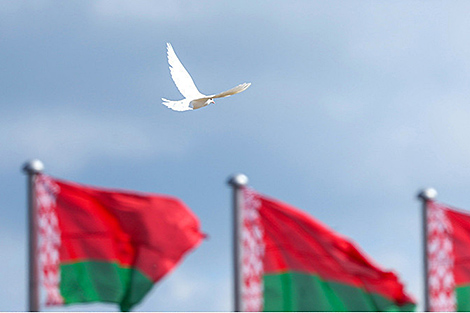
An archive photo
The history of independent Belarus is a chain of decisions made under constant pressure and uncertainty. It was sometimes external, sometimes internal, but most often both at the same time. The early 2000s will be remembered by Belarusians as a gradual exit from the protracted economic crisis of the 1990s. The government relied not on experiments but on stability, controllability, and the preservation of sovereignty. They started calling the adopted measures later on the Belarusian development model. How did it differ from the experience of other countries and what results did the Belarusian leadership manage to achieve in such a short time? How did the young republic search for its place in a changing world while defending its alliance with Russia? And when did Aleksandr Lukashenko first utter one of his most famous phrases: “Facts on the table”? We tell you about challenges of 2002 in the new episode of BelTA’s project “How It Was”.
How Belarus created its own development model
In autumn 2001 a group of U.S. scientists consisting of Joseph Stiglitz, George Akerlof, and Michael Spence won the Nobel Prize in Economic Sciences. In their works they proved the greatest efficiency lies not in a purely liberal or, as we say, market development model, but in the need for the most active regulation of market processes by the state. In other words, the most prestigious international award was bestowed in recognition of the very actions the Belarusian state began taking back in the mid-1990s, trying with all its might to get out of the crisis, and for which it has been berated for decades now.
Assessing the experience of Belarus, many experts and institutions, including the World Bank and the IMF, began talking about the Belarusian model or the Belarusian way of development.
After the collapse of the USSR Belarus’ leadership, just like the leadership of Russia, inherited terrible problems. But while Russia chose the path of criminal privatization, Belarus decided to live by its own wits and root all decisions in reality, as Aleksandr Lukashenko likes to repeat. “We learn from mistakes of our friends. We would not like to repeat these mistakes,” the Belarus president explained in an interview with the U.S. newspaper Wall Street Journal.
This is why Belarus met the year 2002 with cautious optimism. The economy was gradually recovering. Industrial output was on the rise, the operation of key enterprises stabilized, and real incomes of the population gradually increased. The state relied on the real sector of the economy: mechanical engineering, agriculture, and processing. And the policy announced by Aleksandr Lukashenko was perfectly clear: to preserve manufacturing, employment, and social stability. The president emphasized that it is easy to destroy but difficult to restore. This is why Belarus was in no hurry to abandon proven management mechanisms and, against the background of controversial reforms and shock therapy in neighboring countries, deliberately took a different path. Certainly, the Belarusian economy was not created from scratch. A great deal had been done back in the Soviet times, but it took years to bring everything together and add something of its own.
“We have familiarized ourselves with the practice of economic transformations and the formation of a market economy in China and Russia. The experience of China and the experience of Belarus are very close to each other, they are promising and are being successfully implemented in practice. I became convinced of this during my repeated visits to the People’s Republic of China. Both their country and ours demonstrated peculiarities of the transition period such as the regulating role of the state, the principle of evolutionary transformations, the creation of a strong and effective vertical of state power, a clear system of legislation ensuring the common interests of the state and every citizen individually, and the careful preservation of the good things created earlier rather than their thoughtless destruction,” the president emphasized at a seminar for heads of national and municipal government bodies in March 2002.
At the same time, Aleksandr Lukashenko noted that such an approach does not mean that the experience of the United States of America and Western Europe is entirely unacceptable. “There is something useful everywhere. We need to draw serious lessons from the practice of social and economic transformations in Russia. Firstly, in order not to repeat the mistakes of the initial stage of reforming the Russian economy. And secondly, to find real ways of bringing our countries closer to each other in the new political and economic conditions of the 21st century,” the Belarusian leader stated.
State support in exchange for returns
Here are a few figures. In 2001 Belarus’ gross domestic product increased by more than 4%. Industrial output grew by 5.5%, and the growth rates as against 1990 reached 106%. For comparison, the same indicator in Russia fluctuated around 70%, and in Ukraine it barely exceeded 40%. Industrial output in these countries stood at 57% and 65% respectively.
Real disposable money incomes of the population in Belarus grew by 25% in 2001 while real wages grew by more than 30%.
Evaluating economic indicators, experts of the United Nations Organization ranked Belarus first among the CIS countries in terms of the Human Development Index. Yet at one time, from 1991 to 1995, Belarus’ indicator in the global ranking dropped from 40th to almost 70th place. By 2002 Belarus had managed to rise to the 53rd place.
Certainly, the accomplishment was earned with sweat and blood, metaphorically speaking. Perhaps, not metaphorically. Aleksandr Lukashenko regularly traveled to the regions, visited factories and agricultural enterprises, and held managers strictly accountable for results. The main message was simple: state support in exchange for discipline and returns. Close attention was paid to the countryside. The development of the agribusiness sector was viewed not only as an economic measure but also as a matter of demographics, culture, and food security.
The peculiarity of the Belarusian development model
What was the peculiarity of the Belarusian model? The first one was strong and effective authority. The role of the state, Aleksandr Lukashenko said, is to ensure the safety of citizens, social justice, and public order, and not to allow crime and corruption to unfold. And only strong authority, the president declared, made it possible to pull the Belarusian economy out of the abyss of economic crisis. Perhaps this thesis is hardly disputed by anyone today.
“We must produce finished goods from our forest and supply them. This is our money, our income, our budgets, and so on. I prohibited the export of roundwood. I am afraid to even talk about how they do it. But if they export not furniture and these products, but roundwood, then their heads will roll. We must process it here so that the money stays with the state,” Aleksandr Lukashenko insisted during a trip to the regions. It is one example but it demonstrates the insistence on high standards, without which it would not be easy to build a strong state.
The second peculiarity of the Belarusian model was that the private sector must develop alongside the state one, but by no means at the expense of national interests. In other words, if you are a private owner, it does not mean that you can act according to the principle “I do whatever I want”. National interests have always remained the priority and the goal of the Belarusian state.
Therefore, Belarus did not force the artificial growth of the private sector, and barriers were even put in place in some cases. But only for those who create firms for exporting capital to offshore zones, who take loans without intending to repay them, who establish paid universities without planning to educate students, who persistently evade taxes. But isn’t this exactly how any civilized state acts, one that stands guard over legality and the protection of its citizens’ interests?
 print version
 make home page
 add to bookmarks