



Events
Ambassador: Belarus seeks to lower global confrontation
An archive photo
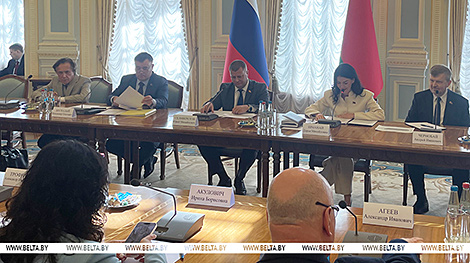
MOSCOW, 18 August (BelTA) – The primary objective of Minsk on the international arena is to reduce the level of confrontation, Belarusian Ambassador to Russia Yuri Seliverstov said during a roundtable at the embassy dedicated to the Eurasian Charter of Diversity and Multipolarity in the 21st Century, BelTA has learned.
“Belarus has always firmly stood on peace-loving positions, and our international initiatives clearly confirm this. We have never proposed an agenda of division - only mutually beneficial cooperation and peaceful coexistence. Today, Minsk’s main goal on the world stage is to lower confrontation, restore trust in international relations, and strengthen common security through honest, equal dialogue,” Yuri Seliverstov said.
One of the initiatives aimed at shaping a new security architecture in Eurasia amid the dismantling of the previous security framework and the emergence of a multipolar world is Belarus’ proposal to develop the Eurasian Charter of Diversity and Multipolarity in the 21st Century. “Belarus sees it as a response to the growing demand from the states of the global majority for creating their own, regional frameworks for interaction, free from external diktat and taking into account the diversity of civilizational development models,” the ambassador said.
The initiative to develop the Eurasian Charter is gradually moving from conceptual discussions to the practical development phase. He recalled that the idea of developing the charter was first voiced at the 1st Minsk International Conference on Eurasian Security in October 2023. “It received principled support from the Russian Federation at that time. Subsequently, the presidents of Belarus and Russia repeatedly confirmed their interest in its implementation. Russia actively joined the process of advancing the initiative, which has essentially become a joint one,” Yuri Seliverstov said.
In 2024, the process took on a more structured form. At the 2nd Minsk Conference, a specialized panel discussion on the charter was organized, and following the event, Belarus and Russia issued a Joint Vision of the Eurasian Charter of Diversity and Multipolarity in the 21st Century, a document setting out guidelines for further work.
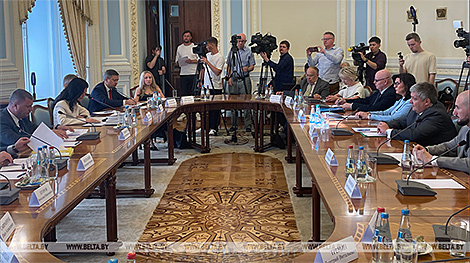
In 2025, the process gained significant additional momentum. Briefings were held in Geneva, at the SCO and CIS secretariats, and another panel discussion on the charter took place as part of the 3rd Minsk International Conference on Eurasian Security. In addition, during the conference, five states - Belarus, Russia, Iran, the DPRK, and Myanmar - co-authored a joint statement Towards the Eurasian Charter of Diversity and Multipolarity in the 21st Century, thus forming the core of supporters of the initiative. At the same time, the ambassador stressed that forming a core of supporters does not create any privileges or hierarchy: any interested state can join the negotiating process at any stage, and all participants will have equal rights.
“This year, together with our Russian friends, we have continued active explanatory briefings for partners in Eurasian integration formats, collecting proposals and discussing the document’s architecture. Answers to questions about why the charter is necessary today, what logic and principles Belarus is embedding in it, and what the conceptual framework of the document is, were reflected in an article by Belarusian Minister of Foreign Affairs Maxim Ryzhenkov, published in October 2025 in the authoritative journal Russia in Global Affairs. The key message underpinning the idea of the charter is that Eurasian states can fully unlock their potential only when they themselves determine the parameters of cooperation in security, economics, humanitarian cooperation, and intercivilizational dialogue,” Yuri Seliverstov said.
“The charter is designed to be a tool that will help build a regional order based on a balance of interests and resilience to external destructive influence. Strengthening peace, security, and cooperation on the Eurasian continent must be based on the principles of sovereign equality, equal and indivisible security, and respect for civilizational diversity. It is important that the document envisions not isolation, but an open regional model compatible with the principles of the UN Charter. It could add significant value to the formation of a more just and stable global architecture, taking into account the geopolitical weight of Eurasia, where the majority of the world’s population, natural resources, and transport arteries are concentrated,” he stressed.
The ambassador also recalled that the article by Belarus’ minister of foreign affairs proposed eight guiding principles to be upheld at all stages of work on the charter: constructiveness - the document is not directed against third countries or groups of states, its goal is creation, not confrontation; agency - the leading role belongs to the Eurasian countries themselves, who know their own needs and historical context better than others; collectiveness - the content is shaped through consensus, excluding the imposition of one participant’s will on others; inclusiveness - participation is open to all Eurasian states without exception; engagement - consultations are envisaged with regional organizations and integration bodies, including the CIS, SCO, EAEU, and others; comprehensiveness - covering all key areas: security, economy, humanitarian affairs, and civilizational dimensions; procedural clarity - a clear roadmap for coordination, preventing delays in the negotiation process; strategic perspective - enshrining principles that support the long-term development of Eurasia and its partnership with other regions.
“Belarus is committed to these principles and intends to consistently follow them in the work on the charter,” Yuri Seliverstov concluded.
 print version
 make home page
 add to bookmarks