


Press releases
Full bearer of Order of Glory at 21: Story of heroic feats of Belarusian Lev Khodanovich
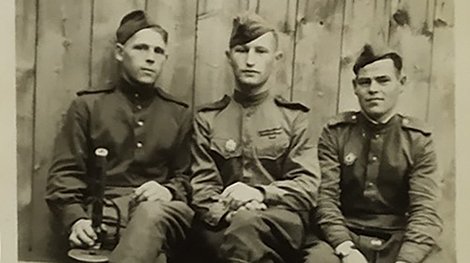
Lev Khodanovich (center) with his fellow servicemen, Germany 1945
The Belarusian Lev Khodanovich was a legendary scout during the Great Patriotic War. Working behind enemy lines, he managed to capture 15 prisoners for interrogation, which was an unprecedented number! For his heroism and bravery, he was awarded all three classes of the Order of Glory by the age of 21.
Saved by a miracle
“Dad often talked about the war,” the veteran's younger son, Aleksandr, said. This is surprising because the generation of victors generally did not like to recall the Great Patriotic War. But Lev Khodanovich was an exception not only in this: “Our family often gathered together and listened to how father went behind enemy lines and captured prisoners for interrogation, and how he was honored. He became a full bearer of the Order of Glory by the age of 21, even though he had only completed 8 years of schooling. Before the war, he tried to help his parents in every way: he worked as a bell ringer, a shepherd, and a blacksmith's assistant."
In July 1941, when the Germans were advancing across our country, the Khodanovich family, like hundreds of other residents of Korma District, was evacuated deeper into the Soviet Union.
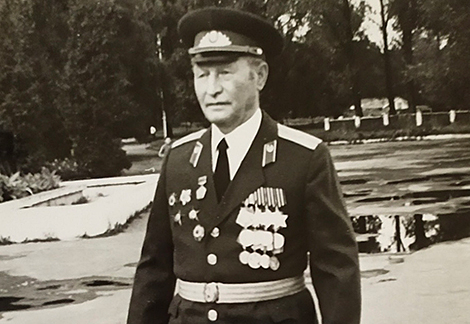
They settled in the city of Yelets, Oryol Oblast, where the 45th Reserve Rifle Regiment, part of the Bryansk Front, was stationed at that time. When 17-year-old Lev Khodanovich learned of this, he added the missing months to his age and petitioned the regimental command to enlist him as a Red Army soldier. On 15 September, 1941, he was called up for active military service and sent to a training battalion located in Oryol.
Meanwhile, German troops were rapidly advancing toward Orel Oblast, compressing the Red Army soldiers’ training to just a few days before they were dispatched to the rifle battalions of the 45th Regiment. In early October, the regiment’s headquarters and permanent staff were redeployed to the Ural Military District.
During the Orel-Bryansk Defensive Operation, the regiment in which Lev Khodanovich served was encircled by the enemy. After fighting their way out of encirclement at great cost, Lev Khodanovich and a few other survivors found themselves unable to reach Soviet lines. Forced to adapt, they fought their way into the Bryansk forests, where they organized a partisan detachment and carried on their resistance.
In May 1942, the fighters merged into the Voroshilov Partisan Detachment, which operated in Bryansk Oblast as part of the First Gomel Partisan Brigade. Lev Khodanovich was assigned to a sabotage unit within a reconnaissance platoon, taking part in derailing seven trains carrying enemy equipment and personnel. In August 1943, for his bravery and combat heroism, partisan demolitionist Khodanovich was nominated for the Order of the Red Star.
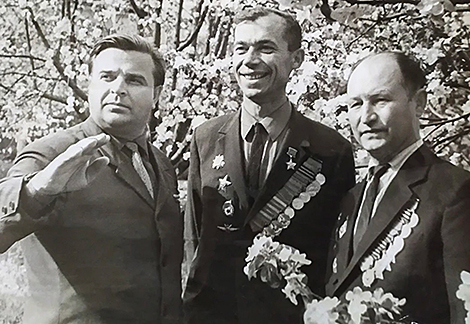
Lev Khodanovich (far right)
The highest soldier’s award
The partisans linked up with advancing units of the Red Army’s 139th Rifle Division on 17 September 1943. Weeks later, Lev Khodanovich was formally re-drafted into the Red Army and assigned to the division’s 718th Rifle Regiment. In the spring of 1944, he was transferred to a foot reconnaissance platoon.
“My father took part in major operations, repeatedly going behind enemy lines not only to take prisoners, but also to seize vital enemy maps. Once he even helped capture a bridgehead. Every mission is a story of bravery and courage,” says his son, Aleksandr, with pride.
I remember my father lamenting how often he had to kill the enemy. But war is war. The Motherland needed defending. To do the job he was assigned, one had to be exceptionally brave.”
The main distinguishing feature of reconnaissance service was the autonomy soldiers had in carrying out their combat missions. Once they left the regiment’s position, they could rely only on themselves and their own experience.
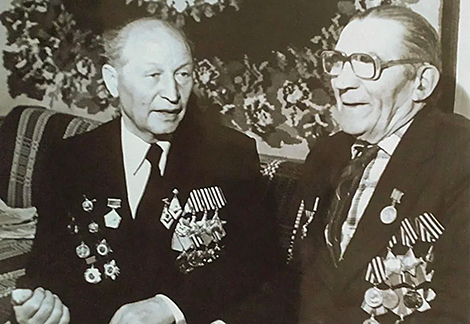
Lev Khodanovich (left)
…On 22 June 1944, the 718th Regiment was preparing for an offensive, but the command was in urgent need of a ‘tongue’ – a prisoner for interrogation. Lev Khodanovich was included in the search party and was one of the first to reach the German trench. He stunned a sitting enemy soldier with his submachine gun, hoisted him onto his back, and dragged him towards our trenches while his fellow soldiers, rushing to his aid, provided covering fire against the attacking Germans. Valuable intelligence was obtained, and for this action, Lev Khodanovich was awarded the Medal for Courage by regimental order on 19 July 1944.
He also participated in Operation Bagration. Soldiers of the 718th Rifle Regiment, as part of the 2nd Belorussian Front, were engaged in heavy fighting near Molodechno. It was clear that the enemy artillery fire was well-adjusted, so the soldiers were tasked with locating and eliminating the forward observers. Sergeant Khodanovich was the first to identify the most likely location, pointing to the tall pine trees on a hill – and he was right. On the night of 23 July, together with two comrades, he infiltrated the height, neutralized the enemy, and then delivered vital information to the command. By morning, the enemy firing points were suppressed, and the regiment resumed its advance. For this feat, Lev Khodanovich was awarded the Order of Glory, 3rd Class.
Senior Sergeant Khodanovich received the Order of Glory, 2nd Class after the liberation of Belarus. On the night of 1 December 1944, he and his group carried out a daring raid, penetrating the enemy’s forward line of defense. The Germans did not even have time to understand what was happening when grenades were thrown into their dugout. During this raid, Lev Khodanovich personally destroyed a heavy machine gun and captured two prisoners.
On 29 June 1945, at the age of 21, he became a Full Cavalier of the Order of Glory. The award citation, dated 21 February 1945 and signed by the regimental commander, reads: “In the battle that took place on 13 February, Senior Sergeant Lev Khodanovich, as leader of a reconnaissance group, penetrated the enemy’s position, captured a prisoner, and obtained valuable information about the Germans’ forward defenses. He deserves the government award of the Order of Glory 1st Class.”
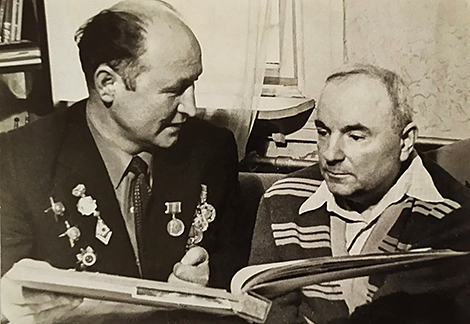
Lev Khodanovich with his comrade in arms
Victory Parades
When news of the upcoming Victory Parade was announced, Junior Lieutenant Lev Khodanovich was chosen from among the servicemen of the 718th Rifle Regiment to participate in this grand event.
“The selection was very strict. They looked not only at the number of awards, though that was the main requirement, but also at the height, weight, and physical fitness of the Red Army soldiers. Many candidates were eliminated, but our father met all the criteria. For a whole month, the participants practiced, and in their free time, they actively engaged in physical training,” Aleksandr Khodanovich recalled.
Later, Lev Khodanovich had the honor of marching across Red Square twice more, this time as part of the veterans' formation. He participated in the Victory Parades held in Moscow on 9 May 1985 and 1990.
After returning from the war, Lev Khodanovich chose a peaceful profession. He studied at the Gomel River Technical School and was assigned to work in Pinsk, on the Dnieper-Bug technical section of the river fleet. He married and had three wonderful sons. The correspondent asked them why their father did not remain in the armed forces after the Victory.
“Father used to say he was tired of the war. He didn’t want to fight and kill anymore,” his son Viktor says. “People who went through the Great Patriotic War were deprived of so much. I remember my father was always hungry, even though the war had long been over. He was a good man, but also principled, demanding, and a lover of discipline.”
“Wherever we, his sons, were, we always came to Pinsk on 9 May. It is a very important day for our family. The veterans would always meet at the park by the Eternal Flame and lay flowers, and then they would talk with each other and with the residents. Father was always the center of attention,” Aleksandr adds. “Father has been gone for a long time, but we will never forget his love and wise advice.”
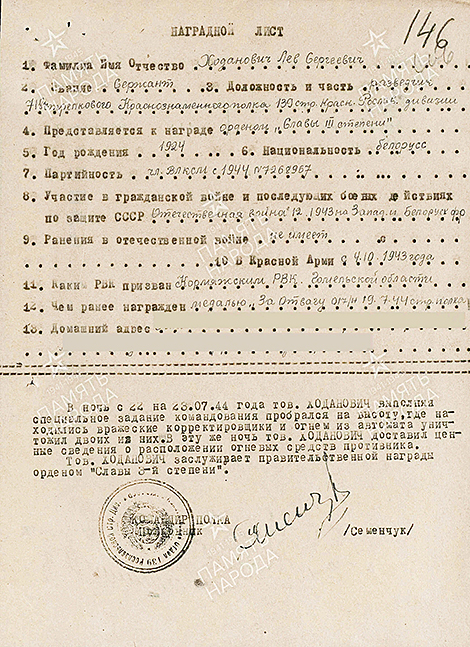
More than a dozen unique photographs, contributed by the veteran himself, are kept in the archives of the Museum of Belarusian Polesie. Senior researcher Aleksandr Orzhekhovsky spoke with Lev Khodanovich on several occasions. According to him, he was a man of an incredible fate: “He was both exceptionally brave and incredibly fortunate. Just imagine: nighttime operations across no man’s land, which was typically mined, with our scouts crawling. Under constant illumination from enemy flares, visibility was like day. Defensive lines of barbed wire, rigged with tin-can alarms, protected the German positions. A single misstep would draw instant machine-gun and mortar fire. Very few scouts who faced what he did lived to tell the tale, making this man’s experiences truly legendary.”
In Pinsk, Brest Oblast, a street is named after Lev Khodanovich, and in the Korma District of Gomel Oblast the Khizy secondary school bears his name.
Yulia GAVRILENKO,
7 Days newspaper
Photo courtesy of the archives of the Museum of Belarusian Polesie
 print version
 make home page
 add to bookmarks