

Events
‘We are creating a state for the people’. Lukashenko’s 2007 agenda for Belarus
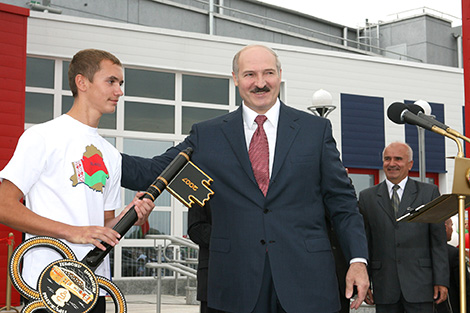
“Bring me back my 2007’”. Internet users often leave comments like this on social media. In 2007, the world stood on the threshold of major technological and social change. That year, humanity welcomed the first iPhone, Facebook, and Twitter, gradually moving into virtual reality. On the political map, more space was needed for the European Union, which expanded to include Bulgaria and Romania. On the economic front, the global financial crisis that would sweep the world in 2008 was just brewing. What was happening in our country at that time? To give a general sense of the situation in Belarus at the time, here is one quote from the president during an exchange with journalists: “As the head of state, I stand firmly on my own two feet. I know well what is happening in our society and where we need to move. We have reached a stage of development where no one will be able to break our stability.” How Belarusians strengthened their sovereignty in 2007 - we will explore this in the new episode of the How It Was project.
‘Independent Belarus – Our Proud and Reliable Home’
The heart of any home is the family that lives in it. By presidential decree, 2007 was declared the Year of the Child in Belarus. This was a logical continuation of previous initiatives: 2006 had been the Year of the Mother. There were reasons of national importance for this. In the early 2000s, Belarus was considered an aging country, with far fewer people being born than dying. Increasing the birth rate, reducing mortality, and strengthening family values… These tasks were added to the list of national priorities. The president called them matters of the state's very survival in the future.
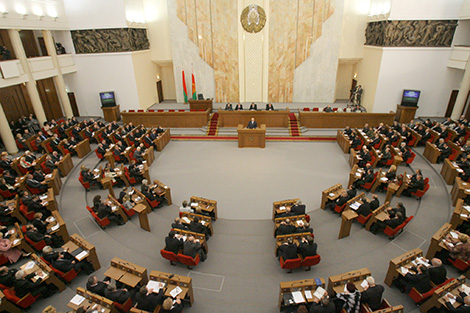
Aleksandr Lukashenko delivers the Annual Address to the Belarusian People and the National Assembly, 24 April 2007
The state not only called on people to have more children but also took care of them. The one-time financial assistance at the birth of a first child was increased from 2 to 5 subsistence minimums, and for the second and subsequent children—to 7 subsistence minimums. Additional measures were adopted to protect the rights and legitimate interests of children, above all orphans, children with disabilities, children with special psychophysical development needs, and children from disadvantaged families. In August 2007, the president signed a decree “On Certain Issues of Ensuring the Rights of Orphans and Children Left Without Parental Care” which clearly spelled out the mechanism for providing housing to this category of citizens. All of this was aimed at giving them decent starting conditions for beginning an independent life. These measures were consolidated into the National Program for the Demographic Security of Belarus until 2010.
That year, a course was also set to ensure comfortable living conditions for people of all ages and across the entire country. This was the focus of an entire State Program for Regional Development. At the center of attention were small towns and communities with populations under 50,000, which had remained hostages of the old Soviet-style economic management. Heavily dependent on their local town-forming enterprises in the new market conditions, they faced a host of problems. Local factories and plants, cut off from administrative and economic technological chains, turned out to be uncompetitive. There was no money for modernization, and people were either left without work or forced to put up with meager wages. The future of small communities became a pressing concern. The solutions considered formed the basis of a comprehensive program. The president summed up the overarching philosophy of the document as follows: “We are building a state for the people, and this means that the state must go to where the people are. If about half of the country's population lives in rural communities and small towns, then the center of attention must be shifted there.”
The key development document identified a list of settlements that were particularly in need of state support—187 of them. The President demanded that the program be built according to a specific formula: settlement – economic project – cost. The program provided for the construction of 57 new industrial enterprises and production facilities, the modernization of 80 existing ones, and the reconstruction of 56 agricultural and service-sector facilities. And this was rather a basic minimum than a lavish maximum. The work was carried out comprehensively, and everyone was involved, from the chairperson of the village council to the president. In November 2007, Minsk hosted a large seminar of senior officials from national and local government bodies. Opening the seminar, Aleksandr Lukashenko emphasized that it was unacceptable to allow the lagging of small and medium-sized towns to lead to a serious slowdown in economic development and a threat to the country's social and political stability. He called the task of comprehensively revitalizing small and medium-sized towns a new state priority.
The president particularly emphasized the need to develop entrepreneurship in small towns. Favorable conditions for small business were worked out and established. As a foundation for economic recovery, 195 key investment projects were identified for priority implementation. The total funding for the program amounted to nearly Br2 trillion, with only a quarter of that sum coming from the budget. The rest came from enterprises’ own funds and bank loans. Of course, problems were not solved at the snap of a finger. Some regions got down to work immediately, while others needed time to get going. Time which they did not have. But positive examples were not long in coming. For instance, a fruit drink plant was launched with the involvement of German capital in the town of Vysokoye in Brest Oblast; a sewing production facility was opened in the village of Divin in Kobrin District. In Nesvizh, they organized the production of injectable, infusion and dialysis solutions and eye drops.
“That time is gone, when we moved forward by trial and error”
For the development of both large and small settlements, technology is needed. Ideally, domestic technology. On 2 November 2007, the most authoritative figures from Belarus’ leading scientific institutions gathered in Minsk for the First Congress of Scientists. The president personally insisted on holding the congress. First, because scientific developments were the foundation of the five-year development plan. Second, the congress drew a line under the process of reforming the scientific system. From then on, what was needed was results, which the president called the measure of everything. “In the new century, moving forward is only possible on a scientific basis. Not a single step without scientific groundwork - we have no time, no money for that. I emphasize once again: the time when we moved forward by trial and error is gone,” the head of state stressed back then.
‘Independent Belarus – Our Proud and Reliable Home’
The headline of the President's Address to the Belarusian people and the National Assembly on 24 April 2007 featured the thesis: “Independent Belarus – Our Proud and Reliable Home”. “The primary task today is to strengthen the independence of the Belarusian state by all means and forces. That means ensuring the RIGHT to independently conduct our own foreign and domestic policies, and to ensure national security across all its dimensions, from defense to information and food security,” Aleksandr Lukashenko said at the time. The entire year of 2007 was dedicated to the comprehensive solution of this paramount task.
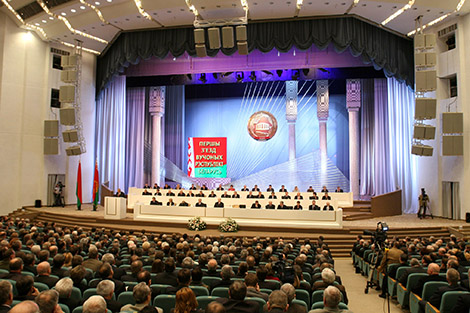
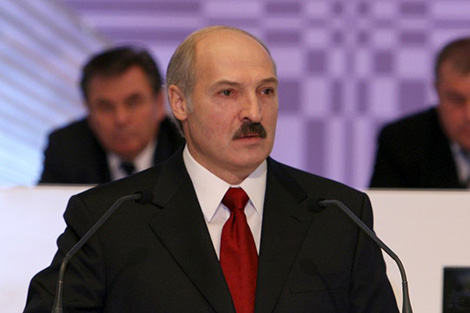
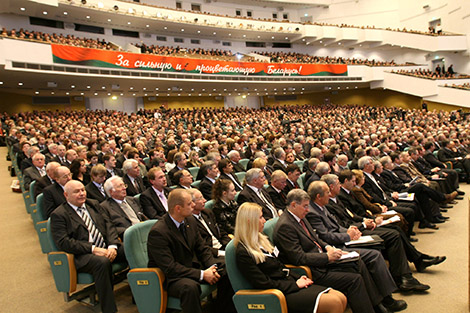
Aleksandr Lukashenko at the First Congress of Scientists, 2 November 2007
Speaking at the Congress of Scientists, the president called for more active efforts from those working in energy and related scientific fields. In 2007, the country was moving toward nuclear energy. The question of whether to build or not was no longer on the table. The fundamental decision was made by the head of state at the end of 2006. In 2007, construction had not yet begun, but organizational work was actively underway, without which it would have been impossible to launch such a large-scale project.
Economic motives were at the forefront. The situation in 2007 showed that the decision to build a nuclear power plant was correct and timely. “Regarding energy. The opposition shouts: ‘We don’t need a nuclear power plant, let’s hold a referendum!’ But we are already surrounded by nuclear power plants on all sides. We will act as the rest of the world does. And the current trend is that even the European Union, after its conflict with Russia over gas and oil, has been seriously focusing on nuclear energy,” the head of state noted.
A few words about the conflict with Russia, which the president mentioned. At the end of 2006, Russia significantly raised gas and oil prices, which was unfavorable for Belarus. The parties argued fiercely and imposed duties. In the end, a compromise was reached, but conclusions were also drawn. When it comes to sovereignty, Belarusians are not prepared to relax. “When I first became president, everyone was intoxicated with independence and sovereignty. But I warned back then: it comes at a high price. The fact that Russia raised gas and oil prices for us confirms those words. We were told directly: either join Russia as a region, or we will put you on an equal footing with other countries, such as Germany, in terms of hydrocarbon prices. But independence and sovereignty are worth more. We will not trade them for anything,” Aleksandr Lukashenko told the media.
In this context, the construction of a nuclear power plant also became a factor in the country’s energy security. Therefore, on the issue of using nuclear energy, Belarus’ position is unequivocal: we cannot abandon the construction of a nuclear power plant. Work got into full swing.
'Unique historical experience has taught our people to better understand and accept one another'
Thus, people lived in a stable, peaceful state in 2007. There are jobs even in small towns and villages, and existing challenges are being steadily resolved. A system of benefits and financial support has been developed, with assistance provided on a targeted basis rather than indiscriminately. The people have their basic needs fully met. The healthcare system operates efficiently: by 2007, Belarusian medical professionals have learned to successfully nurse newborns weighing less than one kilogram. Belarus looks to the future with optimism, and this future will be shaped by the very children whom the state is carefully nurturing in 2007, doing everything possible to raise a healthy, intelligent generation of Belarusians.
The health of future generations is ensured, first and foremost, at sports facilities, which the president was already calling ‘a new type of hospital’ back then. In 2007, the active construction of sports arenas continued across the country. One of the most famous facilities is the rowing canal in Brest, which served as the foundation for the Regional Olympic Training Center for Rowing Sports. The head of state personally inaugurated it.
Sports facilities were also opening in small and medium-sized towns. In 2007, the president personally opened an ice arena in Pruzhany. And of course, Pruzhany was not the only city to get such a facility. For small and medium-sized towns across the country, ice arenas were more than just sports venues - they were also a stimulus for economic development. “An entire industry is developing in the country. Today, we are focusing on producing our own sports gear. This is not only a profitable venture, but it also means new jobs, wages, and higher living standards for our people. In other words, these ‘tiny seeds’ trigger a whole chain reaction across the economy. Years ago, we began aggressively building housing, which ended up driving virtually the entire economy forward,” Aleksandr Lukashenko said at the opening of the ice arena in Pruzhany.
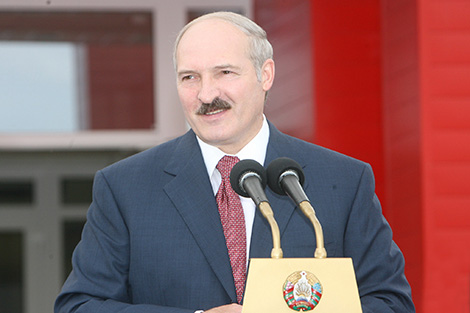
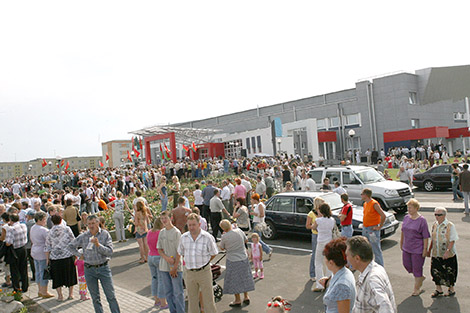
Aleksandr Lukashenko during the opening of the Ice Arena in Pruzhany, 27 July 2007
The state also did not lose sight of caring for the inner world of the individual. In a state that is young by historical standards, great importance is attached to spiritual revival, self-awareness, and independence - behind this lie centuries of history and hundreds of people from the past whose experience helps modern Belarusians stand firmly on their feet and look confidently to the future. In 2007, in the ancient city of Polotsk, the reconstructed reliquary of St. Euphrosyne of Polotsk was consecrated. This landmark event, which took place on the saint’s feast day, 5 June, was shared by the president together with the faithful. “All the activities of the great enlightener are inseparable from the beautiful city of Polotsk, which was one of the centers, the main center, of the formation of the Belarusian people. Here, on Polotsk soil, we all feel especially keenly how important it is to preserve the memory of our ancestors’ glorious deeds and to build on their fine traditions,” Aleksandr Lukashenko said at the time.
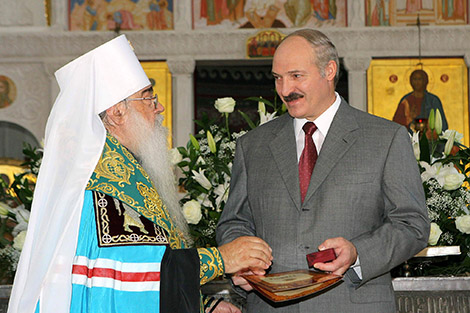
Aleksandr Lukashenko and Metropolitan Filaret at the reliquary of St. Euphrosyne of Polotsk, 5 June 2007
In October 2007, an international conference titled Dialogue between Christianity and Islam in the Context of Globalization was held in Minsk under the patronage of Metropolitan Filaret, with the president in attendance. “The Belarusian people have developed a resilient immunity to any manifestations of inhumane ideologies and views aimed at dividing and destroying people. That is why we place such a high value on peace and mutual respect among nations. In our cities and historic towns, a church, a Catholic cathedral, a mosque, and a synagogue stand side by side on the very same square. This unique historical experience has taught our people to better understand and accept one another,” Aleksandr Lukashenko said at the conference.
‘We are going wide’
This ability to understand and accept one another is the driving force behind Belarus’ foreign policy. It was in 2007 that a course to the East was chart. Aleksandr Lukashenko paid his first official visit to the United Arab Emirates. In that same year of 2007, Aleksandr Lukashenko paid his first official visit to the Sultanate of Oman. The fruits of this groundwork are still being reaped today, 19 years later. In 2007, the Belarusian leader was received in India. “Such a colossal state, with such human resources, huge economic human resources, huge economic potential cannot fail to be in demand in the world. Not a single issue in the world can be resolved today without India’s participation.”
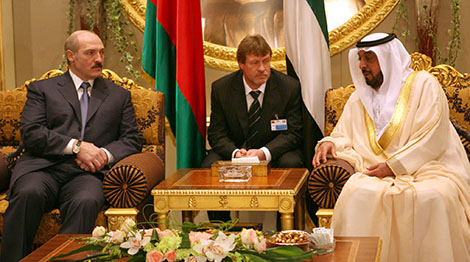
Aleksandr Lukashenko and Sheikh Khalifa bin Zayed Al Nahyan, 5 March 2007
To say that in 2007 relations between Belarus and Venezuela developed intensively would be an understatement. In a little over 11 months Belarus managed to accomplish as much as it would have done after several years with another country. In June 2007 Hugo Chavez visited Belarus. This was his second visit. The first had taken place a year before. “We are going wide,” the Belarusian leader said as he described the bilateral relations during a meeting with his Venezuelan counterpart.
Minsk and Caracas successfully passed the first, introductory stage of relations. Belarusian oil workers, builders, and entrepreneurs came to stay in Venezuela. As many Venezuelans made their way to Minsk. The creation of Belarusian assembly enterprises in Venezuela was actively discussed. Belarusian experience in expanding the natural gas grid across residential communities also met interest.
In December Aleksandr Lukashenko paid a return visit to Venezuela. Hugo Chavez personally announced the visit of his Belarusian counterpart live on the state TV channel. “President Lukashenko’s visit is very important,” he said then. As a priority he identified such an area of cooperation as the creation of joint ventures in mechanical engineering in Venezuela. It is worth emphasizing that only a year and a half passed between the first visit of Hugo Chavez to Minsk and the first visit of Aleksandr Lukashenko to Caracas. During this time the presidents of the countries, which are separated by 10,000km, met four times.“We are united by an independent foreign policy, a people-first domestic policy of both countries, the desire to build a multipolar world, and the need for joint efforts to counteract outside pressure, wherever it comes from,” the Belarusian president said during the visit.
Relations between the countries quickly reached the level of strategic partnership. This meant not only complete political understanding, but also numerous economic ties. Speed was the first peculiarity of Belarusian-Venezuelan relations. The second one was the mutually beneficial nature of cooperation. This was embodied in the creation of joint oil production. The resource, over which even the closest partners can quarrel, united Belarus and Venezuela. As we can see, they were distant only geographically. Despite excellent relations with Venezuela, nobody gave up on diversifying oil shipments to our oil refineries. The course toward the diversification of fuel and energy resources was named the most important element of the country’s energy security concept for the period till 2020. As the head of state told journalists, these issues were discussed with partners from the United Arab Emirates, Iran, Azerbaijan, and other countries.
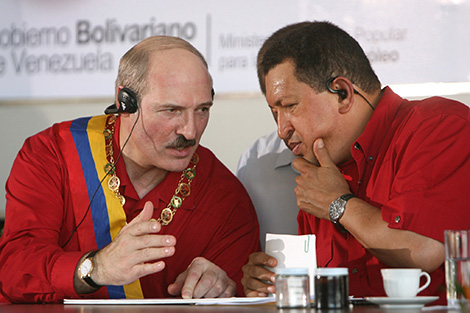
Aleksandr Lukashenko and Hugo Chávez, 10 December 2007
Despite active and effective cooperation with remote countries, Belarus did not abandon its principles in relations with neighbors. Here is a confirming quote. “We will develop good, human, partner relations with our neighbors. We cannot act otherwise. Why should we position ourselves differently in the world? Why should we be some unstable, unpredictable, incomprehensible state and an unpromising partner for our closest neighbors, and indeed for all states? We will only win if, taking our place in the world, we are stable, predictable, good partners. We will act to that effect,” Aleksandr Lukashenko stressed while talking to reporters.
By tradition at the end of the year it is customary to review the year’s results and assess everything that happened. In his New Year’s address Aleksandr Lukashenko called 2007 the most difficult in the history of our young state. The reason was the severest political and economic pressure, the introduction of various sanctions, floods of lies and disinformation. The increase in energy prices became a major test of strength for our economy. It was such a large-scale blow that could ruin any country. But the Belarusians stood firm and ensured the development of their country.
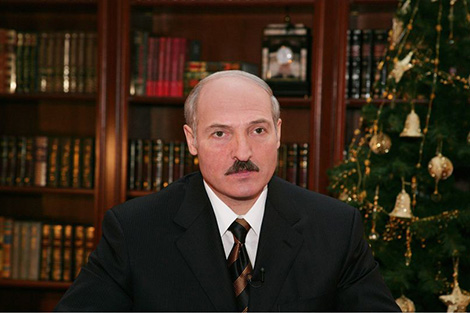
Aleksandr Lukashenko delivers his New Year's address to the Belarusian people, 31 December 2007
Over 19 years Belarus has gone through many more tests and has overcome many difficulties. It is possible that during this period there was a year, probably more than one, that can be called “the most difficult one in history”. What these difficulties were and how our country coped with them, we will tell in the next episodes of the How It Was project. For now we will be grateful if you drop a comment about what your year 2007 was like and whether you’d like to bring it back.
 print version
 make home page
 add to bookmarks