




Events
Terrorism, migration, Western threats: Volfovich on outcomes of CSTO security talks
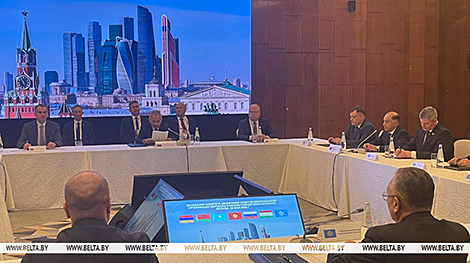
MINSK, 26 May (BelTA) – State Secretary of the Security Council of Belarus Aleksandr Volfovich told journalists about the outcomes of the meeting of the Committee of Security Council Secretaries of the Collective Security Treaty Organization (CSTO) in Moscow on 26 May, BelTA has learned.
Aleksandr Volfovich noted that the talks primarily focused on threats posing a danger to all CSTO member states. “These include terrorism, drug trafficking, illicit arms trafficking, and migration issues, which are also highly relevant to the western flank of the Collective Security Treaty Organization. Based on this, today’s primary outcome is the coordination of measures to counter these challenges and threats,” he said.
The meeting approved a draft decision of the CSTO Collective Security Council “On the anti-terrorism strategy of the CSTO member states through 2030” and a decision of the CSTO Committee of Secretaries of Security Councils “On the plan of measures to implement the anti-drug strategy of the CSTO member states for 2026–2030.”
“Of course, these documents are yet to be reviewed and approved by the CSTO Collective Security Council, which will meet this autumn under the leadership of our heads of state,” Aleksandr Volfovich said.
He noted that during the meeting, the Belarusian side focused primarily on the situation in the Eastern European collective security region and the threats posed to the CSTO by its western neighbors. “In previous years, one could agree that the threats emanating from Afghanistan on the organization’s southern borders were indeed a matter of serious concern. Of course, those threats still persist and remain concerning, but what is unfolding on our western borders now outstrips, in my view, even that tense situation,” the state secretary of Belarus’ security council said.
“The aggressive, militaristic policies of our western neighbors, aimed not at good-neighborly relations but at escalating tensions, are certainly a matter of serious concern. This threatens not only Belarus and Russia, but the entire organization as a whole. While we used to address these issues on our own, we have now urged all member states to take note of the threats facing the organization from the west,” he said.
“Today, we invited our colleagues, high-level security officials, and CSTO experts to come to Belarus and see for themselves what is happening on the European Union border. We want them to look at the situation unfolding on Belarus’ southern borders – the Belarusian-Ukrainian border – and see exactly where the threats are coming from,” Aleksandr Volfovich added.
 print version
 make home page
 add to bookmarks