


Events
Russia-Ukraine POW swap underway in Belarus
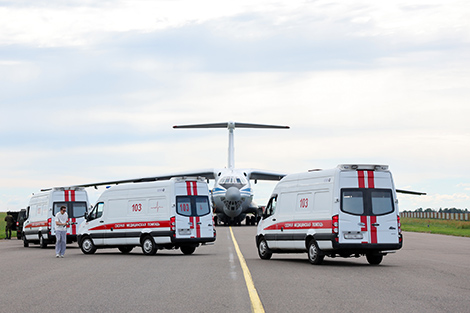
GOMEL DISTRICT, 26 June (BelTA) – At this moment, another exchange of prisoners of war between Russia and Ukraine is taking place on the territory of Belarus, BelTA has learned.
Belarus continues to fulfill its humanitarian mission and has once again served as a venue for the exchange of prisoners of war. Russia and Ukraine handed over 160 people each.
The Belarusian side organized the entire logistical operation, from the aircraft’s landing at Gomel airport and the bus convoy’s route to the Novaya Guta checkpoint, where the exchange took place, to the provision of hot meals and medical assistance along the way.
One Russian serviceman said that upon seeing the “Republic of Belarus” sign at the border, he was flooded with emotion. “The emotions are just overwhelming... We received a very warm welcome,” he recounted.
The news that he would be included in the exchange filled him with overwhelming joy. “You can’t describe the emotion of coming home after a year, a whole year without seeing anyone,” he said, his voice breaking. He immediately made his first call to his family. “Everyone is waiting for me. My wife said she already knew yesterday that I’d be coming. My daughter is crying with joy that I’m on my way back,” added Roman.
As noted by Chairperson of the Standing Commission on Labor and Social Affairs of the House of Representatives Irina Kostevich, a humanitarian corridor was once again opened today, allowing for the return of 160 prisoners of war from each side. “Belarus is a safe venue [for this process]. On this platform, prisoners of war from both sides, having lost all hope, found on Belarusian soil a renewed belief that things would work out after all,” she said.
Irina Kostevich emphasized that this platform not only gave prisoners of war a chance at life but also served as a receiving point for refrigerated trucks carrying the bodies of the fallen. “This work must also continue, because it is important for families to lay their loved ones to rest with dignity in their homeland,” she said.
“It is deeply moving to hear words of gratitude from both Russian and Ukrainian prisoners of war. The comfort we offer may be modest, but it comes from the heart. That heart reflects the spirit of the Belarusian people and of our president, whose sincerity, kindness, and steadfast dedication to peace drive our efforts toward the swiftest possible end to this conflict,” she added.
“Our buses transport prisoners of war, and hot meals are provided. ‘Thank you, Belarusians... We are moved to tears’ – those words mean more than we can say,” emphasized Irina Kostevich.
She also noted that this platform enables dialogue. “It may not resolve the conflict, but it does prompt reflection on why peace is worth fighting for. Peace is needed to preserve life,” she added. “We Belarusians have always been committed to peace. Our peaceful nature, our love for people, and our humanity allow us to address these difficult issues. Belarus is determined to provide as much assistance as possible whenever we are needed.”
Russian Human Rights Commissioner Yana Lantratova said that during today’s negotiations with her Ukrainian counterpart Dmitry Lubinets, the discussion centered on the need to conduct POW exchanges more frequently. “And most importantly, humanitarian efforts to reunite families and return civilians. I can say that a very important humanitarian exchange will take place in the coming days, and we plan to meet here again,” Yana Lantratova announced.
“We are deeply grateful to our Belarusian colleagues, because everything has indeed been organized at the highest level. There is an opportunity here to hold negotiations and exchange documents. In addition, all the guys, both from Ukraine and from Russia, have been fed. Packages are handed over to them, and they have the opportunity to change clothes here. Many thanks to the Belarusian colleagues for the flawless organization of the process. I say this as a representative of the Russian side, and the Ukrainian side says the same, and we repeat this on all our platforms,” emphasized Yana Lantratova.
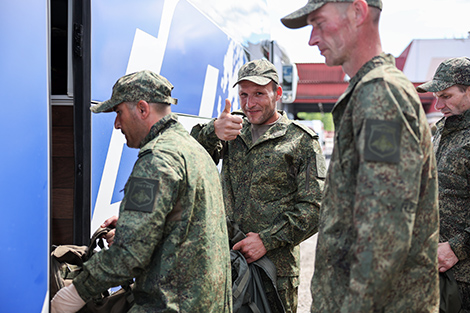
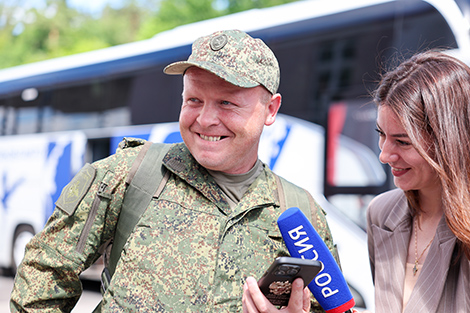
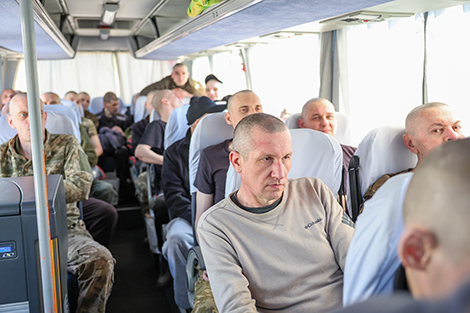
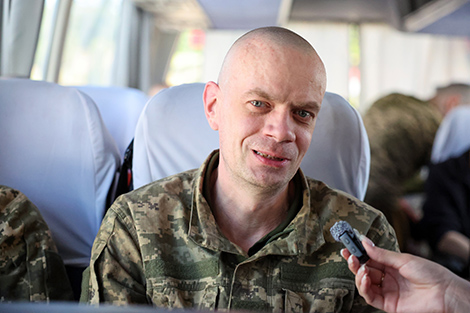
On this day, Russian serviceman Artur could not hold back his tears. “Tell Mom and everyone not to worry. Everything is fine. I’m alive. Kisses,” he said during his first call in a long time to his daughter, which turned out to be the most emotional moment for him. According to him, thoughts of his wife, children, and brother helped him hold on and not give up. “The first thing I’ll do is visit my family, my daughters. My mother is sick. I want to see her, but I don’t know if she’s alive or not,” Artur said anxiously. “And today’s tears are tears of joy. I wish everyone a speedy return home,” he added.
Immediately after the exchange procedure, another Russian serviceman, Sergei, heard familiar voices on the phone. “I’m in Belarus. Everything is fine. I love you. Kisses,” he said to his family, whom he had not seen for ten months.
“We’re already in Belarus, but I still can’t quite grasp that we’ve arrived here. When I learned I would be coming home, I was in shock. My wife said she was in shock too. She had been hoping and waiting all this time. And the hope of reuniting with my family also helped me keep going. My wife and children are at home. That’s what matters most. What else is there to live for?” Sergei asked rhetorically.
“I would like to say a big thank you to the Belarusian side for the warm welcome and for the meal. I was very pleasantly surprised by the condition of the roads [in Belarus] and the atmosphere,” said one of the freed Ukrainian servicemen. Speaking about what kept him going all this time, he said that it was faith and the desire to return home. “The understanding that our families need us and we need them. I really wanted to go home. Most people were waiting for this moment and believed it would happen. We are glad that exchanges have become more or less large-scale lately,” he said.
Another Ukrainian serviceman admitted that he was morally supported by news from home, from his wife and his now adult daughter, who will turn 19 in October. When asked what he would do first upon returning home, he replied, “I owe my wife a tremendous thank you. She took on the care of our home and our parents, bearing it on her fragile shoulders after I was captured on 12 April 2022. I am deeply grateful for everything she has done. My only dream is that my daughter and the next generation will never have to know war,” the Ukrainian serviceman added.
Ambulance teams are on standby throughout the exchange process to respond immediately if needed. “We provide all necessary medical assistance, from taking medical histories to instrumental examinations, including electrocardiograms and glucose measurements. If necessary, we are prepared to provide full medical care, including connection to a ventilator, as well as the full range of electrical defibrillation,” said Kirill Yuzenkov, a paramedic with the Gomel emergency medical response team and a psychologist.
“We are always prepared for anything. Our assistance includes psychological and medical support. Our main task is to ensure that the patient travels from point A to point B in good, stable condition. We are ready to provide all the necessary assistance,” Kirill Yuzenkov emphasized.
A protocol has also been established for situations requiring urgent hospitalization. “All necessary medical services are provided at the pre-hospital stage. Should the need arise, we are prepared to transport patients to a larger facility for inpatient care, including intensive care if required,” Kirill Yuzenkov added.
In total, more than 70 exchanges of prisoners of war and the fallen have taken place on the territory of Belarus.
 print version
 make home page
 add to bookmarks