


Events
Results of nationwide opinion poll on social, economic development presented in Minsk
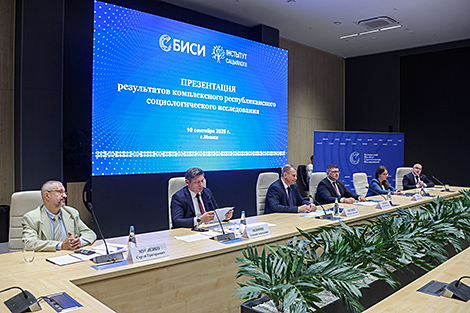
MINSK, 10 September (BelTA) – The first part of results of a comprehensive nationwide sociological survey that focuses on the key matters of social and economic development in Belarus was presented in Minsk, BelTA has learned.
The Institute of Sociology of the National Academy of Sciences of Belarus conducted the survey in July-August 2026 upon request of the Belarusian Institute for Strategic Research (BISR).
Director of the Institute of Sociology of the National Academy of Sciences Nikolai Myslivets said: “Today we present the first part of our results. We will review the block of social and economic matters. After that there will be a block on the socio-political situation in the country. The final presentation will focus on high-profile matters. We have studied various aspects of the social well-being of our country’s residents. Over 2,000 respondents representing all regions of Belarus were surveyed. Men and women, married and unmarried people, individuals with different education levels took part in the study. The sample represents the population of the entire country. Residents of 99 populated localities took part in the survey, sharing their views with interviewers on their satisfaction with living conditions in their population centers, their priorities regarding work, leisure, and values. This spectrum allows us to picture how modern Belarusians live and how comfortable they feel in their home country.”
Vitaly Punchenko, Deputy Director of the Belarusian Institute for Strategic Research, called the sociological study the most significant recent project for the Institute of Sociology of the National Academy of Sciences of Belarus and the Belarusian Institute for Strategic Research. “This is not just a study, it is a tool of strategic awareness. The presented results are notable for their representativeness and scale, both in terms of population coverage and the breadth of questions asked,” he stressed.
In his words, the need for such a comprehensive study is driven by many factors. “First, comparing notes at the start of the new five-year period. The program of social and economic development adopted at the Belarusian People’s Congress is based on proposals from the people. Today it is important to evaluate the initial results of meeting the priorities not only by statistical, but also by sociological criteria. It is very important right now to maintain a live connection with citizens, to hear their opinions, aspirations, and fears,” Vitaly Punchenko emphasized.
“The second factor is that the world is changing rapidly and waiting for no one. This is not only about unprecedented external turbulence, under which we need to make an honest, objective assessment of the internal situation, the readiness of society for joint intensive work on the peaceful front, to which the head of state calls us. It is also about the rapid development of technologies. Artificial intelligence is marching across the planet, and Belarus is no exception. Technologies are already changing, and in the near future they will change even more the public attitudes toward labor, law, and communication. It is necessary to understand the readiness of society for these changes, see problem points, and work out counter-steps on the part of the state to prevent digital inequality,” the BISR deputy director outlined.
Another aspect of the study relates to the approaching People’s Unity Day. “On the eve of the main unifying holiday of the country, it is of crucial importance to see real points of intersection and divergence of interests between young people and retirees, residents of rural areas and cities in different corners of our country. It is important to take into account the opinion of everyone and, on this basis, gradually improve our social contract and strengthen public trust in the state,” Vitaly Punchenko concluded.
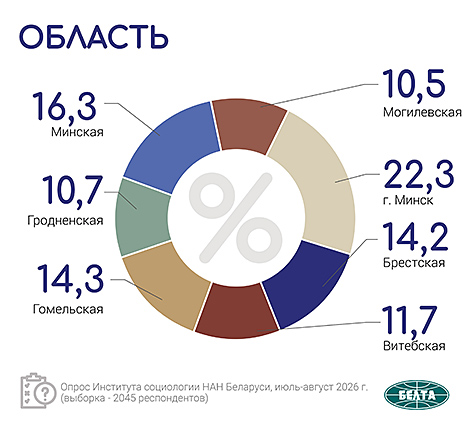
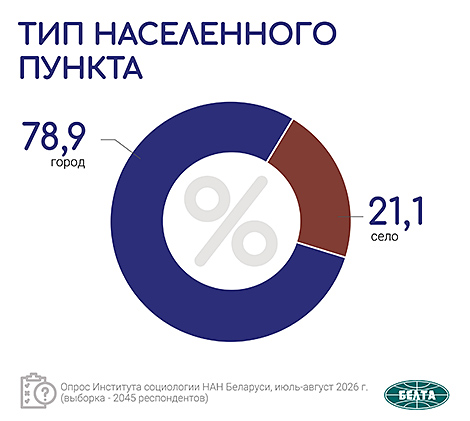
A total of 2,045 respondents participated in the sociological study, including 22.3% from Minsk, 16.3% from Minsk Oblast, 14.3% from Gomel Oblast, 14.2% from Brest Oblast, 11.7% from Vitebsk Oblast, 10.7% from Grodno Oblast, and 10.5% from Mogilev Oblast. Among them, 78.9% were urban residents and 21.1% were rural residents.
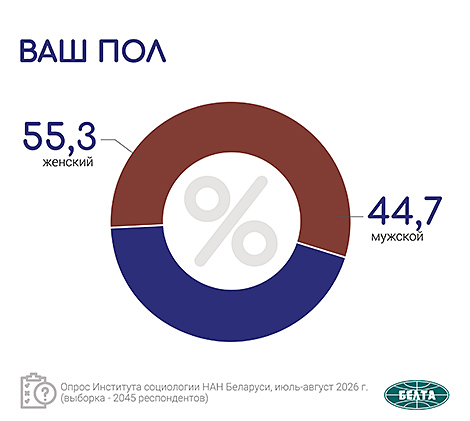
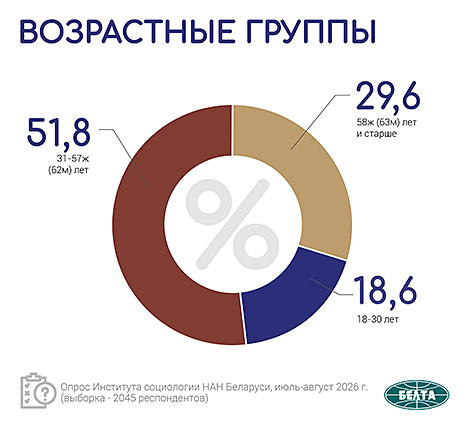
As many as 55.3% of the respondents are women and as many as 44.7% are men. They belong to different age groups: 18.6% of the participants are 18-30 years old, 51.8% are 31 to 57 years old for women and 62 years old for men, and 29.6% are 58 years old and older for women and 63 years old and older for men.
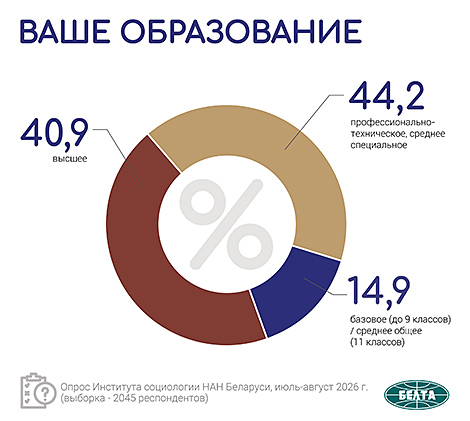
As many as 40.9% of the respondents have a higher education degree, 44.2% have a vocational or technical degree or a specialized secondary education, and 14.9% have a basic education (up to 9th grade) or a general secondary education (up to 11th grade).
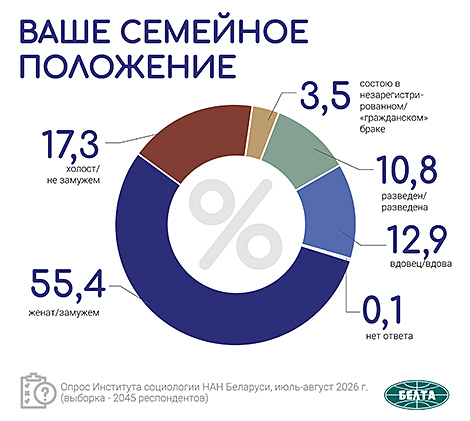
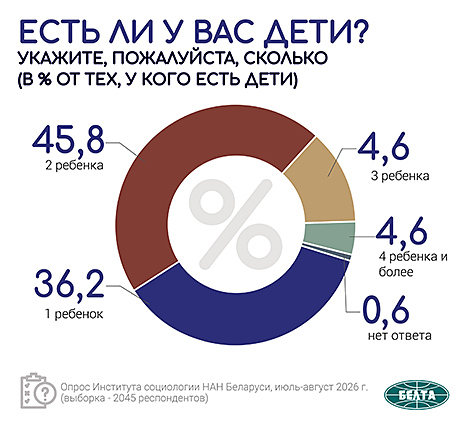
55.4% of the study participants are married, 17.3% are single, 12.9% are widowed, and 10.8% are divorced. 75.6% of the respondents have children.
 print version
 make home page
 add to bookmarks