



Events
Lukashenko’s talk with Macron, readiness to meet with Zelensky. Belarus’ peace diplomacy at work
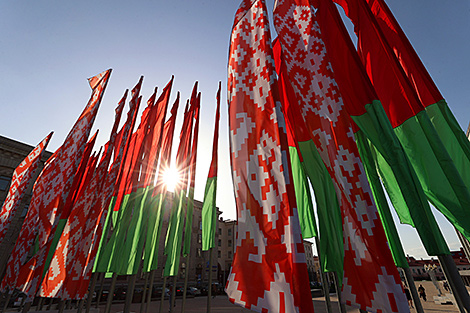
An archive photo
Upon the initiative of the French side a telephone conversation between Belarus President Aleksandr Lukashenko and France President Emmanuel Macron took place last Sunday. A few days before that, the Belarusian leader declared readiness to meet with Vladimir Zelensky if the latter wants to talk or seek advice. The foreign press as well as the expert community responded with a flurry of comments. However, it seems they ended up with more questions than answers. Well, let us also try to look for answers and, at the same time, find out how the Belarusian peace diplomacy works today and where its strength comes from.
What does Paris keep quiet about and what does Minsk talk about?
Not many details of the phone call between Aleksandr Lukashenko and Emmanuel Macron are available. According to comments from the Belarusian side, the talks focused on regional problems, relations between Belarus and France, and with the EU as a whole. But as the Belarusian Ministry of Foreign Affairs pointed out, such conversations happen for a reason. Besides, relations between Minsk and Paris can hardly be called simple.
“On Sunday, French President Emmanuel Macron and his Belarusian counterpart Aleksandr Lukashenko held a rare phone conversation. During the call, which was initiated by France, the leaders discussed relations between Belarus and the European Union as well as regional matters,” the Bloomberg news agency reported.
“Analysts view this call either as a possible attempt to reopen long-blocked diplomatic channels or as a strategic move designed to test Minsk’s role in relations between Moscow and the West,” the Balkanweb outlet noted.
The curiosity of the Western press was further fueled by the fact that the French authorities provided virtually no comments. An inside scoop from an unnamed source was dropped merely for the domestic audience, claiming that Macron was full of bravado during the conversation, warning Aleksandr Lukashenko against getting involved in the Ukrainian conflict.
It sounded so ridiculous that even reports in the Western press were tinged with bewilderment. No, the fact that the French leader likes to show off is well known. But he usually does it in public. Yet in this case there were neither loud statements nor promises to introduce another package of sanctions. And frankly speaking, Paris has no reasons for any fears. Quite the contrary, there is a feeling that European elites see no threats to themselves from Russia or Belarus at all. Figuratively speaking, if you are afraid of a lion, you obviously will not stick your head into its mouth. Yet Europeans do this regularly.
But let us return to Macron. Or rather, to what the French leader keeps away from the public eye for obvious reasons. On the whole, we analyzed the policy of the French president, his motives and political vacillations a few months ago in the article titled “Russia will still be there tomorrow. What is the essence of Macron’s halfway diplomacy?”. In short, the French leader is trying to have his cake and eat it too. For example, he wants to make a profit on weapons sales, for the sake of which France has fired up its military-industrial complex, and to gain political weight by promising to extend its nuclear umbrella over European allies. But for this to happen, to paraphrase a line from a song by the legendary Freddie Mercury, the war must go on.
At the same time, Macron fails to hit the right note. In the weapons market he had to share space with London and Berlin, which are also keen to cash in on the military hysteria in Europe. On top of that, Brussels is trying to use the militarization to centralize power, create a single army, and establish the post of the EU president – something that hardly aligns with Paris’ plans. Meanwhile, the USA comes forward with peace initiatives on Ukraine, leaving European allies on the sidelines. In parallel, Washington is establishing contacts with Minsk, completely breaking down the fencing-off strategy of the European elites.
However, the war in the Middle East seems to have been the last straw. The European economy has effectively fallen hostage to someone else’s conflict while the EU simply has no leverage. This situation perfectly demonstrates how vulnerable Europe is today to external factors, which will only multiply in conditions of geopolitical turbulence. The reason for this vulnerability is also obvious – the lack of a solid economic foundation, which, alas, cannot be built without Russian energy resources.
European leaders who talk about this publicly can be counted on the fingers of one hand. Macron is clearly not one of them. He will not openly admit his mistakes. This is why he does not call his Russian counterpart Vladimir Putin although he has saying the call is necessary since the end of last year.
The thing is that Vladimir Putin poses very specific questions to the European elites – questions concerning the end of the Ukrainian conflict, reduction of strategic armaments, and a new security architecture that will put an end to the insane militarization in Europe. Macron is not ready to answer these questions yet. But he is probably getting ready.
That is why he calls the president of Belarus, hoping that in this way he can test the waters, gauge the mood and the positions of the parties, and perhaps convey certain signals. All of this quietly, without public fanfare, without losing face. After all, Minsk, in the context of the Ukrainian crisis, which might more accurately be called a pan-European crisis, does not set conditions. It simply offers dialogue as the first step toward peace.
The Belarusian leader conveys very simple yet extremely important messages to Europeans: we need to come to an agreement, to take steps toward one another; there is no alternative to peace. And dialogue is the most important step toward mutual understanding and peace. Rejecting dialogue is a deliberate ignoring of problems or an intention to make them worse.
Lukashenko is certainly listened to and heard, but not everyone appreciates his rhetoric.
What is the essence of Kiev’s shrill diplomacy?
The intensification of contacts between Washington and Minsk has also noticeably invigorated our southern neighbors. On the one hand, this is understandable, given that Belarus is actively promoting peace initiatives regarding Ukraine, supporting the Americans in their efforts to resolve the conflict, sharing its experience and its vision of the situation in the region, and proposing possible ways out of the crisis.
On the other hand, Minsk’s peace efforts are hardly compatible with Kiev’s plans. In fact, those plans are hardly compatible with anything at all. Plans to return to the 1991 borders, plans to join NATO, plans to join the EU... What unites Ukraine and its European allies is this: all their plans have come undone - torn on the British flag, as it were - and they lack the courage to admit it and take responsibility. So they simply continue to move forward by inertia, dragging out the Ukrainian conflict and hoping for God knows what.
Under these circumstances, Belarus, which is calling on Europe to come to its senses and stop, has become a source of irritation for Kiev. Hence the stream of confrontational rhetoric. Claims that Belarus will attack Ukraine any day now, and then will inevitably go to war with NATO. On one day, Kiev warns of a military threat from Belarus; on another, it threatens to launch a preemptive strike on our territory.
Watching what Kiev is doing, one might assume that the Ukrainian leadership’s goal is to force Minsk off the negotiation track and weaken Belarus’ influence over everything related to the conflict resolution process. And clearly, Belarusian influence must indeed be significant, given that the Ukrainian authorities have found the time and resources to open an information front against our country.
After Macron’s call to Minsk, Zelensky’s office will likely have to strain even harder.
“Although details of the conversation were not disclosed, the contact itself was interpreted by many in Kiev as evidence that some Western governments increasingly view Lukashenko as a negotiating partner rather than an isolated authoritarian leader,” writes the Belgian publication EUalive, noting that Kiev appears determined to confront this approach head-on.
Why does Lukashenko sympathize with Zelensky?
A few days before Macron’s call, the Belarusian leader commented on statements and threats made by Zelensky against Belarus. The head of state noted that Belarus has no intention of being drawn into a war with Ukraine. There is no need for that whatsoever, neither civilian nor military.
“As for his statements that Belarus will be dragged into the war, I just said: we will be dragged in only in one case, if aggression is committed against our territory,” Aleksandr Lukashenko said.
At the same time, the head of state dismissed Zelensky’s statements as chatter. “I do not react to this chatter coming from Kiev. Including from President Zelensky. In this case, I try to sympathize with him. There is a war going on, anything can happen; the man is under serious pressure. Unfortunately, he does not want to draw conclusions or analyze the situation. Maybe I don’t know everything. That is his business. So I have not reacted, understanding that a person can be going through all sorts of things,” Aleksandr Lukashenko said.
And then another notable statement, which sparked interest in the Ukrainian media. The president of Belarus declared his readiness to meet with Zelensky - in Ukraine or in Belarus.
“Vladimir Zelensky needs to calm down, come to his senses, analyze the situation in Ukraine itself and on the front lines, and draw appropriate conclusions. The right conclusions,” the Belarusian leader added. “If he wants to talk about something, consult, or anything else - please, we are open to that. Anywhere, in Ukraine or Belarus, I am ready to meet with him and discuss the problems of Belarusian-Ukrainian relations. And perhaps talk about the future. For some reason, we have things to talk about with the Americans, Germans, Poles, Lithuanians, and Latvians, but with Ukraine we have nothing to talk about...”
“As for him trying to scare us, that is not for me,” the head of state remarked.
The Belarusian leader’s statement surprised many. Not the part where Lukashenko says Belarus has no intention of fighting Ukraine, in fact, even Western experts have refuted Kiev’s fabrications on this topic. What surprised people was how calmly the president of Belarus reacted to Zelensky’s outbursts. Despite everything, Lukashenko speaks of sympathy and offers to meet.
Would many European politicians, following a stream of ultimatums and threats, decide to engage with representatives of the Ukrainian authorities? Politicians who live by short-term interests would not. However, statesmen who look at the long-term perspective and put the interests of their country and the security of the people above personal grievances would.
Perhaps the empathy Lukashenko speaks of is dictated by the fact that both countries – Belarus and Ukraine – have long borne the burden of being a geopolitical buffer. Positioned between East and West, our countries were destined to balance relations and maintain this equilibrium for the sake of peace in the European region. But for Ukraine, this burden proved too heavy. Kiev rushed toward the West: first politically, and then militarily. The fragile balance was disrupted, and war broke out.
Minsk was fully aware of what was driving Ukraine and what it could lead to – something the Ukrainian leadership and European leaders had been repeatedly warned about. Now, there is nothing left but regret and empathy. Not only for Ukraine, but for Europe as a whole – divided, vulnerable, and drifting helplessly toward the abyss.
Yet let us not forget that this Europe still remains our shared home. Belarus understands that as long as conflict potential continues to rise in the region, our country will not be able to look to the future with confidence.
How Belarus’ peace diplomacy works
“If you want to make peace with your enemy, you have to work with your enemy. Then he becomes your partner,” Nelson Mandela once said.
Belarus is unlikely to have enemies. Yet, there are some by no means friendly political systems with which we must find common ground, whether we want to or not.
Today, Minsk is building partnerships with the majority of countries worldwide. Our diplomacy also has an approach toward Western nations – a pragmatic dialogue that allows us to achieve essential goals. Belarus’ primary objective is security, both economic and military. This is our baseline.
Today, even the West openly acknowledges that our country has a special geostrategic position in Europe. There, Belarus is referred to as a “balcony” separating Russia from NATO countries. From a military standpoint, that is true. However, we, the Belarusians, are definitely against our country being described in military terms. That is why Belarusian policy and diplomacy are aimed at ensuring our state is perceived not as a buffer, but as a bridge connecting two parts of greater Eurasia.
Unlike Ukraine, Belarus fully recognizes the military and political reality that has emerged in Europe and takes responsibility for maintaining the balance of power in the region. This is also seen by the Donald Trump administration, which is sending its envoys to Minsk. It is seen in EU countries as well. Interaction is already underway – for now in the form of quiet diplomacy, on a bilateral level. But this is already a major step forward.
The Belarusian president plays a special role in this regard. In Washington, and progressively across Europe, he is viewed not merely as Moscow’s closest ally, but as the leader of a country that holds strategic importance that is ready to contribute positively or, if required, serve as a mediator to facilitate dialogue and find common ground.
This is what the Belarusian Minister of Foreign Affairs Maxim Ryzhenkov said on this matter: “We have been seeing this trend for a long time: the president is viewed as a person who understands the current situation very well and, through his personal involvement, can help in achieving the goals of ensuring stability, security, and peace. At least in our region, that is for sure. Over time, this understanding is growing more and more among various participants in this process, which is why they reach out to the president.”
Today, Minsk can convey its position and send important signals without resorting to loud diplomacy or putting on political shows. For instance, the contacts between Minsk and Washington signal to Europe that even at the current level of confrontation, it is possible to build a pragmatic dialogue and jointly solve pressing issues. Lukashenko’s words addressed to Zelensky are also a kind of signal, not only to Kiev but also to its allies in the USA and Europe. It can be interpreted as a direct response to all provocations and insinuations by our southern neighbors: our country pursues no military goals and is absolutely open to peace talks. The ball is in the court of Ukraine and its allies.
And the signals are reaching their destinations. Macron’s recent call – the first in over four years of the Ukrainian conflict – speaks for itself.
This is roughly how Belarus’ peace diplomacy works today, aimed at overcoming confrontation, finding common ground, and building bridges instead of walls. Amid a trust deficit, the absence of civilized dialogue, and rising geopolitical uncertainty, Minsk’s foreign policy strategy is likely to become increasingly sought after in Europe.
It is remarkable that for years, there were persistent efforts to reshape our country according to Western blueprints. Paradoxically, however, possible that Belarus might be the very nation that can bring positive change to Europe.
Vita KHANATAYEVA,
BelTA
 print version
 make home page
 add to bookmarks