


Events
Lukashenko’s Address: The unread part
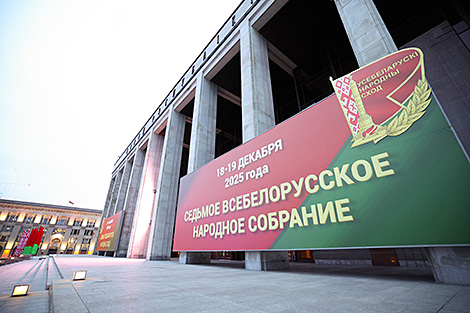
Belarusian President Aleksandr Lukashenko delivered an Address to the Belarusian people and Parliament at the second session of the 7th Belarusian People’s Congress on 18 December. Speaking about Belarus’ international priorities, the president mentioned that he was intentionally shortening his speech but promised it would later be published in full. The transcript of the head of state’s address has now been published. Here is what was in the part the president did not read out.
On the global majority
In his Address, Aleksandr Lukashenko emphasized that Belarus is going its own way, and this path is free of illusions. “We have lived under political and economic pressure throughout our sovereign history. That is the price of independence. Ever since the USSR ceased to exist, we have been holding our ground under that pressure. But we work and find our way out of this situation, orienting ourselves towards external markets. China, India, Russia, countries of Asia, Africa, Latin America - this is the global majority. And we are part of that global majority, no matter how much some might wish otherwise,” the president stated.
According to the head of state, the economic balance today is shifting entirely in favor of the countries of the global East and South. Belarus is integrated into this system. “The future is with blocs such as BRICS and the SCO, where they look forward to our participation and welcome us with pleasure,” the Belarusian leader stressed.
Aleksandr Lukashenko spoke about a number of crucial high-level agreements that have been reached with many countries. In far-abroad countries, for example, there is a surprising demand for Belarusian products.
“We have increased the share of far-abroad countries in our exports from 11% in 2021 to 20% in 2024. For us, these are interim figures. The goal is for one-third of Belarusian exports abroad to find buyers in Asia, Africa, and Latin America,” the Address read.
On unconditional priorities in the international arena
However, relations with Russia and China remain an unconditional priority. There can be no compromises here, Aleksandr Lukashenko stressed in the Address.
“The Russian Federation is the main ally and partner of Belarus. Two-thirds of our exports go to its market. We purchase roughly the same amount from them. Mutual trade in goods and services will reach a significant figure of $60 billion in 2025. These volumes need to be increased, but now through production cooperation and joint ventures. Our task is to bring such enterprises to full capacity and maximize the use of materials and components from the Union State market,” the head of state outlined.
The president noted that a corresponding legal framework has been developed, and criteria for classifying industrial products as goods of the Union State have been agreed upon, a tool Belarus and Russia must use to protect their common market.
“Cooperation in the transport and logistics sector has reached a new level. We are actively developing the transshipment of Belarusian cargo through Russian ports. This year, its volume will reach 16 million tonnes. That is a full recovery to pre-sanction levels. There should be no administrative barriers or bureaucratic misunderstandings between our countries,” stressed Aleksandr Lukashenko.
The president believes the government and parliament should pay special attention to systematic work with Russia to form common sectoral markets, as Belarusians and Russians are truly kin nations.
“We must move away from the empty accounting of who owes what to whom. That is a relic of the old days,” the head of state is convinced. “All our exports to Russia are just a drop in the ocean! We do not create any significant competition for a single Russian product. Our union must not be held back by ordinary clerks and bureaucrats.”
According to Aleksandr Lukashenko, China is the second-largest trading partner after Russia and one of the leaders in terms of direct investment in the Belarusian economy. Over the last decade, Belarusian exports to China have increased almost threefold. The total trade turnover has now grown to over twice that with the whole European Union.
“Major projects have been outlined in new promising areas, from forestry chemistry to unmanned transport. The clearest example of our countries’ industrial partnership is the Belarusian car BelGee, which is now seeing a major push to increase its domestic manufacturing,” the president mentioned as the most significant project.
On priority task for exporters
Today the number one task for Belarusian exporters is to expand into distant markets, Aleksandr Lukashenko outlined. As an example, he cited the strong pace of shipments to India, which in January-October 2025 increased 2.8 times to $493 million.
“Today it is the world’s fifth-largest economy and has the largest population,” the head of state noted. He added that there is significant potential for developing trade and industrial cooperation with Iran, Pakistan, Algeria, Oman, and the UAE, countries whose leadership, in his words, speaks to us in a language we understand.”
The president’s visits to these countries resulted in major agreements at the highest level. There is demand there for Belarusian food products, industrial goods, as well as developments in information technology, security, and medicine.
“Expanding economic ties with African countries is a test for our economy and our export promotion system. It is a litmus test to evaluate the work of the entire government, especially the industrial sector. The scope of work is enormous. It is not only ministries that need to move faster. The role of ambassadors must be strengthened: they are key figures in gathering primary information and finding ways to advance our interests,” Aleksandr Lukashenko set out the tasks.
According to the head of state, enterprises themselves must take the lead: Belarusian businesses should become more actively involved in building logistics chains and dealer networks in the countries of the Global South and East. The work of Belarusian parliamentarians within integration associations should, beyond its political effect, also deliver tangible economic results, the president added.
“We are always open to dialogue and cooperation at any level. We will find common ground with everyone. Belarusians have rich experience. But it must be a conversation on equal terms!” he said in the Address.
On international ties that are more than friendship
“Throughout our history, we, Belarusians, have built our statehood together with different peoples. First within the family of Eastern Slavs, later with the peoples of the vast Soviet Union. Everyone who has ever come here from the former Soviet republics (on an official visit, a work assignment, to see relatives, or simply for vacation) knows: here they are welcomed as family. Our ties are more than friendship,” Aleksandr Lukashenko noted in his Address.
He emphasized that nearly a century of shared history cannot be erased from collective memory. Many Belarusians found a second homeland in different corners of what was once a united country, while many others came to Belarus. And on both sides truly international families live today.
“Yes, we, the heirs of the Soviet Union, are going through difficult times. The West has thrown us into an intra-Slavic conflict that has flared into war in Ukraine. I will not delve into political backstage, but I will repeat what I have said before: we are open to Ukrainians. You are not strangers!” the Belarusian leader addressed Ukrainians in his speech.
On the unity of the Belarusian people
Aleksandr Lukashenko stated that Belarusians today are like one large family, comprising more than 150 ethnic groups and nationalities.
In the past five years alone, over 17,000 people have received Belarusian citizenship, coming from more than 60 countries: from the United States and Canada to Sri Lanka and Madagascar.
“Now they are our people, Belarusians by passport and by mentality,” the president emphasized. “The right to the free development of the cultures of all national communities living in the Republic of Belarus is enshrined in our Constitution. Every two years we hold the National Festival of Cultures in Grodno.”
As an example of harmony in society, the head of state pointed out decisions to establish centers for the country’s major religions.
“I am convinced that over time these sites will become symbols of the national unity of the Belarusian people: open and peace-loving,” concludes the part of the speech not delivered personally by Aleksandr Lukashenko but published in the official transcript.
 print version
 make home page
 add to bookmarks