




Events
Lukashenko: Minsk’s average salary must be maintained, not forced
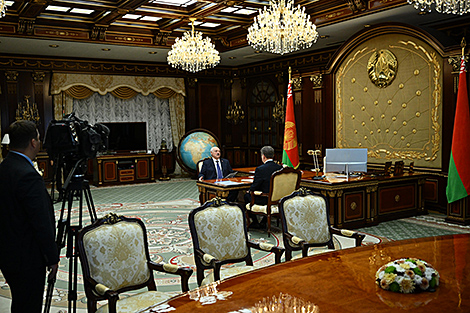
MINSK, 3 September (BelTA) – The fairly high average salary level in Minsk must be maintained but not forced, Belarusian President Aleksandr Lukashenko said as he heard a report from Minsk Mayor Vladimir Kukharev on 3 September, BelTA has learned.
The head of state was informed that the Belarusian capital’s economy is operating stably. Notably, Minsk secured a 102.2% growth rate in its Gross Regional Product (GRP), hitting its targets. Vladimir Kukharev emphasized that Minsk’s GRP accounts for 32% of the nation’s GDP.
“Impressive,” the president said. At the same time, he directed the Minsk mayor toward further economic growth, setting a target of no less than 3.5% GRP growth by the end of 2026.
The head of state also set the task of reaching a higher level for the entire economy of Belarus. According to data for January–July 2026, GDP increased by 2.1% compared to the same period last year. The president demands that this figure be accelerated to 3% by the end of the year.
“God willing, we will hit 3% [GDP growth for the full year] nationwide – that is the target I am setting. We absolutely must add 3% to Belarus’ GDP. We need to push through to reach 3% by the end of the year. And you [in Minsk] must strive for 3.5%, we need to hit that mark,” Aleksandr Lukashenko said.
The Minsk mayor also reported on the fulfillment of the salary growth indicator. According to him, the average nominal salary in Minsk reached Br3,878 in H1 2026. “This is a fairly high level. We will do everything to maintain it,” he said.
“Mr Kukharev, we must maintain this level but not force it,” Aleksandr Lukashenko said. “Because salaries, huge amounts of money will sooner or later lead to inflation. And inflation in Minsk will spread across the entire country, and we will find these earnings wiped out by rising prices.”
In this regard, the head of state particularly emphasized the need to focus on manufacturing. “It should not happen that salaries and disposable incomes skyrocket while production falls. Thank God, this is not the case either in Minsk or across the country. However, we must monitor this to ensure that labor productivity remains high. And we must certainly achieve improvements through underperforming enterprises,” the president said.
“The core principle is that money must be earned,” Vladimir Kukharev agreed. “We maintain the required ratio [of salary growth to labor productivity growth] to prevent any disruptions in the currency market, because that would lead to inflation.”
Speaking about the development of the capital’s industrial base, Aleksandr Lukashenko reminded the Minsk mayor that he is responsible for this area: “Do not forget that enterprises in Minsk are, first and foremost, your enterprises, and only then belong to the Ministry of Industry, the government, and so on. It is all yours. Just like in other regions.”
Investment activity in the capital was also discussed. According to Vladimir Kukharev, investment growth reached 10% in H1 2026, primarily driven by the construction industry. Currently, over 700 facilities are under construction in Minsk, including social infrastructure, housing, and technology park facilities. “This year, around $500 million is the contribution of the North Waterfront (Severny Bereg) neighborhood – their investment into the city’s coffers. And we continue to work with investors who are building enterprises in the city,” he said.
The president took a critical view of this trend, pointing out that a major share of investments is driven by social infrastructure rather than production facilities. “After all, investment in creating production facilities lags behind housing and other cultural and museum sites,” the Belarusian leader said.
 print version
 make home page
 add to bookmarks