




Events
Lukashenko: Discipline is the foundation of everything
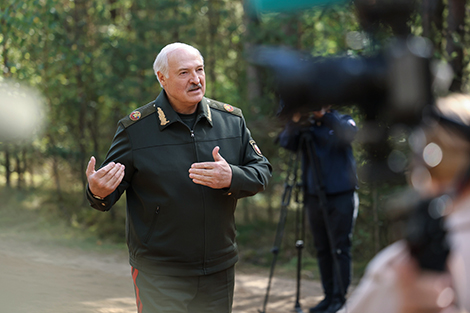
BARANOVICHI DISTRICT, 11 September (BelTA) – The updated Directive No. 1 focuses on discipline, Belarusian President Aleksandr Lukashenko told the media during his visit to the Obuz-Lesnovsky combined-arms military training area on 11 September, BelTA has learned.
The president was asked what drove the decision to update Directive No. 1 “On measures to strengthen public security and discipline” and whether it was linked to the rise of certain threats. In this regard, Aleksandr Lukashenko noted that threats have always existed and will continue to do so. At the same time, this concerns not only external security threats but internal factors as well.
“Discipline is the foundation of absolutely everything. The emphasis is placed on this as well. If there is discipline, it means that even compared to last year’s high performance, we will produce more grain than usual. Technologically, we already know how to do everything. The military knows how to fight, and the farmers know how to cultivate grain. Then why does it sometimes not work out or turn out completely bad? Because it’s not done on time, there is no discipline. If there is discipline, things will work out,” Aleksandr Lukashenko said.
The head of state drew attention to the army, where these issues receive significant focus. “Right now, the State Secretariat is putting the army to the test in combat conditions just as it should be [a combat readiness inspection in conditions maximally close to a real armed clash]. There is no resentment from Minister Khrenin [Defense Minister Viktor Khrenin] or the servicemen. They are working hard. Just as farmers earn their bread, they work here. But they know that they will be held accountable,” he added.
As previously reported, the revised text of the directive adapts to contemporary risks and challenges by enhancing approaches to public security. It introduces new mechanisms to maintain public order, including in the virtual environment.
The decree outlines the strategic priorities for government agencies aimed at establishing additional conditions to elevate the public life safety. It focuses on fostering essential skills for socially responsible behavior of citizens, shaping a supportive social environment, and encouraging harmonious personal growth.
 print version
 make home page
 add to bookmarks