




Events
Karanik comments on potential enrollees of Belarusian Academy of Intellectual Technologies
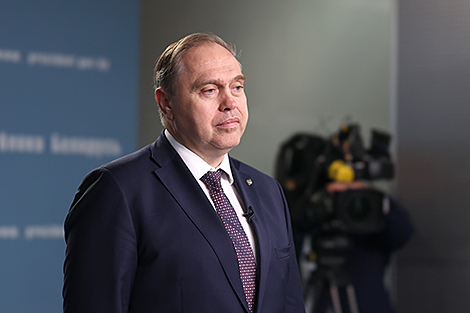
MINSK, 4 August (BelTA) — Training at the Academy of Intellectual Technologies will be available not only to school graduates but also to university students, university graduates, and even established scientists. Opportunities for admission to postgraduate and doctoral programs will also be provided for them at the institution, Vladimir Karanik, Chairman of the Presidium of the National Academy of Sciences, told reporters following a meeting with the Belarusian president to discuss the academy concept, BelTA has learned.
“If there are progressive ideas, competencies, and a willingness to work for the benefit of the country, the opportunity to study at the academy should be granted regardless of age,” Vladimir Karanik said.
According to him, the Academy of Intellectual Technologies will not provide a classical university education but will instead train specialists for the R&D sector. “It does not matter where these specialists will later work, whether at state enterprises, in the private sector, or at academic institutes. The country needs such specialists, and there must be a structure that will train them,” Vladimir Karanik noted.
He believes that the academy should become a systemic integrator, with the ability to send its students to any laboratory in the country whether it be a lab at an institute of the National Academy of Sciences, an industrial flagship, or a university. “In other words, if the training program requires in-depth knowledge in a particular field, and the relevant expertise exists at another institution, the academy’s students should have the opportunity to acquire the necessary knowledge at the facility where the greatest competencies are concentrated. The scientific and technological progress demands a multidisciplinary approach, and this must be implemented. The academy should essentially take on the role of a systemic integrator, one that will identify which types of specialists are most in demand in the real economy, begin their training, and also forecast future staffing needs for the coming years,” Vladimir Karanik noted.
The Academy of Sciences, he said, is ready to provide its laboratory facilities for training specialists at the Academy of Intellectual Technologies. “The state is making serious investments in developing the infrastructure of academic institutes and in upgrading scientific and technological equipment. I believe it would be right if students or participants of the academy had the opportunity to carry out their scientific projects and take their first steps in science using the technical and human resources of the NAS. The collaboration will be very close," Vladimir Karanik emphasized.
He expressed hope that a great many of the academy's graduates would be assigned to institutes of the NASB. First and foremost, Vladimir Karanik noted, we need those who can propose new idea so that “we not only catch up and ensure technological sovereignty but also shape a scientific and innovation agenda that the country can take pride in.”
 print version
 make home page
 add to bookmarks