




Events
Belarus proposes raising rents for modern rental housing
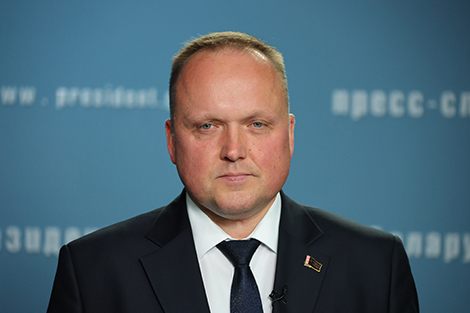
Aleksandr Terekhov
MINSK, 22 September (BelTA) – Belarusian government, acting on a proposal from the State Control Committee, has put forward an initiative to increase rents for modern rental housing, Deputy Prime Minister Aleksandr Terekhov told the media following a meeting chaired by Belarusian president on the prospects for housing construction and improving the efficiency of rental housing use on 22 September, BelTA has learned.
“The head of state emphasized that rental housing should offer good living conditions, be in demand and be built where people, particularly young specialists, need it. This is necessary to retain personnel and young specialists as part of the investment projects being implemented in the country,” the deputy prime minister said.
He also noted that starting from 2026, the authorities have decided to equip rental housing with a minimum set of appliances: a refrigerator, washing machine, and microwave oven. A basic set of furniture will also be provided, such as a fitted wardrobe, so that people moving in will have somewhere to put their belongings.
According to Aleksandr Terekhov, such an improvement in the quality and comfort of housing cannot but affect the level of rent, which was also one of the topics at the meeting with the head of state. However, no fundamental overhaul of the system is planned. The existing mechanisms for providing rental housing and the formula used to calculate rents only require fine-tuning.
“The formula is simple - it is tied to the base amount. Today, the formula is calculated as follows: 0.2 base amount, or Br9 per square meter, is multiplied by the apartment’s floor area,” he said. Thus, the monthly rent for a good two-bedroom apartment measuring 60 square meters would be Br540. However, the deputy prime minister said that no more than 30% of all tenants actually pay the full amount under these rates. Additional coefficients may then be applied to the amount.


For example, a coefficient of 0.1 applies to a similar apartment located in a rural area. Instead of Br540, the monthly rent would therefore be just Br54. Even in Minsk, the coefficient varies from 0.5 to 1.5 depending on the location. This means that the monthly rent in the capital would range from Br270 to Br810.
The government’s proposal in this case was to calculate the basic rent for newly built rental housing equipped with appliances and a minimum set of furniture based on 0.3 of the base amount rather than 0.2 of the base amount. This means that the initial basic rent for a similar 60-square-meter apartment, before applying a coefficient based on its location, would be Br810.
Aleksandr Terekhov also recalled that tenants of rental housing can benefit from another system of reduced coefficients depending on the category of specialists being recruited. “All young specialists, civil servants, and young workers in in-demand categories identified by the executive committees pay with a coefficient of 0.1. That is an additional reducing coefficient,” he said.
In practice, this means that under the current rates, a 60-square-meter apartment with a basic rent of Br540 would cost just Br5.4 per month for a specialist from the list of in-demand professions living in a rural area.
 print version
 make home page
 add to bookmarks