




Events
Belarus’ KGB explains how useful Roman Protasevich has been as spy
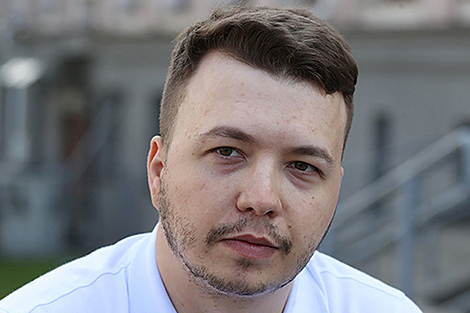
Roman Protasevich. An archive photo
MINSK, 24 December (BelTA) – Chairman of the State Security Committee of Belarus Ivan Tertel has shared details of exactly what information Roman Protasevich had managed to obtain abroad as a Belarusian intelligence operative, BelTA has learned.
One of the reporters asked a question unrelated to the KGB chief’s report to the Belarus president: “There have been many false stories about the Belarusian intelligence operator Roman Protasevich recently. You’ve been mentioned as well. You keep calm, remain silent, and don’t comment on the situation. Can’t you share some details?”
The KGB chief said: “This item on the agenda has been very seriously discussed even by our foreign colleagues in the West and by our allies. I confirm that yes, Protasevich is an employee of our foreign intelligence service. This person has worked in combat environment in the territory of a number of states. He has completed important tasks. Certainly, I cannot talk about them. The matter is unlikely to be totally revealed. It happens in our line of work. But his contribution has been sufficiently serious in a number of aspects.”
Nevertheless, Ivan Tertel shared some details. For instance, when officers of defense, security, and law enforcement agencies gathered every day in 2020 and discussed what they could expect from regular coup attempts, during such conferences the KGB chief made reports on the enemy’s plans: “Including who will go where, who will regulate, what and where they intend to do and other things. Who made the plans, who scouted out various locations, who planned clashes with police personnel and damage to certain economic objects.”
“This information contained a serious percentage of the data acquired by Protasevich. This is why our law enforcement agencies operated rather confidently in that period. They knew how the situation would unfold,” Ivan Tertel said. “Apart from that, completely thanks to his work we possessed knowledge of the dynamics of creation of these subversive centers: who was behind them, who financed them, who came there (for instance, a former Polish prime minister), what money was promised, from what fund, how many positions were allocated for the Warsaw office, which certain ‘cultural figures’ are now trying to futilely develop. It was his [Roman Protasevich’s] work.”
 print version
 make home page
 add to bookmarks