


Opinions & Interviews
Volfovich: Belarus' signature feature is security inside country
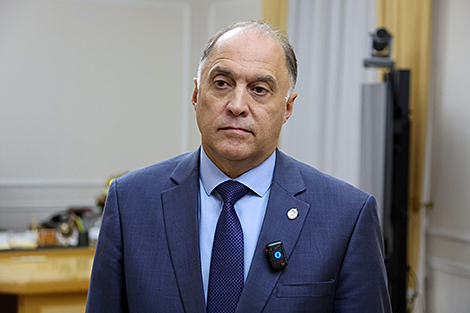
Aleksandr Volfovich. An archive photo
BREST, 20 December (BelTA) – Belarus' signature feature is security inside country, State Secretary of the Belarusian Security Council Aleksandr Volfovich said on the air of the First News TV channel, BelTA has learned.
“Security was a through line of the President's Address to the Belarusian people and Parliament. This message was likely heard not only by those in uniform but by virtually everyone. A state cannot exist without security. It cannot develop or build its future. The economy, simply put, is about creating new industries, reproducing material wealth, creating jobs, and ensuring employment for our citizens. How can any of this develop without guaranteed security? I'm not even talking about external security, but even internal security. Our nation's signature feature, I would say, on the global stage is the security that has been created within the country,” Aleksandr Volfovich said.
He pointed out that a state cannot exist by focusing solely on domestic affairs. “It is crucial to see the security challenges, the risks, not to mention the threats along our external perimeter. The current situation unfolding around our country is indeed highly volatile; as some note, it is perhaps even more dangerous than during the Cold War era. And truly, what is happening in the West today significantly impacts the security and functioning of any state, not only Belarus,” Aleksandr Volfovich noted.
He stated that the actions being taken by politicians in the West are concerning. “Firstly, they are following American directives to increase military budgets to 5% of GDP. These are enormous figures. Secondly, a new program 'Readiness 2030' has been adopted. It allocates additional funds, €800 billion, by the end of 2030 for the development of military infrastructure, the supply of new weaponry, and hardware. Currently, Europe spends about €700 billion on military needs. All of this is being invested not in agriculture, industrial development, or improving social welfare for people, but precisely in accelerating the military machinery,” he remarked.
It has gained such momentum today that it probably won’t be able to stop for the next 10 years. I’m talking about the machine that runs on war readiness. We, of course, take all this into account and see it,” Aleksandr Volfovich said.
He recalled that a Security Council meeting was held very recently, which approved Belarus’ defense plan through 2030. “The documents of this plan account for all risks, challenges, and threats in the sphere of security, and define the methods and forms, so to speak, for their neutralization both within the country and for repelling aggression, preventing any initial border conflict, and in case of an escalation in the scale of a conflictб for repelling aggression against our state. This document is structured in accordance with our National Security Concept. It is defensive in nature. The president has stated repeatedly that Belarus threatens no one and does not intend to threaten anyone. But if the flames of some conflict ignite, we will extinguish them, defend our country, our national interests, and our people with what we have,” said Aleksandr Volfovich.
The state secretary of the Security Council stressed that Belarus’ modern military-industrial complex provides for the structures of the national security system. “We have modern aircraft, helicopters, air defense systems, and missile complexes today. We have established the production of modern firearms, ammunition, and other weaponry necessary for the defense of our country,” he said.
Given the risks and challenges, Aleksandr Volfovich noted, Belarus is shaping its policy together with strategic partners. “No single country in the world today can alone withstand the existing risks, challenges, and threats. That is why we have strategic allies and partners, such as Russia and China, who support us and with whom we are building, so to speak, a shield for our country. This is why we have established a regional force grouping together with Russia. There are certain plans which, hopefully, will never need to be used. We are building, first and foremost, a line of defense aimed at strategic deterrence.”
Therefore, the president noted in his speech that we were forced to deploy tactical nuclear weapons on the territory of our country. The president also said that a new missile system, ‘Oreshnik’, has been deployed,” the state secretary added.
Speaking about Belarus’ socio-economic development program for 2026-2030 adopted at the Belarusian People’s Congress, he emphasized that it must be linked to real life. “That is why this program includes a new direction: strengthening our country’s defense capability and developing the military-industrial complex. This means, first of all, increasing the share of modern domestic models of weapons and military equipment included in the state defense order. The target is set at no less than 50%. It is a quite significant figure, but absolutely achievable. Today our defense industry already produces the types of weapons that are in service and exported. They meet all modern requirements. Therefore, 50% is a fully realistic figure. The second direction is growth in investment in the production of weapons, military and special equipment. The target is set at 130%, which is high, but calculated and established based on our capabilities, without harming the economy focused on peaceful labor and our development,” Aleksandr Volfovich said.
He recalled that Belarus has always pursued a peace-loving policy. “Look at what began in 2014 in Ukraine: our president became the initiator of efforts to resolve that conflict as it flared up. All issues must be resolved at the negotiating table, finding common ground and solutions. We say this today to our western neighbors: let us build constructive dialogue. The accusations that we pose some kind of threat are absolutely unfounded. The president said that sooner or later the people of Lithuania, Latvia, and Poland will come to their own conclusions. They see what is happening on our territory today. It is no coincidence that we extended the visa waiver program for 38 countries. Poles and Baltic people come to our country with joy today. They enjoy their stay in our health resorts, although they do suffer when they pass through the border checkpoints because of their politicians,” he concluded.
 print version
 make home page
 add to bookmarks