
Opinions & Interviews
Dodon highlights importance of Lukashenko’s heartfelt appeal to safeguard Moldovan statehood
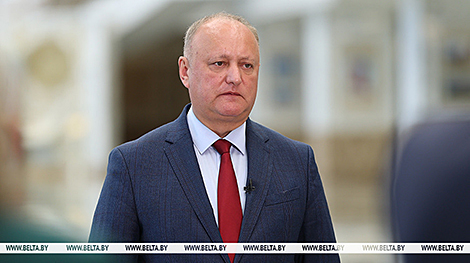
MINSK, 26 May (BelTA) – The words of Belarusian President Aleksandr Lukashenko about the need to preserve Moldova's statehood are very important, Moldovan politician and former president Igor Dodon, who currently serves as the leader of the Party of Socialists of the Republic of Moldova (PSRM), told the media following the meeting with the Belarusian leader in Minsk on 26 May, BelTA has learned.
“Lukashenko's heartfelt words about the need for Moldova to hold onto its statehood are, of course, very important,” Igor Dodon said. “I explained [during the meeting with the head of state) that the overwhelming majority of Moldovan citizens are against the liquidation of the country’s statehood.”
"The failed policy of European integration that Maia Sandu [the current president of Moldova] is pursuing leads to nothing good. Given that she can no longer run for the presidency, she is ready to blow up the situation in Moldova to suit herself,” Igor Dodon explained, emphasizing that he does not accept such a scenario for his country. “I think this will not happen. We will preserve our country. We will preserve our statehood. What our fathers and grandfathers passed down to us - an independent, sovereign Moldova, we must pass on to our children and grandchildren. I am confident that we will succeed in this,” he emphasized.
Igor Dodon also paid special attention to the importance of restoring bilateral relations between Belarus and Moldova to their previous level. Indeed, in recent years, trade between the two countries has halved, from a peak of around $260 million in 2017-2019 to $120-115 million.
“For the first time in 35 years of independence, the current Moldovan parliament, which is controlled by Maia Sandu, has refused to have a friendship group between the parliaments of Belarus and Moldova. Not once in all the years of Belarusian and Moldovan independence has there been such a situation where there was no interparliamentary friendship group,” the Moldovan politician said.
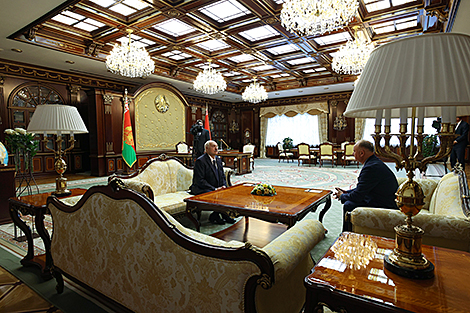
“Being the main opposition parliamentary party, we disagree with this. What does not exist at the official level, we will make up for through our interparty relations,” he continued, adding that he is currently on a visit to Belarus at the invitation of the Belarus - Rus party, including to participate in a conference on multipolarity and diversity in the 21st century, which will take place in Brest.
“To all our Belarusian friends and brothers, I thank you very much for your support. Come to Moldova. It’s not easy right now, but we will manage. We were friends, we planted corn with your president, we made mamaliga… I believe we will bring those times back in the near future," noted Igor Dodon.
As BelTA has reported, during his meeting with Igor Dodon the Belarusian president called for preventing the loss of Moldova’s sovereignty and independence. “Recently, we’ve been hearing from all sorts of sources that Moldova is practically ready to become part of another state. I’ll be straightforward with you: as a person who is completely enamored with your country (and you know this perfectly well) when I hear these things and I'm absolutely horrified,” the Belarusian leader said. "I would strongly ask both you and your supporters not to allow the destruction of such a flourishing, beautiful country as Moldova, even if it is small in size.”
The head of state recalled his impressions from 2018, when during a visit to Moldova he and President Igor Dodon planted corn in a field not far from Chișinău: “It was on some kind of hill. And the image before my eyes: from there I looked out at Chișinău, and the city was completely enveloped in orchards. Everything around was in bloom, everything was blossoming, the whole city white.”
“So I find myself thinking: how can anyone give away such beauty and such a hardworking people, the Moldovans, who could move mountains to someone else or incorporate it into some other state? Therefore, I believe that for you as a patriot and for your supporters, the main thing is to preserve Moldova for the Moldovans,” the head of state said. “We understand this. No one needs us anywhere. Experience has already shown us (I don't want to name countries). It has shown us how we are treated.”
 print version
 make home page
 add to bookmarks