



Press releases
Where walls speak and stones remember: Brest Hero Fortress memorial complex turns 55
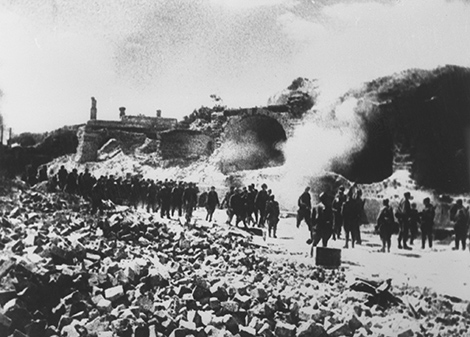 Soviet troops at the Brest Fortress, 1944
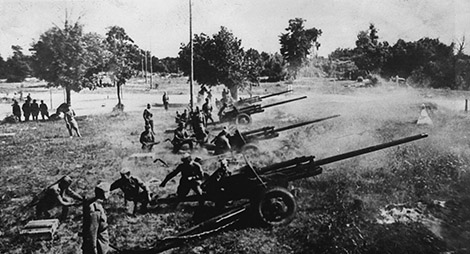 The battles for Brest, 1944
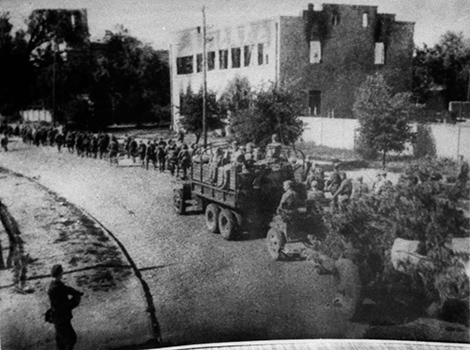 In liberated Brest, 1944
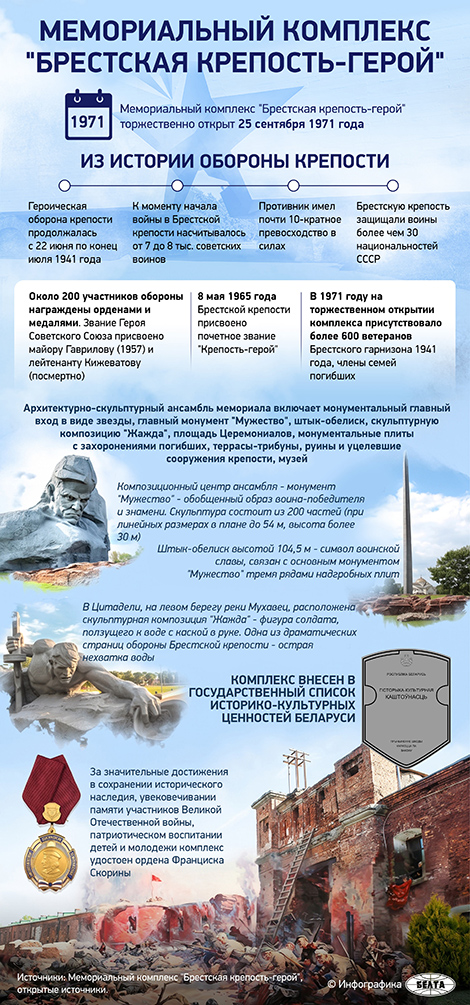
The grand opening of the complex took place on 25 September 1971. It was attended by more than 600 veterans of the 1941 Brest garrison, including the defenders of the fortress and family members of the fallen. On the same day, the Eternal Flame was lit.
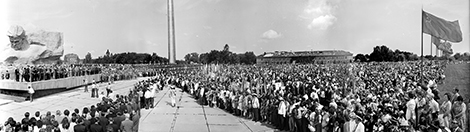 The Brest Hero Fortress memorial complex immortalizes the feat of its defenders during the heroic defense in June-July 1941. In the opening hours of the war, the garrison was cut off from the main forces of the Red Army but put up fierce resistance against overwhelming enemy numbers. The defense lasted for about a month under conditions of complete encirclement and a severe shortage of ammunition, food, and water. The fortitude of the fortress’ defenders became one of the first symbols of the future Victory.
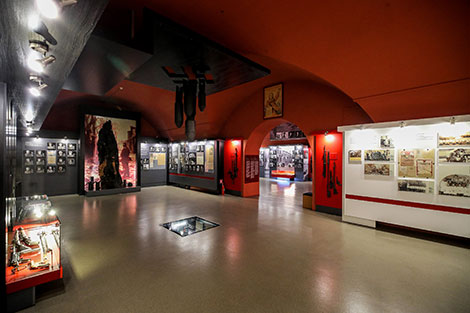
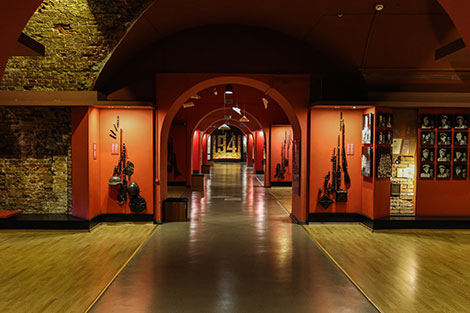
The memorial complex is one of the most recognizable and visited tourist attractions in Belarus. Having been built as a military installation and survived the fires of two world wars, the fortress remains a place of memory and peace today. The unified ensemble brings together battle sites, ruins, surviving defensive structures, sculptural compositions, and museum exhibitions. Currently, the Brest Hero Fortress memorial complex and its fortification system are included in the State List of Historical and Cultural Values of Belarus.
Over the years, the legendary citadel on the Bug River has welcomed representatives from every continent except Antarctica. In 2026, the Brest Fortress hosted visitors from around 40 nations, welcoming its 29-millionth visitor on 4 September. For decades, the Brest Fortress has remained a magnet for all who cherish the memory of the defenders of the Fatherland.
The memorial complex was created by a creative team led by People’s Artist of the USSR, sculptor Aleksandr Kibalnikov. Construction began on 8 May 1968. In parallel, large-scale work was carried out to preserve the surviving ruins of defensive structures, barracks, and other buildings, which subsequently became an integral part of the memorial.
Each compositional element of the architectural and artistic ensemble carries profound symbolic meaning and delivers a powerful emotional impact.
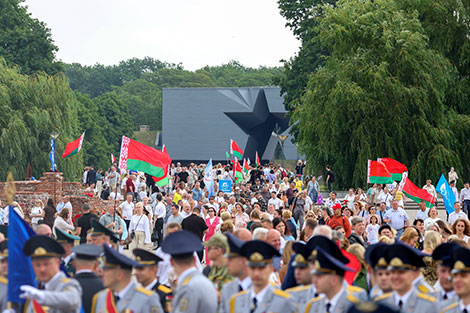
 The main entrance to the Brest Fortress is a monumental arch shaped like a massive five-pointed star carved into a concrete block. The structure is supported by the slope of the fortress rampart. The walls of the passageway are lined with polished dark granite, contrasting with the ruins of the casemates exposed in the opening. This architectural design is intended to create a deep visual, emotional, and psychological effect on everyone who crosses the threshold of the citadel.
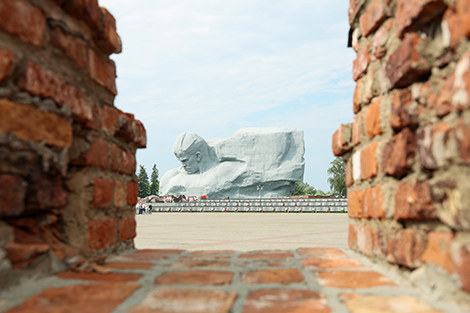
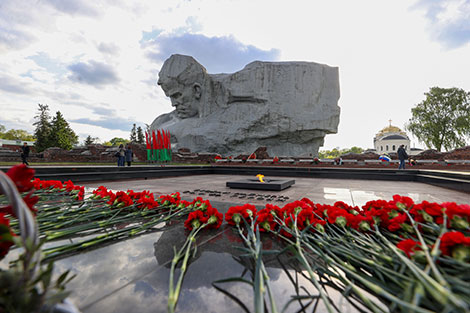
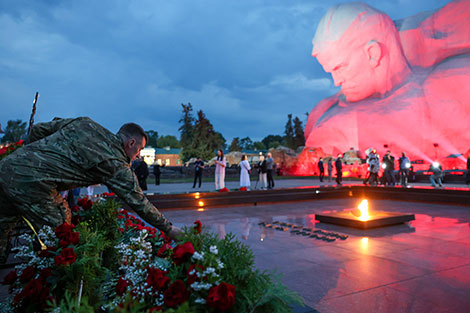
The compositional center of the ensemble is the Courage monument, a generalized image of a warrior-conqueror and a banner. It is a sculpture of enormous size, consisting of 200 parts. The bayonet obelisk, 104.5 meters high, is visible from any point in the fortress and is linked to the main Courage monument by three rows of gravestones. On the rear side of the monument are bas-reliefs depicting episodes of the defense of the fortress in 1941.
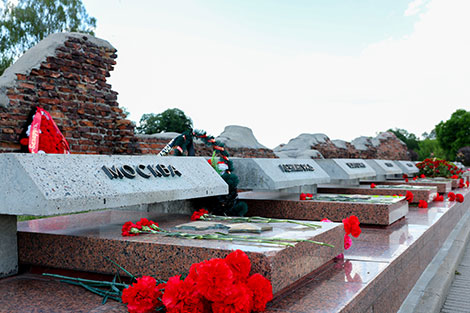
Near the ruins of the former Engineering Directorate, the Eternal Flame burns. Not far from it is the memorial site of the hero-cities of the Soviet Union. Under granite slabs bearing the image of the Gold Star medal, capsules containing soil from the hero-cities have been placed.
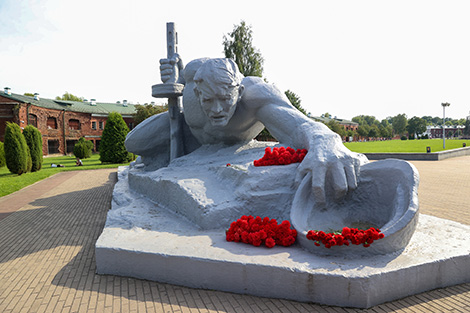
On the left bank of the Mukhavets river branch is the sculptural composition Thirst - the figure of a Soviet soldier who, leaning on a machine gun with a helmet in his hand, crawls towards the water. One of the most dramatic pages in the history of the defense of the citadel was the catastrophic shortage of water. The water supply was put out of action on the first day of the war, and the abnormally hot summer of 1941, the suffocating clouds of smoke and the gunpowder fumes only worsened the defenders’ situation. The approaches to the water were under fire, and at night the banks were illuminated by searchlights. Many soldiers and commanders died trying to obtain the precious drops. After the war, pierced helmets, flasks, mugs and the remains of the dead were found on the riverbanks. The creators of the memorial, knowing of this tragedy, decided to tell of it in the language of sculpture.
In the eastern part of the citadel, to the south-east of the defense museum, fragments of one of the last stone buildings of old Brest-Litovsk have survived, in places destroyed down to the level of the foundation. Nearby is the Ceremonial Square with a three-tiered necropolis, where the remains of soldiers, Red Army commanders and members of their families are buried.
On 22 June 2011, the sculptural composition To the Heroes of the Border, to the Women and Children Who Stepped into Immortality through Their Courage was solemnly unveiled. The sculpture stands by the Terespol Gate, where border guards commanded by Lieutenant Andrei Kizhevatov, head of the 9th border outpost, fought to the death.
In January 2021, the memorial’s staff were honored with a laureate diploma for a special presidential award for cultural and art workers, for their major contribution to keeping alive the historical truth about the Great Patriotic War and to carrying out the Union State project Major Repair, Restoration and Museumification of the Structures of the Brest Fortress in the Brest Hero Fortress Memorial Complex” (2018-2020). In September that year, the Brest Hero Fortress memorial complex was decorated with the Order of Francysk Skaryna.
The feat of the defenders of the legendary citadel is not subject to time. Today, as more than half a century ago, the memorial continues to fulfil its sacred mission - to stand confidently and firmly on guard of the truth about the Great Patriotic War, passing the banner of memory on to future generations. The atmosphere of this place has become an eternal reminder of the price of peace, a lesson that humanity is obliged to remember always.
 print version
 make home page
 add to bookmarks