




Press releases
Unearthing secrets of Ruzhany Palace: Archaeologists make stunning finds
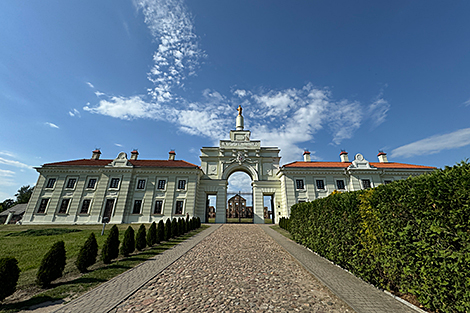
The majestic Ruzhany Palace complex is gradually being brought back to life. Just a few decades ago, the former residence of the Sapieha family lay in ruins. Today, the site is often referred to as the Belarusian Versailles. Visitors can admire the restored central entrance gates and explore the museum in the side wings. Soon, the Eastern Wing will open its doors to tourists, featuring an atmospheric cultural space, a small hotel, and a cafй. But that’s not all! Restorers are now working their magic on the main palace building, while archaeologists are making sensational discoveries. From beneath centuries-old debris, they have unearthed what was long considered lost forever. The towers from the early 17th century and cellar entrances have seen the light of day once again, and artifacts belonging to the estate’s former owners have been found. BelTA correspondents visited the excavation site.
Once upon a time, Ruzhany was a hub of social life and political decision-making. Today, tourists come here for quiet aesthetic pleasure. Olga Pleshko and her daughter made a stop on their way to Grodno and dropped in at the palace complex. “It’s a culture shock! I was here about 20 years ago - it was just ruins. The contrast between what I saw then and now is enormous. We walked in, and it took our breath away. My daughter is 13 and a half. She said to me: ‘Just imagine, this is all our Belarus’. I didn’t expect such delight from a teenager. I’m amazed myself. You look at the old brick and the restored parts – it’s like a junction of times, past and present,” the tourist shared.
According to her, the spirit of history lingers within the palace complex. “I’m a firm believer in continuing to revive our cultural heritage in Belarus. I’ve traveled a lot, but I haven’t felt this much beauty in a long time. The only things that impressed me more were the mountains the first time I saw them, and the sea,” Olga assured.
Tourists stroll leisurely around the grounds, taking in the antiquities. They watch with interest as restorers carry out their meticulous work. But they see only the external efforts, unaware that just a few meters away, archaeologists are encountering astonishing finds.
To understand the significance, we must turn to the past. The Ruzhany residence belonged to the Sapieha family from the late 16th century. From here, active political, social, and cultural activities were conducted well into the 18th century. Take, for instance, Leu Sapieha, who made a tremendous contribution to the development of diplomacy and the formation and unification of Belarusian jurisprudence. The owners initially built a defensive castle, which was later rebuilt into a palace, drastically changing its appearance.
“We know that the estate was purchased at the end of the 16th century. So there must have been some buildings and infrastructure. Archaeology must provide answers: we need to trace the topography - where everything was located on the estate. We are doing this as part of archaeological monitoring. During restoration and conservation work, earthworks are carried out, and we track the process. As a result, in 2025 we uncovered the original core of the residence, slightly to the east of the main building. We already have a plan, but we need a full-scale archaeological study. We’ve put that off for now because the focus has shifted to the central and eastern wings,” explained Aleksandr Bashkov, Doctor of Historical Sciences and Professor at the Department of Belarusian History and Special Historical Disciplines at Pushkin Brest State University.
Inside the restored Eastern Wing, archaeologists worked last year. They studied the area of the room that once housed a theater. “We uncovered part of the load-bearing structure - the colonnade that supported the theater loggias. This was important for understanding what ruins exist inside the wing. The designers will need to take this into account when preparing project documentation for the interior work,” the scholar said.
At the end of 2025, restorers began conservation work on the main building. Its fate has been unfortunate. In the early 20th century, a major fire broke out, causing wooden floors to collapse and part of the vaults to cave in. Only the walls remained standing. Now the debris is being cleared, and the excavated soil is being sifted by archaeologists for artifacts. When structures are uncovered, they are documented and measured to provide designers with an accurate plan for further work. And here lies the greatest mystery. Originally, the central building looked different - it had three towers. The northeastern and southern towers were destroyed during the castle’s reconstruction, while the western tower was incorporated into the central building.
Archaeologists have taken up the search for the two lost towers. Moreover, the location of the northeastern one was previously known. “In the late 1980s and 1990s, there was an idea to restore the complex. Archaeologists conducted an initial survey of the tower’s remains and concluded that further excavations were necessary. But the year was 1992, and for obvious reasons, it was not a priority. Unfortunately, time has gradually erased all traces of the tower,” Aleksandr Bashkov said.
Specialists from the Institute of History of the National Academy of Sciences of Belarus (NASB), along with history lecturers and students from Pushkin Brest State University, took up the task. “The work was difficult to start, especially in the first few days when we were just clearing the compacted soil. We worked with crowbars and shovels. It was tough because you don’t work with such tools every day. There was no frantic rush to dig something up as fast as possible. We moved calmly, without rushing anywhere, and reached an incredibly cool find. You probably won’t see anything like it in many places. It’s so emotional that I personally took part in the excavations, carrying buckets up and pushing wheelbarrows. I value this on the highest possible scale,” student Bogdan Yarets said.
The archaeologists carefully used shovels and crowbars to remove the soil layer. Then, trowels, brushes, and specialized air blowers came into play. Another essential tool was a metal detector.
“The northeastern tower is unique, it’s five-sided. We went deep, down about three-plus meters. Everything is authentic, the original 17th-century brickwork. The walls are up to 90 cm thick. We uncovered intact structures: the remains of a vault and stairs, and a passage to the cellars. When you dig, you begin to understand the architectural design. No one really knows what it looked like. Our task is to reveal all the nuances, to show the designers and restorers all the structural elements. Based on this, they will make decisions on how to preserve it, remove any hazardous sections, build on, or reinforce it,” the historian highlighted.
According to him, experts suspected the existence of the entrance to the cellars. However, no one had any idea whether it had survived, what it might look like, or what its dimensions were. After all, it could have been destroyed. But then came a surprise – it was in pristine condition. After clearing, you can actually walk through the cellars. The office of Lew Sapieha was located on the second floor of the northeastern tower.
From documents, experts also knew about the southern tower, but there were no visible traces of it either. Once again, a happy coincidence changed everything. “The restorers were working and stumbled upon it. They were lowering the ground level and caught some brickwork. Since we conduct architectural supervision, we suggested checking out what was there. We thought it might be just some random fragment. But when we cleared it a bit, it turned out to be excellent masonry, which gave us every reason to say that the remains of the tower are here too,” Aleksandr Bashkov said.
Thanks to the excavations, a square tower with walls up to 2 meters thick was brought to light. Previously, there was a chapel on its second floor. Archaeologists have dug down about 2.5 meters, and work there is still ongoing. “There was a bit of intrigue. We expected to see a passage in the southern wall of the main building, but it is walled up. It’s unclear whether it was planned and then they changed their minds and blocked it, or if it functioned for some time and was walled up only after that. We cannot answer this question yet. You can tell by the brickwork that it’s all 17th century,” the archaeologist explained.
During the excavations, an impressive collection of artifacts was gathered. Among the finds are coins, fragments of an elegant cast lamp or candelabra, ceramic tableware, and structural ceramics (predominantly stove tiles). “Splendid specimens from the 17th to 19th centuries. Monochrome and polychrome, there are even fragments of heraldic stove tiles with the Sapieha coat of arms,” the professor said. The objects are carefully collected, and each one is documented. In the future, the collection will be transferred to a museum.
The main building of the Ruzhany Palace will likely become a museum. To achieve this, specialists need to understand how to adapt it for tourist needs in order to conduct full-scale guided tours. Following the archaeological excavations of the two towers, the restoration and conservation project will be adjusted. Tourists will then be able to see not only the 18th-century architecture but also the original foundation and layout of the Sapieha Castle.
Restoration work will continue under archaeological supervision. Who knows what else the ruins of the ancient castle are hiding, and whether they will reveal their secrets.
Alevtina Chernovolova,
BelTA
 print version
 make home page
 add to bookmarks