



Press releases
Tracing roots of Slavs: Historian explains three theories
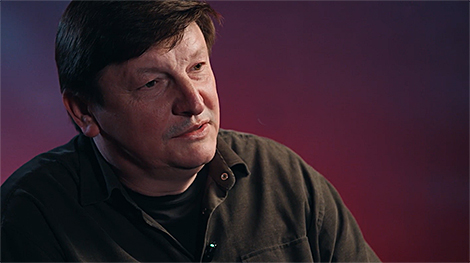
Igor Marzalyuk. Screengrab/BelTA
MINSK, 3 June (BelTA) – Chairman of the Commission on Education, Culture and Science of the House of Representatives of the National Assembly of Belarus Igor Marzalyuk spoke about where to look for the origins of the Slavs and the most ancient part of the Slavic homeland in BelTA’s project True History. Lectures by Igor Marzalyuk.
“The most ancient Slavic archaeological sites on earth are Belarusian,” Igor Marzalyuk said. The historian noted that the fact that Belarusians are a Slavic people is indisputable: “Therefore, the appearance of the Slavic community on earth is the most important starting point of our protohistory, and later of our early history. There are several theories: the Danube, the Vistula-Oder, and the Pripyat-Dnieper theories. According to one, the Slavs once lived on the Danube and then scattered across Europe. According to the Vistula-Oder theory, which was very popular, especially in Polish academia in the 1930s-1950s and later, the most ancient part of the Slavic homeland – and therefore the most ancient Slavs – are the Poles. The Vistula-Oder theory had many supporters, including among archaeologists, linguists, and historians across the Soviet Union,” Igor Marzalyuk noted.
The historian explained that the third, Pripyat-Dnieper theory has very ancient roots. “The renowned Czech Slavic scholar Lubor Niederle was the first to emphasize this. He believed that the origins of the Slavs and the oldest part of the ancestral Slavic homeland should be sought precisely in southern Belarus and northern Ukraine, as that was the location of the most ancient Slavic antiquities. In the 20th century, the brilliant Polish scholar Kazimierz Moszyński provided numerous arguments in favor of Belarusian Polesie and the Belarusian Dnieper region. This position is also shared by the academic circle in Krakow, including the late, world-famous Polish archaeologist Kazimierz Godłowski, among others,” Igor Marzalyuk noted.
“Why? Because it is Polesie that represents the most ancient relict of Slavic culture. This is the so-called ‘zone of Slavic purity,’ where the primary toponyms and hydronyms are entirely Slavic. This refers to Belarusian-Ukrainian Polesie. Speaking of Belarus, this includes Brest Oblast, Gomel Oblast, southern Minsk Oblast, and the southeast of Mogilev Oblast,” the historian stated. “This correlates exceptionally well with archaeological data, because, without a doubt, the oldest sites of the Prague-Korchak culture are located precisely in this area. Brest Oblast, Gomel Oblast, southern Minsk Oblast, and southeastern Mogilev Oblast fall exactly within the distribution zone of the earliest sites of the most indisputable Slavic culture – the Prague culture.”
 print version
 make home page
 add to bookmarks