



Press releases
Symbol of immortality. Ahead of 60th anniversary of Mound of Glory Memorial’s groundbreaking
An archive photo
This year marks the 60th anniversary of the groundbreaking ceremony of the memorial complex “Mound of glory of the Soviet Army – the liberator of Belarus”, built to honor the feat of the soldiers who took part in Operation Bagration, the codename for the operation to liberate Belarus from the Nazi invaders. This man-made mound, containing soil from hero cities, has become a tangible embodiment of victory, independence and the unbreakable bond between generations. Everyone who climbs to its summit remembers the tremendous price paid for peaceful skies over our country. Six decades later, this sacred place for every Belarusian remains a symbol of national pride, bringing together the past, present and future of the Belarusian people.
A nationwide cause. Construction of the “Mound of glory of the Soviet Army – the liberator of Belarus” memorial complex
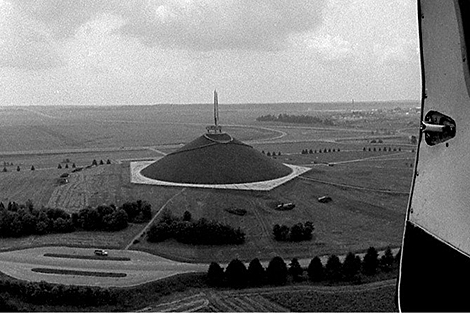
The majestic man-made Mound of Glory was built at the 21st km of the Minsk-Moscow highway. It was here that a 150,000-strong grouping of Hitler’s troops was encircled during Operation Bagration in July 1944 – an event that became known as the Minsk Pocket.
The decision to build the Mound of Glory memorial was made on 18 August 1966. When designing the memorial complex, its creators – the sculptors Andrei Bembel and Anatoly Artimovich, the architects Oleg Stakhovich and Lev Mitskevich, and the engineer Valery Laptsevich – sought austere and strict simplicity. The majestic Mound of Glory blends harmoniously into the surrounding landscape, is clearly visible from afar and from all four roads at which intersection it stands.
The memorial complex was laid on 30 September 1966 by representatives of the hero cities of Moscow, Leningrad, Volgograd, Sevastopol, Odessa and Kiev as well as Brest Fortress. Workers, students and military personnel from Minsk and Minsk Oblast took part in the event. The first handful of soil was laid at the foot of the future Mound of Glory.
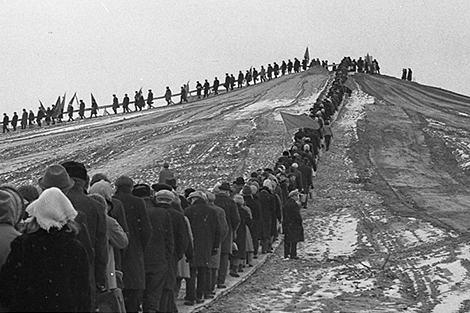
The construction of the Mound of Glory became a people’s cause. Thousands of people considered it their duty to contribute to this effort. People from all corners of the Soviet Union tried to bring some soil in memory of those who gave their lives for peaceful skies. Soil was brought here from Belarusian cities and villages, the hero cities of Moscow, Leningrad, Volgograd, Sevastopol, Odessa and Kiev, the legendary Brest Fortress and other memorable places associated with the heroic deeds of Soviet people during the Great Patriotic War of 1941-1945.
Film and photographic newsreel footage shot at the time conveys the unprecedented zeal and enthusiasm, with which people came to the construction site of the Mound of Glory to lay, handful by handful, the soil they had brought with them. Huge lines of people wishing to take part in creating this majestic, truly man-made monument formed. Only after the pilgrimage of those wishing to add a handful of soil had ended did excavators and trucks start working here.
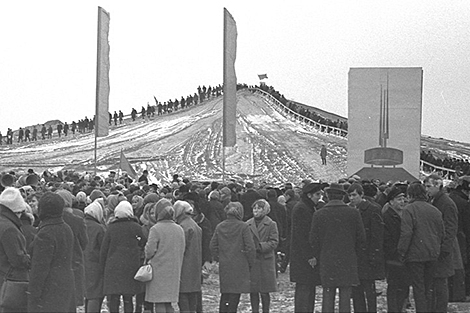
The monument was solemnly unveiled on 5 July 1969 during celebrations marking the 25th anniversary of Belarus’ liberation from the Nazi invaders.
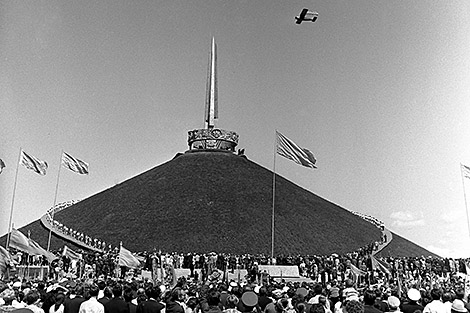
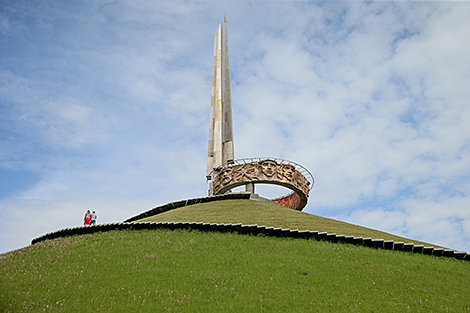
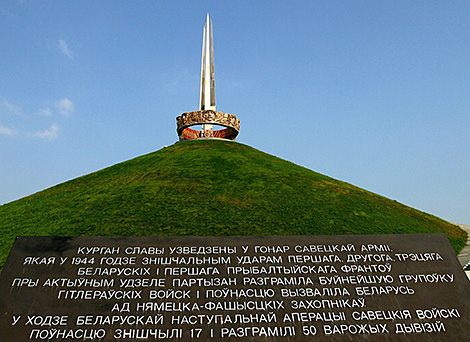
The memorial is 70.6m high in total. A 35m-high earthen mound is crowned by a sculptural composition of four bayonets, each 35.6m high. The bayonets symbolize the fronts that took part in the liberation of Belarus: the 1st, 2nd and 3rd Belarusian Fronts and the 1st Baltic Front.
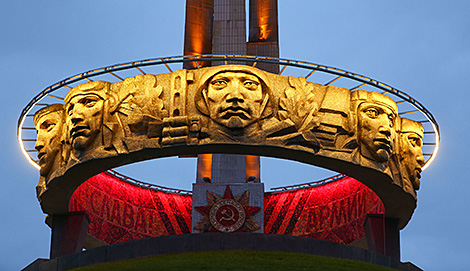
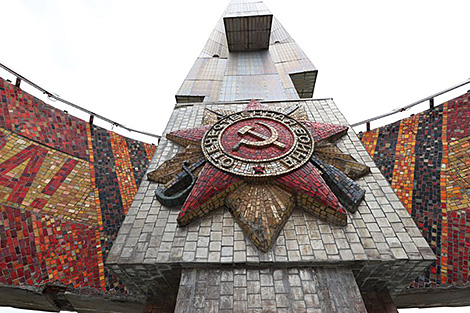
A broad stone ring surrounds the foundation of the obelisks. Inside it is a mosaic inscription “Glory to the Soviet Army, the Liberator Army!” and mosaic images of the Orders of the Patriotic War and of Glory. The outer surface of the ring features bas-reliefs of faces symbolizing generalized images of defenders of the Motherland (a young female partisan, an old partisan, a pilot, a sailor, a tanker, and young and old infantrymen) covered with gold enamel.
Two staircases, each with 241 steps, encircle the Mound and lead to an observation platform at its summit. Each step is secured separately.
At the foot stands a granite memorial plaque bearing the inscription in Belarusian: “At the Mound of Glory, handful by handful, soil was laid from hero cities and other sites of fierce battles, from cities and villages that forever glorified themselves through military and labor feats for the freedom and independence of the Soviet Motherland.”
To ensure the stability of the structure during construction, a pile foundation extending 30m into the ground was laid. These measures were taken to prevent landslides.
Reconstructions of the Mound of Glory memorial complex
The Mound of Glory has undergone reconstruction several times since its opening.
In May 2003, the republican committee in charge of organizing preparations to celebrate the 60th anniversary of Belarus’ liberation from the Nazi invaders decided to carry out a large-scale reconstruction of the Mound of Glory.
During the first stage of the reconstruction the surrounding area was improved, administrative buildings and utility networks were repaired, and a new irrigation system was installed. During the second stage the upper decorative ring was restored, the steps were repaired and a military hardware museum was established.
In spring 2004, a park named after the 60th anniversary of the Victory in the Great Patriotic War was laid out on the complex grounds.
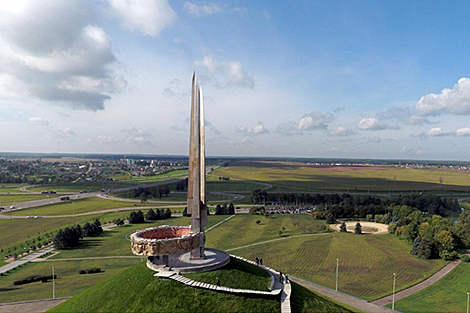
The restored Mound of Glory was solemnly reopened on 1 July 2004 in the presence of numerous guests who had arrived for celebrations marking the 60th anniversary of the liberation of Belarus. Belarus President Aleksandr Lukashenko and the leaders of Russia and Ukraine laid flowers at the foot of the memorial and honored the memory of those who died during the Great Patriotic War.
In May 2015, ahead of the 70th anniversary of the Great Victory, the grass covering the slopes of the Mound was completely replaced. An anti-mole mesh was laid under the turf to help it retain its proper appearance for longer. The worn steps of the staircases underwent major repairs and reconstruction. The bas-reliefs of Soviet soldiers and partisans and the inscription “Glory to the Soviet Army, the Liberator Army!” on the inner part of the decorative ring were restored.
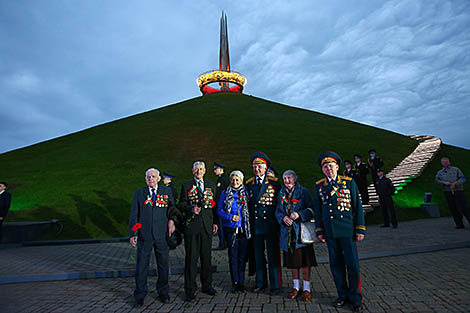
A new lighting system was installed at the Mound of Glory. The bas-relief on the observation platform was also illuminated in amber to emphasize its natural bronze glow. Inside the ring, the mosaic was given a ruby background, as if the Eternal Flame were burning on the observation platform.
The reconstruction was carried out by the Federation of Trade Unions of Belarus. The organization has patronized the Mound of Glory memorial complex since 2004. For implementing a number of large-scale projects, including the reconstruction of the Mound of Glory, the Federation of Trade Unions of Belarus received the highest award – the For Spiritual Revival Prize of the President of the Republic of Belarus.
Ahead of the celebration of the 71st anniversary of the end of the Great Patriotic War, a cascade of solar panels was installed near the memorial. Photovoltaic elements make it possible to illuminate the monument continuously in the evening and at night.
In 2017-2018, information stands were installed here about the greatest offensive operation of the Great Patriotic War, Operation Bagration, and the military commanders who led the offensive. The information comes from archival documents, people’s recollections and academic studies. Thus, every visitor to the memorial complex can learn the historical truth of those events in greater detail.
In 2023, the third reconstruction began, with the work planned to span several years. During the reconstruction the central staircase leading to the pedestal for laying flowers underwent major repairs, a pedestal for laying flowers was built and the surrounding area was improved. The fountain and water storage tanks for the automatic irrigation system were reconstructed, the staircase leading up to the Mound of Glory was repaired and the stele was restored. The reconstruction also covered utility networks and the parking area, administrative and utility facilities, and outdoor lighting networks. Multimedia screens capable of broadcasting exclusive video materials in three languages were installed on the memorial complex grounds.
In 2025, a new park shaped like the wings of a stork – a symbol of peace – was laid out at the Mound of Glory during a nationwide voluntary work day.
Open-air museum
In June 2004, an open-air museum displaying military equipment from the Great Patriotic War was established on the grounds of the Mound of Glory memorial complex at the initiative and with the support of the Federation of Trade Unions of Belarus. Its exhibits include heavy Soviet tanks, including the IS-2, the most powerful and most heavily armored mass-produced vehicle of the Great Patriotic War and a fairly rare one today.
The site also houses the ISU-152 self-propelled artillery gun, the postwar T-10, and artillery guns produced in different years – the 1941 ZiS-2 anti-tank gun, the 1942 ZiS-3 and the 1944 D-44 divisional gun.
One of the last T-34 tanks in Belarus was found for the memorial complex museum in the military training area Polessky where the tank had been used as a training target. After restoration, the legendary T-34 took its place among the museum exhibits.
In 2009, the Alley of Heroes of Minsk Oblast was laid out on the memorial complex grounds. The initiative was launched by Great Patriotic War veterans. It was officially opened in May 2010.
In August 2019, the military equipment exhibition at the Mound of Glory was expanded with the legendary IL-2 armored ground-attack aircraft, which the Nazis called the Black Death. In June 2020, a Katyusha combat vehicle was added to the open-air museum. The legendary artillery system played a key role in the fighting in the territory of our country during the war.
In 2024, ahead of the 80th anniversary of the liberation of Belarus, one of the museum’s most notable exhibits was added – the Em-728-58 steam locomotive, built in 1933. In 2025 the exhibition was expanded with an armored reconnaissance and patrol vehicle, a tracked tractor, an anti-aircraft gun and other exhibits. In 2026, T-72A and T-64 tanks and infantry fighting vehicles were added to the museum.
Steps of memory through time
Today the Mound of Glory is part of the WW2 memorial complex Khatyn and is included in the State List of Historical and Cultural Values of the Republic of Belarus.
Every year solemn events, military oath-taking ceremonies, veteran tributes and the starts of motor rallies to sites of military glory and other events are held at the monument. The Mound of Glory is also popular with newlyweds from Minsk, who have made it a tradition to lay flowers there on their wedding day. Over the course of existence of the Mound of Glory memorial complex about 40 million people from more than 100 countries have visited it.
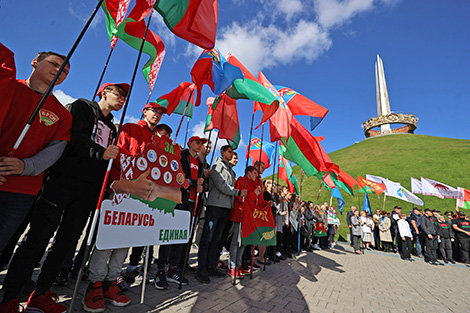
Holding nationwide voluntary work days on the memorial complex grounds has become a good tradition. In 2021, during one of them, a project to study unknown pages of military operations was launched at the memorial.
The memorial grounds host thematic “Exhibitions at the Mound of Glory” – a large-scale regional project that is widely popular with residents of central Belarus and tourists.
On Victory Day and Independence Day, the memorial complex traditionally becomes Minsk Oblast’s main venue for celebrations.
The Mound of Glory is 482 steps of memory of the most terrible war in human history and the heroism of our people. Every step on these stairs is a tribute to the great feat of the liberators. Time has no power over this man-made giant. The memorial complex reminds us of the importance of being patriots of our Motherland and the need to preserve historical truth.
 print version
 make home page
 add to bookmarks