




Press releases
Researchers establish timeline of Slavic settlement on Menka River near Minsk
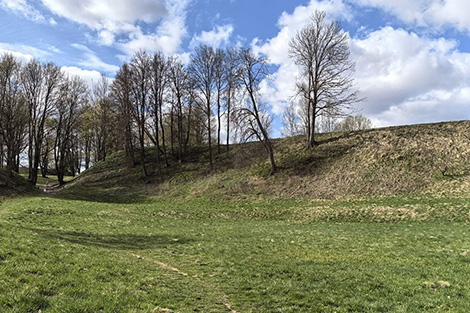
MINSK, 11 August (BelTA) - Archaeologists have established new facts during the excavations on the Menka River, Andrei Voitekhovich, Head of the Department of Medieval and Modern Archaeology at the Institute of History of the National Academy of Sciences of Belarus, said at a press conference, BelTA has learned.
In 2023-2025 archeologists conducted large-scale excavations on the Menka River in the village of Gorodishche, 10km away from Minsk. The research showed that this complex was an ancient Rus’ town. “In 2026, smaller-scale, targeted work was carried out on certain sites that still raise questions. The research was conducted on the grounds of the small hillfort, one of the earliest sites of the complex. In the ancient Rus' period, it housed a detinets, the most fortified, main part of the town. Small excavations were carried out over an area of 20 square meters. We found the earliest materials of the Prague culture Slavs.
Previously, it was believed that the Slavs came to this land from the south not earlier than the 9th century. Now we have proven that it was around the 7th century. Pottery, several ornaments and a spindle whorl were found. Let me emphasize once again; this is indeed one of the early Slavic complexes,” Andrei Voitekhovich said.
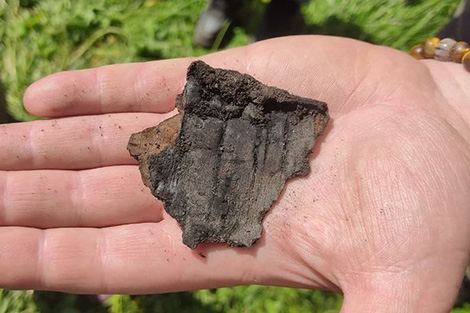
Traces of a powerful fire that occurred in the 11th century were also found. “Based on the materials and pottery, this happened somewhere in the mid-11th century. The most interesting thing is that fragments of wooden utensils were found in the burned log structure. They were preserved precisely because they had been exposed to fire and became charred. This is the first time we have had such a find of a wooden artifact at this site. Wood does not survive here, nor does other organic matter, due to the acidity of the soil. We also found arrowheads, a spearhead, and women’s jewelry dating to the time of the fire,” the scientist noted.
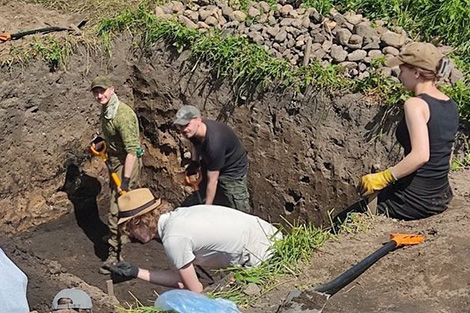
“Another very interesting discovery. It was believed that the town on the Menka ceased to exist in the early 12th century. But it turned out that that the small hillfort housed a modest feudal homestead that continued to operate throughout the 12th, 13th, and 14th centuries as a minor feudal manor. In the 14th century, this manor gradually evolved into an extensive estate compound,” Andrei Voitekhovich added.
According to him, archaeologists plan to conduct small-scale work next year to clarify certain details. Large-scale excavations on the Menka River are no longer required.
 print version
 make home page
 add to bookmarks