




Press releases
Historic coins discovered at Bernardine convent ruins in Brest
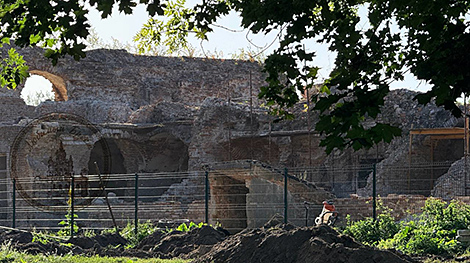
BREST, 9 September (BelTA) – Conservation efforts at the ruins of Brest’s Bernardine convent have yielded a massive collection of valuable historical artifacts, BelTA learned from the Brest City Executive Committee.
The ruins of the Bernardine convent are located on the territory of the Volyn fortification of the Brest Fortress. Restorers have been working on conserving the ruins since late spring 2026. The project, in particular, involves reinforcing the ceilings and foundations, as well as restoring the walls and floors. Workers frequently come across various artifacts. During archaeological monitoring, a large amount of material related to the medieval and early modern history of Brest was collected.
“In particular, fragments of pottery, specifically, stove tiles, as well as various small finds have been discovered. Among them, the coins are certainly of great interest. The coins are the real highlight here, especially the 1660s copper pieces known as boratynki. They were minted at the Brest Mint, which, according to archival documents, we can confidently say was located within the grounds of the Bernardine men’s monastery. We do not rule out that these specific coins originated from our local mint,” Doctor of Historical Sciences and Professor at the Department of the Belarusian History and Special Historical Disciplines at Pushkin Brest State University Aleksandr Bashkov said.
Other historical discoveries have also been made. Scientists expect that they will allow for a more detailed study of the area and will provide a strong foundation for further archaeological work at the Volyn fortification of the Brest Fortress.
For example, in one of the ground-floor rooms, restorers stumbled upon glass flasks, bottles, and ampoules filled with a clear liquid. They were handed over for analysis to chemical experts at the Brest Oblast branch of the State Forensic Examination Committee. About a thousand different containers were submitted for research. Specialists determined the composition of the liquids, which turned out to be codeine, morphine, and barbital used for medical purposes, as well as camphor, phenol, and caffeine. During a ballistic examination, forensic experts also inspected recovered Soviet and German ammunition, concluding that they are unfit for firing.
All artifacts discovered in the ruins of the Bernardine convent are currently being collected. There are plans to create a museum there in the future.
The Bernardine convent complex was founded in the region in the 17th century. Over different periods, the historic buildings were adapted for various needs. The site has been left unused since the early 1990s.
 print version
 make home page
 add to bookmarks