



Press releases
Historian’s view of how and why Kolochin culture perished
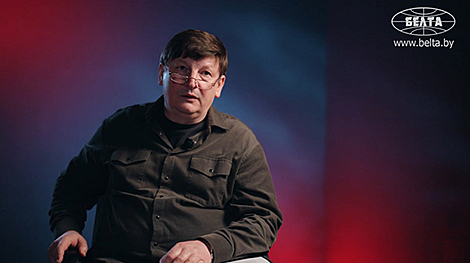
MINSK, 25 May (BelTA) – In the latest episode of BelTA’s project True History. Lectures by Igor Marzalyuk, Chairman of the Standing Commission on Education, Culture and Science of the House of Representatives Igor Marzalyuk spoke about the reasons why the Kolochin culture perished.
The Nikodimovo hillfort, now in Gorki District of Mogilev Oblast, according to Igor Marzalyuk, is a unique archaeological monument, one of the most ancient centers of power on the territory of Belarus, dating back to the 5th–7th centuries. “The settlement perished as a result of a fire, as evidenced by the remains of burned logs,” the historian said.
“The arrowheads found during the excavations are not typical for local warriors. These are trilobate socketed arrowheads characteristic of nomadic, more southern cultures. Scholars take different views as to who destroyed these cultures. There was mass deposition of Antian hoards in the territory from the present Ukraine to the Upper Dnieper region of Belarus in the 7th century, including the famous Gaponovo hoard.
During this time, all these similar cultures, those of the Antian circle, undoubtedly connected by a unity of material and spiritual culture, perished in the flames of fires. Some interpret this as an attack by the Khazars on this territory; others believe it was a clash with relatives, brother Slavs. But as in Nikodimovo, so too in all the other destroyed settlements of these cultures, Avar arrowheads typical of nomads have been found," Igor Marzalyuk stated.
He noted that the majority of researchers today consider the invasion of warlike nomads to be the primary cause that led to the demise of these cultures.
“The fact is that the cause for the destruction of these cultures, according to a number of historians, may have been the refusal by the Antes to take part in joint campaigns against the Eastern Roman Empire, against Byzantium. This happened in early 7th century. And then the Antes disappear from the pages of ancient sources. Only the Sclaveni, the Slavs, remain,” Igor Marzalyuk said. “The Prague-Korchak culture Slavic tribes decided to continue participating in these military campaigns. But the Antian archons [the elders in ancient sources] who had received rich gifts from Constantinople, refused, as evidenced by sparse accounts including from the year 607 AD. This most likely served as the cause of an entire chain of punitive campaigns in the 7th century, which ultimately destroyed these cultures.”
“But this does not mean that they all perished and disappeared without a trace, although in the third quarter of the 7th to early 8th century, other Slavic cultures appear in this territory: the Volyntsevo culture, the Romny-Borshchevo culture, the Luka-Raikovets culture. All of these cultures, though undoubtedly defined primarily by the Prague culture, also contain a component of the material culture that was distinctive to the Antian circle. The fact that part of this population merged into the new Slavic formations is also evidenced by linguistic data, which clearly delineates very ancient linguistic features. They could have arisen only as the earliest branch from the Proto-Slavic language,” Igor Marzalyuk said.
According to the historian, Nikodimovo in Gorki District is evidence of politogenesis processes on Belarusian lands from a very early period: “There were no principalities yet, this proto-state organization already existed on our lands, in Mogilev Oblast. That was in the 5th–7th centuries AD.”
 print version
 make home page
 add to bookmarks