



Press releases
He served on five fronts and became Hero of the Soviet Union. The remarkable story of veteran Ivan Lebedev
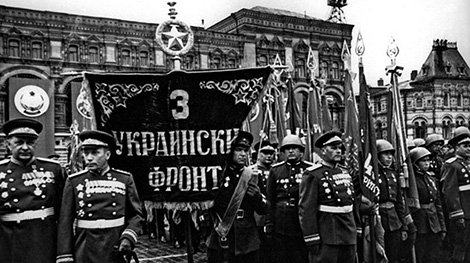
Veteran of the Great Patriotic War Ivan Lebedev marched four times in parades through the center of Moscow. Nevertheless, he viewed the legendary, very first Victory Parade to be the most vivid event of his life. On that day, 24 June 1945, the 29-year-old Hero of the Soviet Union Ivan Lebedev carried the Banner of the 3rd Ukrainian Front across Red Square.
‘The war was terrible’
I had the good fortune to speak with Tereza Belousova from Grodno, who knew the veteran and maintained a warm relationship with the Lebedev family for several decades.
“When Ivan Lebedev and his wife moved to Grodno, they became very close friends with my father, who was also a veteran of the Great Patriotic War. I can proudly say that over time, I also became a good friend to this family,” she said. “After the veteran passed away, I volunteered for over four years, assisting his wife Anna.”
Tereza Belousova does not hide her emotions when speaking of Ivan Lebedev. According to her, he was an exceptionally honest, intelligent, principled, and strong man. Her personal archive still holds not only photographs of the Hero of the Soviet Union but also a unique audio recording. On it are the recollections of Ivan Lebedev, told by him personally.
“The war was terrible... I joined the battle near Leningrad when the city was already surrounded,” Ivan Lebedev recalled. “As it happened, I never had to retreat. I was always advancing and liberating our territory. And if in 1941-1942 the Germans were exterminating millions of our soldiers, then after the Battle of Stalingrad, it was we who, armed with modern weapons, crushed the enemy. In those battles, I captured not just one but hundreds of Germans.”
Ivan Lebedev was conscripted into the army on the very first day of the war. The recruit was sent to political officer training courses in Buynaksk, and then to Lipetsk, where the 294th Rifle Division was being formed. He served as a political officer of a company. He served on five fronts: the Leningrad, Karelian, Northwestern, 3rd Ukrainian and Steppe Fronts.
On 12 October 1941, in the battle near the village of Mishkino, close to Mga station near Leningrad, Ivan Lebedev was severely wounded in the head and arm. He received treatment at a hospital in Sverdlovsk and later served in the 65th Independent Naval Infantry Brigade, participating in battles near Maselskaya station. During the war, the hero was wounded five times, but after each injury he returned to the ranks to fight the enemy.
The first, legendary, combat award
Ivan Lebedev received his first combat decoration, and immediately the Hero of the Soviet Union title, for crossing the Dnieper River in Ukraine.
“I remember, in the autumn we were moved near Kharkov. There was also a village there called Danilovka, the same name as the one where I was born. We were reorganized, our artillery battalion was given Studebakers, and we drove to the banks of the Dnieper. We stopped about three hundred meters away, there was a high cliff ahead. We positioned the artillery battalion on that height. On the other side of the river was a line of German trenches. We fired on them with direct fire, we saw the Germans jump out and scatter. Our infantry approached, and under fire from the opposite bank, we started putting together a crossing. We dismantled old sheds, made rafts, dragged up some fishing boats, and the entire division crossed the Dnieper with difficulty and losses. On the second day, they sent a large pontoon, a whole company could fit on it, but the other shore kept firing at us,” the veteran recalled in his memoirs.
When his commander was wounded, Ivan Lebedev had to take over his duties: “I loaded the vehicles with the howitzer and cannons onto the pontoon, and we crossed the Dnieper. With great difficulty, we quickly set up the guns on the high bank, and then we saw the Germans launching a counterattack. We shot them all with the howitzer. And then my regimental commander comes running up to our guns: ‘Did you, Lebedev, take out those Germans yourself?’ I said yes. ‘Well done!’”
The fighting there was terrible. The Germans tried to push our soldiers back from the riverbank. After serious preparation, on 14 October, they deployed a tank division. Our fighters held their ground, though they also suffered enormous losses themselves.
“The last four tanks that were advancing on our position, I finished off with the howitzer,” the veteran recalled. “We held onto our captured bridgehead. I, of course, risking my life, acted contrary to the usual logic of such crossings. Despite enemy bombing, I preserved all our guns, destroyed dozens of tanks and infantry, and held out until the arrival of the main forces.”
For this feat, by decree of the Presidium of the Supreme Soviet of the USSR on 20 December 1943, Ivan Lebedev was awarded the title of Hero of the Soviet Union with the Order of Lenin and the Gold Star medal.
The veteran celebrated Victory Day in Austria.
“We were approaching the city of Graz. I was in the first vehicle. Suddenly I saw gunfire all around,” Ivan Lebedev recalled. “They were shooting with machine guns, rifles… I sent a soldier to find out what was happening. He came running back and reported: ‘Comrade Major, the war is over!’”
All the sidewalks were filled with people
Speaking about the parade, Ivan Lebedev often repeated that taking part in such a grand event was an unexpected gift of fate. He considered 24 June 1945 the most memorable day of his life. “He was very proud and happy at that moment,” Teresa Belousova said.
Ivan Lebedev remembered that day in the smallest detail. He recounted: “At five o’clock in the morning we were brought to Red Square. And suddenly it began to rain! Not heavy, but it soaked us through. Even our boots were full of water. The standard of the 3rd Ukrainian Front, sewn from double velvet and two meters wide, was drenched through, became very heavy, and weighed not 10 kilograms anymore but probably 20. And when we, soaked, marched on command, the rain was joined by a strong wind. The wind blew at our backs, the standard fluttered, and the pole I held tightly with both hands bent under the weight. I was frightened: what if, God forbid, it broke! But nothing happened, the pole held. Later I learned it was made of oak: they had thought of that! We marched without stopping, and in Moscow all the sidewalks were filled with people, they greeted us, threw flowers, rejoiced at Victory… Later, as the standard-bearer of the 1945 Parade, I took part in three more Victory Parades in Moscow.”
Ivan Lebedev was an honorary citizen of Grodno. Here, an avenue and School No. 39 are named after this legendary man, and a memorial plaque in his honor is installed on the building of the regional military commissariat. Ivan Lebedev passed away on 1 October 2014 at the age of 99 and was buried in the Alley of Glory at the cemetery on Kosmonavtov Avenue in Grodno – the city that became his home.
After returning from the war, Ivan Lebedev married a wonderful young woman, Anna, who came from the same village. She too had walked the front lines as a medical service sergeant. The young couple kept in touch throughout the Great Patriotic War, sending letters whenever possible. Together they lived for 68 years and raised two remarkable sons.
Yulia GAVRILENKO,
7 Days newspaper
Photo courtesy of Teresa Belousova
 print version
 make home page
 add to bookmarks