



Press releases
Grodno excavations uncover remains of 17th-century church
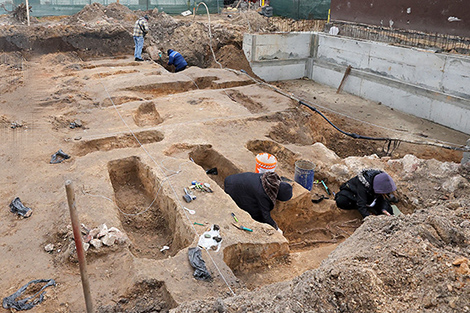
MINSK, 11 August (BelTA) - In Grodno, archaeologists have found fragments of a Roman-Catholic church dating to the late 16th – mid-17th century, specialists from the Institute of History of the National Academy of Sciences of Belarus said at a press conference, BelTA has learned.
According to the scientists, excavations were conducted in Grodno and Lida during the current archaeological season. These works are related to the study of the burial complexes from the 16th - 19th centuries. In Grodno, research was carried out on Malaya Troitskaya Street. During construction work there, the burials dating to the early - mid-16th century were discovered. In addition, fragments of a religious structure were identified. They are believed to be Holy Trinity Church that existed in Grodno from the late 16th to the mid-17th century.
The burials have been discovered next to this structure. “They have an unusual layout and differ from cemeteries of that period: the deceased were placed in a specific arrangement. The study of the finds continues in laboratory conditions. We made a rather rare find for Belarusian territories at this site - a healed trepanation,” the specialists said.
In addition, materials associated with individual cults were found. In particular, this refers to medallions. Artifacts from the 17th - 19th centuries were also found there. It is presumed that this cemetery functioned for a short period of time and was connected with the activities of the church. The burial ground was likely abandoned after the church ceased to exist.
In Lida, archaeologists studied crypts with lead sarcophagi dating to the late 19th century. Three burials were discovered. Notably, scientists managed to restore the names of some of the buried individuals. One of them is Yulian Zdanevich, a lieutenant colonel of the Lida Regiment. He took part in the Russo-Turkish War, was decorated, and spent the last years of his life in Lida, where he was subsequently buried. On another sarcophagus, a plaque with the name of the deceased and individual letters of his surname were preserved. As a result of the research, it was established that this person had headed the Lida Prison Castle for 14 years. A decision was made to rebury the remains of these individuals
Also this year, research will continue on the oldest archaeological site on the territory of Belarus - the Ogovo settlement, located in Ivanovo District of Brest Oblast. According to the latest data, its age exceeds 400,000 years, which is confirmed by the analytical studies. The research stopped at a depth of 7.5 meters.
 print version
 make home page
 add to bookmarks