




Press releases
From Gagarin to new heights. 65 years since first human spaceflight
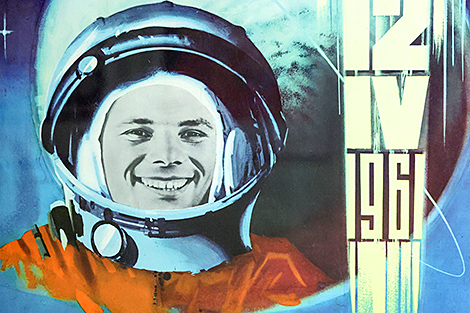
An archive photo
On 12 April 1961, exactly 65 years ago, Soviet cosmonaut Yuri Gagarin made the first human spaceflight in history, ushering in the era of crewed space exploration and paving the way for the study of outer space. At the initiative of the UN General Assembly, 12 April is proclaimed as the International Day of Human Space Flight.
Dawn of the space age
In the first half of the 20th century, scientists from many countries worked on the theoretical development of spaceflight, but the recognized classics of cosmonautics are the Soviet scientists Konstantin Tsiolkovsky, Yuri Kondratyuk, and Friedrich Zander.
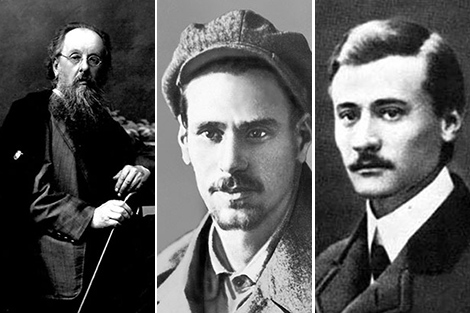
Konstantin Tsiolkovsky is considered the father of modern cosmonautics. In 1903, he published the first part of his scientific work “Exploration of Outer Space by Reaction Devices”, in which he demonstrated that the rocket is the vehicle capable of spaceflight. In his works, the scientist also calculated the work needed to overcome Earth’s gravity, determined the speed required for a vehicle to enter the solar system, and the duration of flight. Tsiolkovsky laid the foundations for the liquid-fuel rocket engine and developed the theory of multistage rockets. He was also the first to theoretically solve the problem of landing a spacecraft on the surface of planets without an atmosphere.
Interestingly, the idea of using a three-stage rocket system was proposed as early as the 17th century by Kazimir Semenovich, a native of the Vitebsk region. He is regarded as a founder of rocketry.
Yuri Kondratyuk (real name Alexander Shargei), in his book “For Those Who Will Read to Build”, written in 1918–1919, independently derived the basic rocket motion equation and provided the design and description of a four-stage rocket powered by oxygen and hydrogen fuel. He proposed using atmospheric drag to slow down a rocket during descent to save fuel. Kondratyuk calculated the optimal trajectory for a flight to the Moon. These calculations were later used by NASA for the Apollo lunar program. The Americans also used his idea, when traveling to other planets, of placing spacecraft into artificial satellite orbit and using a small landing and takeoff craft for human descent and return to the main ship.
Friedrich Zander examined issues of human life support during spaceflight. He proposed the idea of space greenhouses - growing edible plants directly aboard a spacecraft. He was also the first to suggest that the structural elements of an interplanetary spacecraft could be used as fuel.
The actual beginning of the space age is considered to be the launch, on 4 October 1957, of the world’s first artificial Earth satellite by the Soviet Union, named PS-1 (Simple Satellite-1). On the 315th second after liftoff, the satellite’s signals were heard around the world. News of the launch of PS-1 became a global sensation, and the Russian word “sputnik” entered other languages. This event became one of the major milestones in the progress and technological development of human civilization.
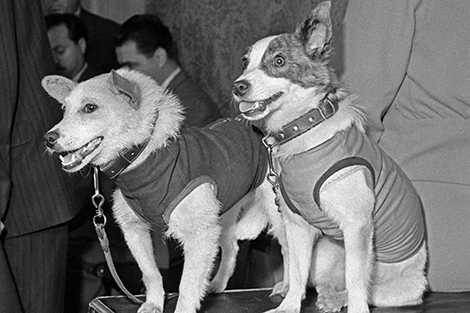
On 3 November 1957, the USSR launched a second satellite, with a dog named Laika on board, who became the first animal cosmonaut to be placed in Earth orbit. The first animals to safely return from an orbital spaceflight were the dogs Belka and Strelka. Their flight took place aboard the spacecraft Sputnik-5 on 19 August 1960. The ejectable container in which the dogs rode was one of the container designs developed for future human flights.
Gagarin’s flight and further exploration of space
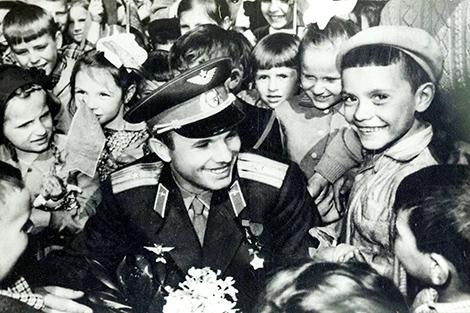
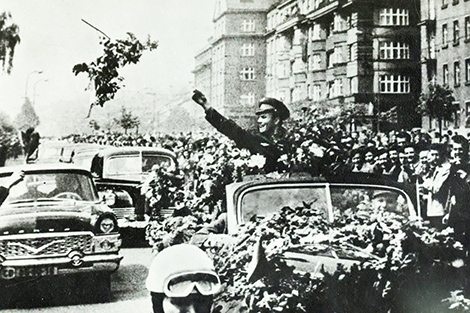
On 12 April 1961, at 9:07 Moscow time, the historic launch of the Vostok spacecraft took place from the Baikonur Cosmodrome, piloted by Soviet cosmonaut Yuri Gagarin. He became the first human to travel into space. After circling the planet once, the cosmonaut received the command to descend. At an altitude of several kilometers, he ejected and made a soft landing. The flight lasted 108 minutes. At liftoff, Yuri Gagarin uttered the phrase “Poyekhali!” (Let’s go!), which later became famous. For the first spaceflight, Yuri Gagarin was awarded the title of Hero of the Soviet Union. This historic event opened the way to the exploration of outer space for the benefit of all humanity. Less than a month later, on 5 May 1961, the first American astronaut, Alan Shepard, ascended into space. His flight lasted just over 15 minutes.
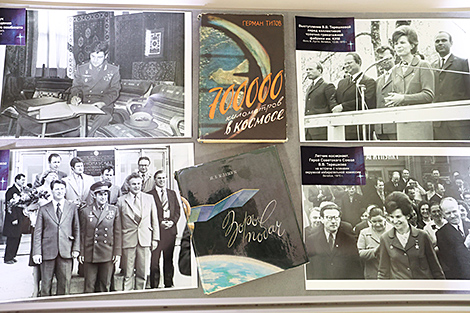
The world’s first female cosmonaut was Valentina Tereshkova, who is of Belarusian descent. Her mother, Yelena, whom her daughter often called “my little Belarusian”, was born in Vitebsk Oblast, and her father, Vladimir, was born in Mogilev Oblast. Valentina Tereshkova made her space flight on 16–19 June 1963, as commander of the Vostok-6 spacecraft as part of a group flight with the Vostok-5 spacecraft piloted by Valery Bykovsky. The flight lasted 2 days, 22 hours, and 50 minutes. During this time, her spacecraft orbited Earth 48 times. A crater on the Moon, a minor planet, and streets in several cities have been named after Valentina Tereshkova.
The next step in the development of cosmonautics was the creation of the multi-crew Voskhod spacecraft in 1964. The crew of this spacecraft was seated in the descent module without spacesuits.
The first spacewalk was performed by Soviet cosmonaut Alexei Leonov on 18 March 1965, from the Voskhod-2 spacecraft. The Berkut spacesuit used for the first spacewalk was designed for 30 minutes of exposure to open space. The total duration of the first spacewalk was 23 minutes and 41 seconds (of which 12 minutes and 9 seconds were spent outside the spacecraft).
The first human landing on the Moon in history took place in July 1969 as part of the American Apollo 11 mission. Neil Armstrong became the first person to set foot on the surface of Earth’s natural satellite, followed by Edwin Aldrin. The astronauts spent more than two hours on the Moon.
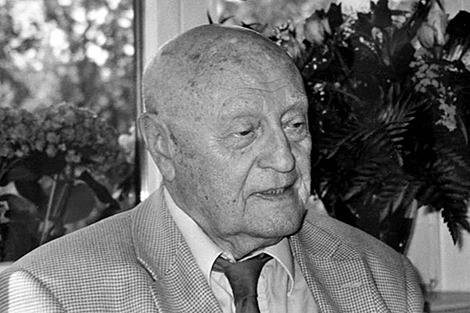
Interestingly, the flight to the Moon and the further development of cosmonautics were made possible thanks to Belarusian Boris Kit, who had been conducting space research in Los Angeles since 1950. It was this scientist who came up with the idea of using liquid hydrogen as rocket fuel. As a result, the American Apollos and Shuttles flew into space on fuel developed by Boris Kit. In addition, Kit authored the first textbook on rocket engineering and space fuel, which for a long time became an essential reference for many scientists working in this field.
On 19 April 1971, the first multipurpose station, Salyut, was launched into Earth orbit. In 1975, the joint experimental flight of the Soyuz-19 and Apollo spacecraft marked the beginning of international cooperation in the exploration and use of outer space for peaceful purposes.
Over the course of this journey, cosmonautics has become a field where cutting-edge achievements converge. Among them are the creation of orbital stations, the conduct of numerous scientific and technological experiments aboard them, and flights to other planets. Many countries have launched their own artificial Earth satellites into space.
The Artemis II mission launched from Cape Canaveral, Florida, on the night of 2 April 2026, marking the first crewed flight to the Moon since 1972. A super-heavy launch vehicle placed the Orion spacecraft into orbit. Four astronauts remained in lunar orbit for seven hours, during which the Orion spacecraft reached a record distance from Earth, approximately 406,608 kilometers. The previous record was set by the crew of Apollo 13 in 1970, when the spacecraft traveled about 400,000 kilometers from Earth. The astronauts conducted extensive photography of the far side of the Moon, capturing craters, lava flows, fissures, and ridges. In addition, the crew observed Earth rising and setting over the lunar horizon, as well as a nearly hour-long solar eclipse.
Belarus - a space power
The first developments in space-related projects in the counrty date back to the early 1960s. Research institutes and industrial enterprises worked on designing and building cutting-edge optical instruments, ground-based rocket launch control systems, and programs for processing space imagery.
On 22 July 2012, Belarus successfully launched its own spacecraft, a remote sensing Earth observation satellite, from the Baikonur Cosmodrome in Kazakhstan. This made Belarus a full-fledged member of the club of spacefaring nations. The first images from the satellite started arriving on 29 August 2012. The launch showcased to the world that Belarus possesses modern technologies and knowledge-intensive industries.
Data from the spacecraft and joint satellite constellations supports national defense and security, monitors natural and man-made emergencies, studies the state and forecasts changes in natural landscapes, agriculture, maintains the state land cadastre, and aids in road design, reconstruction, and construction. Space imagery forms the basis for topographic and navigation maps and is widely used in geological exploration and aerospace education.
In 2013, the UN General Assembly admitted Belarus to the Committee on the Peaceful Uses of Outer Space.
In January 2016, Belarus implemented a project to create a national satellite communications and broadcasting system. A carrier rocket launched the first Belarusian telecommunications satellite, Belintersat-1, successfully from China’s Xichang Cosmodrome. It handles TV and radio signal transmission as well as internet access. In a congratulatory telegram to Belarusian President Aleksandr Lukashenko, Chinese President Xi Jinping noted: “The Belintersat-1 communications satellite project is an important embodiment of the comprehensive strategic partnership between Belarus and China, as well as a key outcome of Belarus-China cooperation in space development.”
In January 2020, the National Academy of Sciences of Belarus hosted the first meeting of the CIS Interstate Council on Space.
In January 2021, the National Academy of Sciences of Belarus joined the International Charter: Space and Major Disasters as a full member.
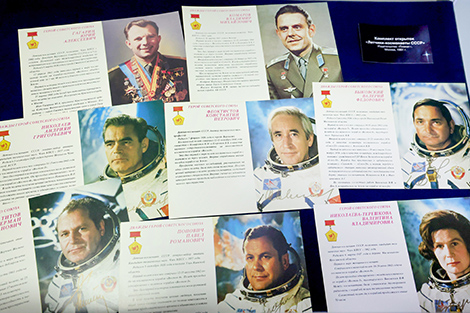
Several Belarusian natives have flown to space over the course of its exploration. Pyotr Klimuk made his first flight in December 1973 as commander of Soyuz-13. He completed three missions totaling 78 days. Vladimir Kovalenok flew three times, spending 216 days in space altogether, including over two hours on extravehicular activity. Cosmonaut Oleg Novitsky led the prime crew on his first flight, which launched to the International Space Station (ISS) on 23 October 2012. During his second mission on 17 November 2016, he unfurled Belarus’ national flag aboard the ISS and took photos of Minsk and other Belarusian cities from orbit. Novitsky has completed four flights totaling 545 days and three spacewalks.
In 2018, a monument honoring these three cosmonauts - Pyotr Klimuk, Vladimir Kovalenok, and Oleg Novitsky - was unveiled on Kosmonavtov Street in Minsk.
On 23 March 2024, Marina Vasilevskaya became the first woman cosmonaut from sovereign Belarus to launch into space. She flew from Baikonur to the ISS as part of the prime crew for the 21st Visiting Expedition, alongside cosmonaut pilot Oleg Novitsky and NASA flight engineer astronaut Tracy Dyson. The mission lasted 14 days, with 12 days on the Russian segment of the ISS. Marina Vasilevskaya carried out a scientific program developed by the National Academy of Sciences of Belarus in collaboration with Roscosmos and the Russian Academy of Sciences.
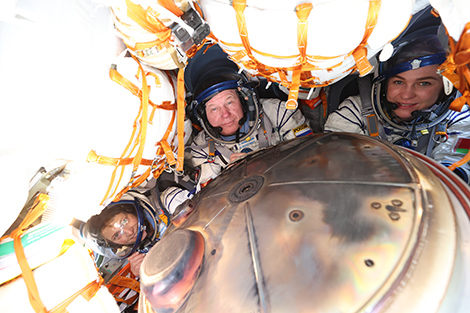
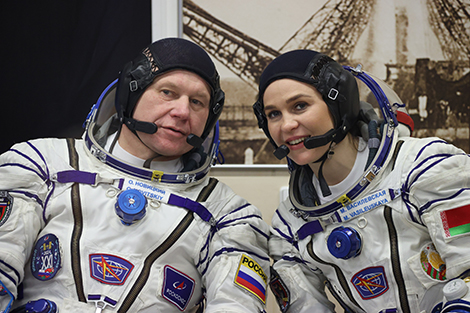
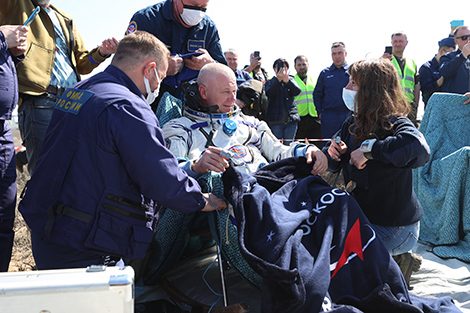
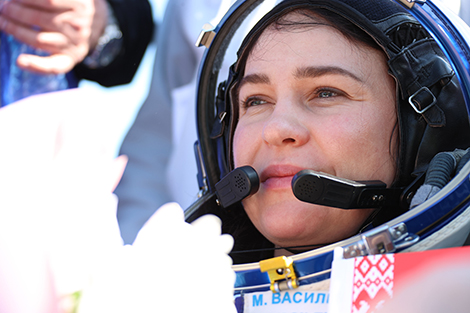
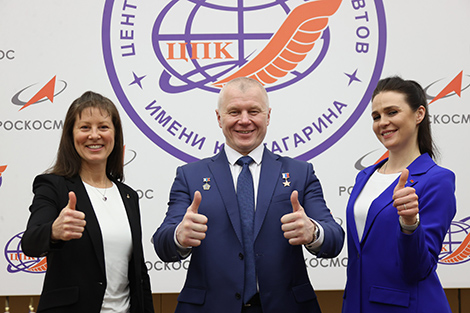
On 11 April 2024, at a ceremony in the Palace of Independence, Belarusian President Aleksandr Lukashenko presented Marina Vasilevskaya with the Hero of Belarus medal and her cosmonaut certificate. The head of state emphasized: “This is our country’s greatest victory. Our people have earned it.” Aleksandr Lukashenko assured that Belarus will continue advancing space technologies: “We will do everything necessary, and we will achieve even more.”
Russia is a key partner for Belarus in space cooperation. The Union State program Complex SG is currently underway, developing three small spacecraft - two by Russia and one by Belarus. They are set to be completed this year, with launch planned for 2027. Two promising projects are also in development: Composite SG (composite materials for space) and Resource SG (extending the service life of spacecraft in orbit).
Belarus’ history in space exploration is captured in the 2025 Belarusfilm documentary Our Space. The film highlights the contributions of Belarusian scientists and engineers to rocket and space technology, shares personal stories of cosmonauts who brought glory to Belarus in orbit, and explores forward-looking projects opening new horizons for national space efforts. It’s filled with rare archival footage and thrilling shots of spacecraft, evoking the grandeur of space and pride in Belarus’ contributions to its exploration.
 print version
 make home page
 add to bookmarks