


Press releases
First milestone, three presidents: What made Slavianski Bazaar 2001 memorable
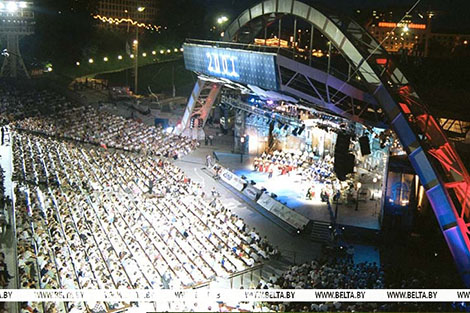
An archive photo
VITEBSK, 20 June (BelTA) – With just 26 days remaining until the opening of the jubilee 35th International Festival of Arts Slavianski Bazaar in Vitebsk, BelTA invites its readers to step back in time. Drawing on archival materials, we revisit the most memorable moments of each festival, day by day. Today, our spotlight falls on the festival of 2001.
For the Slavianski Bazaar, the 10th anniversary celebrated in 2001 marked a truly significant milestone. For the first time, the festival welcomed the presidents of three countries: Belarus, Russia and Ukraine. An informal meeting took place at the Belarusian leader’s residence in Krupenino ahead of the opening ceremony.
The Slavianski Bazaar also served for the first time as the venue for the Day of Friendship of the Fraternal Peoples of Russia, Belarus and Ukraine, an occasion commemorated with a magnificent gala concert.
One of the most unforgettable events was the concert titled “Ten Years of the Slavianski Bazaar”, which brought together all the Grand Prix winners from previous festivals. Incidentally, in 2001, the coveted award went to a Russian contestant, who triumphed over 20 competitors from 17 countries.
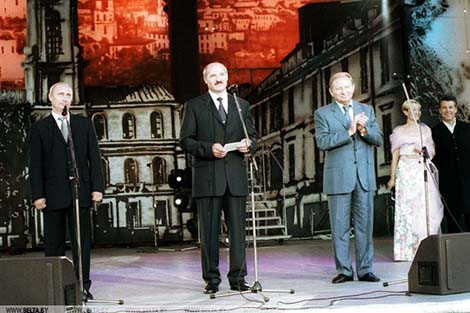
The grand opening gala featured performers from Belarus, Russia, Ukraine, Bulgaria, Poland, Japan and numerous other nations. Despite weather forecasts predicting clear skies, a torrential downpour swept over Vitebsk on 19 July. On other days, however, residents and visitors alike experienced summer at its most intense, with temperatures soaring to +30 degrees Celsius, and on one occasion, the thermometer in the shade reached an astonishing +36 degrees.
The anniversary festival drew participants from 39 countries, with artists from Kazakhstan, Estonia and Malta making their debut appearances. This expansive cultural forum encompassed 120 events, spread across 16 concert venues throughout Vitebsk. The Summer Amphitheater alone hosted 18 concerts, attended by more than 85,000 spectators, while some 900 young performers from 12 countries took part in the International Children’s Program Competition.
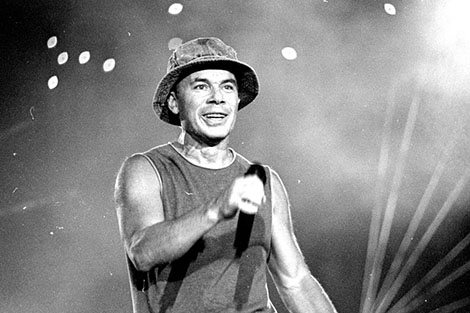
Oleg Gazmanov celebrated his 50th birthday at the festival. During his anniversary concert, he soared across the auditorium on a cable and descended from a height of 30 meters onto an inflatable cushion on stage, concluding his performance by rolling out a giant cake adorned with candles.
Another delightful surprise for the audience came from Nadezhda Babkina, who made her entrance on a motorcycle.
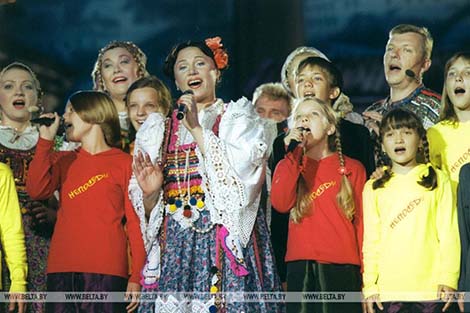
The 10th festival also boasted its most extensive theatrical program to date, with 12 performances captivating audiences, alongside the presentation of nine exhibitions. One of these, titled “Living Traditions of the Russian North”, featured works of decorative and applied art from museum collections from Arkhangelsk Oblast and the Russian House of Folk Art, now known as the Polenov State Russian House of Folk Art. Visitors were enchanted by the beauty of festive women’s and girls’ costumes, items crafted from birch bark, bast and wood, as well as exquisite examples of patchwork sewing and weaving.
A special highlight of the artisans’ fair in 2001 was the expanded offering of Belarusian national cuisine and a rich array of interactive entertainment programs, which featured a Romani ensemble and circus performers.
Karaoke emerged as a new and hugely popular attraction for festival guests and participants alike. During the Slavianski Bazaar days, no fewer than 13 tonnes of ice cream, produced exclusively in Vitebsk, were sold.
Coverage of the anniversary festival was provided by 100 media outlets and news agencies, with concerts broadcast by television companies from Belarus, Russia and Ukraine.
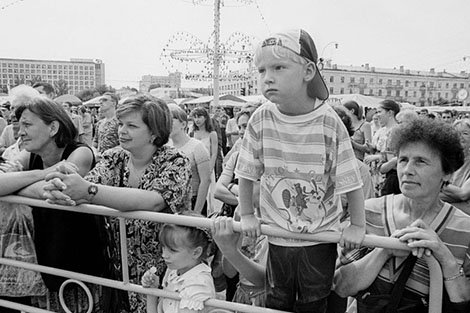
By 2001, the festival had grown considerably in both scope and stature. Its permanent program came to encompass not only competitive events but also classical music and jazz, folk art and folklore, theater and cinema.
Over the course of its first decade, the forum’s organizers took stock of their achievements. During that period, 173 artists from 25 countries competed for the top prize in the song contest for young performers. Artists, singers and filmmakers from 46 nations traveled to Vitebsk to share their craft. The stage and exhibition venues of the Slavianski Bazaar hosted some 900 concerts, theatrical productions, shows, presentations and celebrations, attracting nearly 2 million visitors.
People’s Artist of Belarus, Artistic Director of the State Concert Orchestra of Belarus Mikhail Finberg, offered his reflections on the cultural forum in an interview at the time: “This is a magnificent festival, one that demands immense effort in both preparation and execution. And our republic can take great pride in the fact that such a unique celebration has been taking place in Vitebsk for the tenth time already.”
=
 print version
 make home page
 add to bookmarks