




Press releases
Fifth edition of Belarus’ Red Data Book launched in Minsk
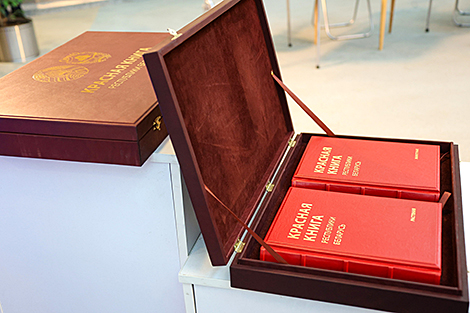
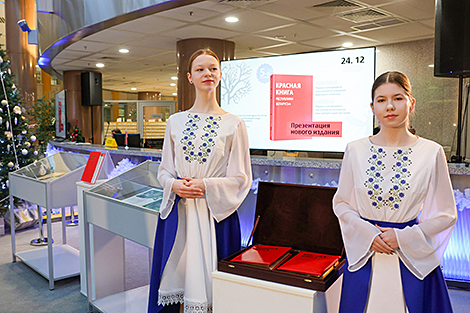
MINSK, 24 December (BelTA) – An event to launch the fifth edition of the Red Data Book of the Republic of Belarus was held at the National Library in Minsk, BelTA has learned.
The Red Data Book serves as the fundamental document that compiles information on the current status of rare and endangered species of plants and animals. It forms the basis for developing scientific and practical measures aimed at their protection, reproduction, and sustainable use.
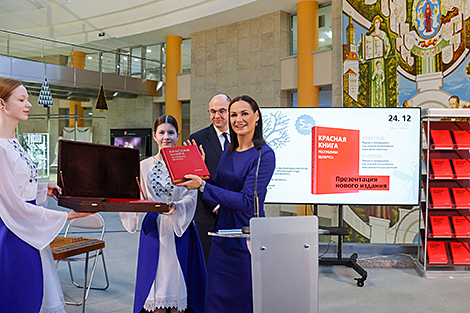
The first copy of the edition was presented to press secretary of the Belarusian president Natalya Eismont who will hand it over to the head of state. “I am delighted and grateful to receive this book to hand it over to the president. I have no doubt it will fintake pride of place in the Palace of Independence. This is a moment that is both symbolic and right. It is symbolic because the Year of Improvement is drawing to a close. Yet we are fully aware that the work will continue. Absolutely every guest who visits our country calls it beautiful, well-kept, and clean. Today we probably always receive such compliments with a smile and take them for granted. But such a reputiton does not appear out of thin air. It is created through the efforts of all of us, Belarusians,” Natalya Eismont noted.
“I cannot help but mention our President Aleksandr Lukashenko's attitude towards the Motherland, the country, its nature, and all living things. His care for his hometown is well-known, and he holds that same affection for every single corner of Belarus. With the president constantly on working trips around Belarus, the country lies before him as an open book. His eye is always on the next improvement, the next detail to perfect,” Natalya Eismont noted.
“The many foreign guests who visit us, as well as the Belarusians who come to the Palace of Independence, will now see the new copy of the Red Data Book in a central, honored place,” said Natalya Eismont. “And this will serve as another reminder of what we must preserve,” she emphasized.
A copy of the fifth edition of the Red Data Book was also donated to the National Library of Belarus. Viktor Pshibytko, Deputy Director General and Director of Information Resources and User Services at the library, noted that its mission is to preserve the nation’s cultural heritage. He stated that the new edition will take an honorable place in the library’s collection and will be carefully safeguarded, just like the four previous editions.
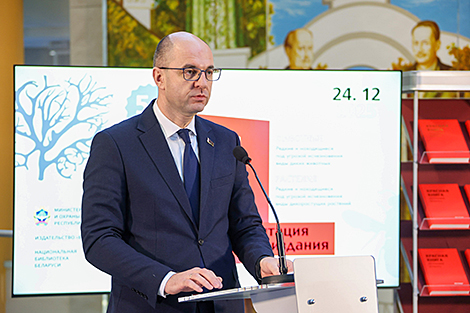
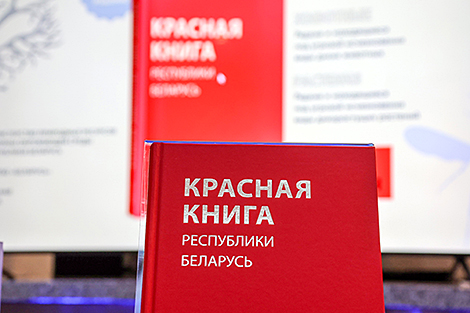
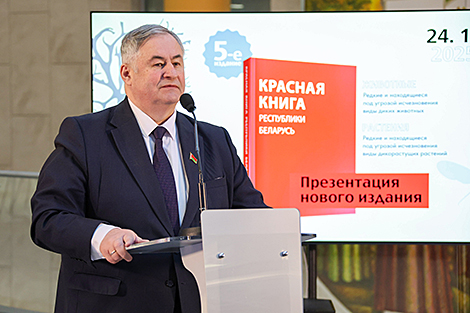
Minister of Natural Resources and Environmental Protection Sergei Maslyak recalled that the first edition of the Red Data Book saw the light of the day in 1981. “It was published in the Belarusian language and featured 85 species of wild plants and 80 species of wild animals. The Red Data Book is a foundational document that compiles information on rare and endangered species of flora and fauna. This book also serves as the basis for developing and implementing a comprehensive set of measures to protect and sustainably use our natural resources,” the minister explained.
The current Red Data Book now lists 523 species of plants and animals. “Fifty-five plant and animal species have been added to the Red Data Book, while 38 species (13 animals and 25 plants) have been removed,” stated Sergei Maslyak.
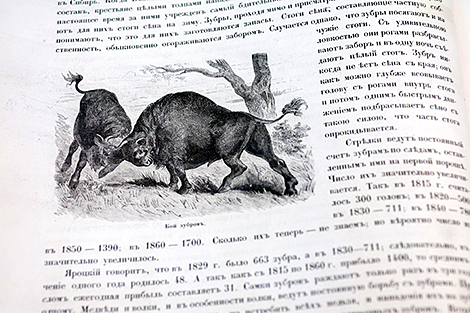
As a successful example, he cited the population of the European bison, which now numbers over 3,000 individuals. “Our country ranks among the top three for this population. Only Russia and Poland are ahead of us. This is a good example of how the European bison has moved from an endangered to a recovering species,” the minister believes.
Dmitry Grummo, Director of the Kuprevich Institute of Experimental Botany at the National Academy of Sciences of Belarus, said that systematic work on the Red Data Book has been ongoing since 1979. Beginning in 2015, work included a comprehensive revision and inventory, the development of new criteria, and the formulation of approaches for selecting new species and assessing existing nominees to determine if they required listing and what conservation status they should be given. “The Red Data Book has five statuses: ranging from endangered species to those that are, in principle, already close to their natural distribution conditions. A precautionary list is also being formed. There is also a ‘black list’ of presumably extinct species. As a result of the inventory for this edition, six species from the ‘black list’ were rediscovered on the territory of Belarus,” he explained.
Dmitry Grummo also spoke about the methods used in the research. One of them is molecular genetic analysis. “Thanks to it, we established that two species are hybrids and do not meet the status of protected species. It was also revealed that the appearance of some species in Belarus is related to accidental introductions. During the war, supply convoys brought in provisions, and species were introduced to our territory in this way. Therefore, they were excluded,” the scientist explained.
He noted that this is systematic work that allows for the preservation of the country’s species diversity.
 print version
 make home page
 add to bookmarks