



Press releases
Brest historian sheds light on artifacts unearthed at Bernardine monastery site
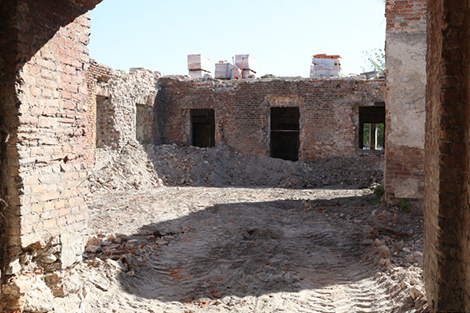
BREST, 9 September (BelTA) - Since the spring, restorers have been working on the preservation of the ruins of the Bernardine convent on the grounds of the Volyn Fortification of Brest Fortress, Aleksandr Bashkov, Doctor of Historical Sciences, Professor at the Department of Belarusian History and Special Historical Disciplines at Pushkin Brest State University, told BelTA.
The work is being carried out under archaeological supervision. During this time, specialists have uncovered numerous finds connected both to the medieval history of Brest and to the history of the Modern era. Not only artifacts have been unearthed but also fragments of historical structures.
Four buildings once stood on this territory, the existence of which is known from documentary sources, including cartographic sources. The complex of the Bernardine men’s and women’s monasteries began to be built in the 17th century. They acquired their final appearance by the 18th century. Then came a turning point in the history of Brest - the construction of Brest Fortress. During the major reconstruction and changes to the topography, the old town was relocated to another place. Some structures were adapted for other purposes. The Bernardine men’s monastery, for example, was converted into a cadet corps.
“During earthworks, a basement structure was uncovered that falls within the footprint of the men’s monastery building. What this structure was? We cannot actually say without serious archaeological research. We only have a hypothesis: since it lies within the building footprint, it may have been part of the monastery compound that was later rebuilt into the cadet corps,” Aleksandr Bashkov believes.
The basement was discovered by chance during earthworks for laying utility lines. The historian noted that it is not a tunnel, although such a hypothesis had existed. “There was a tradition of connecting Bernardine men’s and women’s monasteries with passageways. In this case, that hypothesis was rejected: in fact, we have a basement room measuring approximately 5x5 meters, vaulted, made of brick, and almost completely filled in. For a more detailed description, it needs to be cleared out,” the archaeologist explained. At this stage, the room has been documented and added to the plan. Aleksandr Bashkov clarified that the men’s monastery was destroyed. Only its foundations and basement rooms remain underground.
Also, during the utility works, fragments of another structure were found. This refers to one of the two buildings of the hospital complex that were built on this territory in the late 19th to early 20th century.
Numerous artifacts are being found among the ruins. The material is carefully accumulated, and the collection is gradually growing. Its scientific processing will begin after the completion of field work, and for now, the artifacts are being temporarily stored at Pushkin Brest State University.
 print version
 make home page
 add to bookmarks