



News & Events in Belarus
Lukashenko’s big tour: A quarter of the world’s population on his itinerary
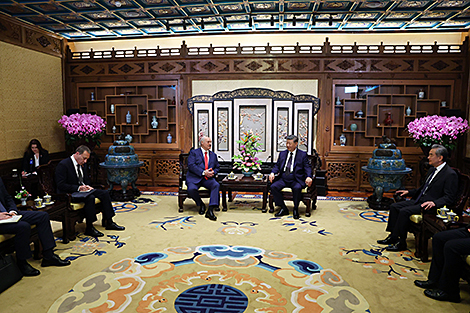
New contracts and strategic agreements: Belarusian President Aleksandr Lukashenko’s extended overseas trip was not merely a series of visits but a demonstration of how Belarus is building long term relationships with partners on the international stage. Russia, China, Indonesia, Myanmar. The head of state’s itinerary covered countries with a combined population of more than two billion people, nearly a third of the global economy. Major manufacturing hubs, new technology corridors and logistics chains are concentrated there. For Belarus, cooperation with this region is not just a matter of trade; it is part of a long term strategy to strengthen sustainable economic and political ties with centers of global growth. The most important takeaways from the negotiations, the standout statements and everything that unfolded away from the formal table are all captured in this BelTA roundup.
The first stop on the big overseas trip was Russia, Belarus’ longtime ally. In Valdai, Aleksandr Lukashenko and Vladimir Putin met one on one, and the following day they held a new round of talks in an expanded format. The Belarusian leader then headed to China, where a working visit, his 17th to date, proved both busy and productive. The visit to Indonesia opened up new opportunities for Belarus to cement its presence in one of the world’s fastest growing regions. After the talks in Jakarta, the president traveled to Myanmar, which is a promising partner within ASEAN.
China: A strategic partnership with no blank spots
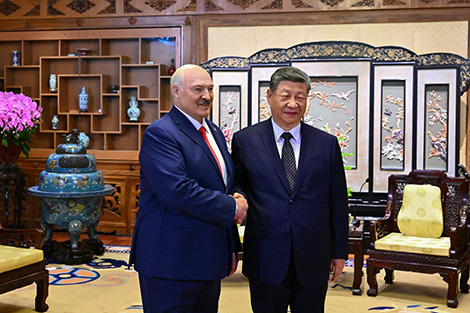
Aleksandr Lukashenko arrived in China on the evening of 28 June. The following day he had a working meeting with Chinese President Xi Jinping. The Chinese leader spoke highly of the bilateral relations between the two states: “I am very pleased to welcome you again, my dear friend. I am very glad to see you. We meet often, we speak often, and we have timely, in-depth dialogue on a wide range of issues.”
Xi Jinping noted that Minsk and Beijing are developing an all-weather, comprehensive strategic partnership. “China and Belarus are iron friends. Our relations have withstood every test of international turbulence, and our friendship only grows stronger. Our cooperation is multifaceted, keeps pace with the times, and constantly produces new results. Belarus-China relations are experiencing a historic peak,” Xi Jinping said. “We also remain in close touch on international matters.”
A case in point is the Great Stone industrial park, which has evolved into an international hub for high tech manufacturing. Notably, 2026-2027 had been declared the Years of Industrial Cooperation between Belarus and China. Aleksandr Lukashenko remarked that Belarus is employing Chinese technologies across the full spectrum of its economic development and is pleased with both their sophistication and the quality of the finished goods.
“We regularly share our views with you on international issues and the regional situation. I make it a point to keep you updated on all of this. I think it is essential that we maintain and deepen these contacts in the future,” the president said.
Some details of the talks were disclosed by First Deputy Prime Minister Nikolai Snopkov, who has long overseen the China portfolio. He said that the talks made clear that a new chapter has opened for Belarus and China to expand cooperation in every area.
“This suggests that the bar will be set higher in the near future,” Nikolai Snopkov said. “The Chinese side is ready for any level of cooperation, provided we are ready as well. We need to take the initiative, be more proactive and have a clear understanding of what we want, how we want it and when. Experience and practice show that our Chinese colleagues are prepared to work in all areas and at all levels.”
A key focus is industrial cooperation. Belarus intends to bring in Chinese technologies, 11 of them so far, and use them as a springboard for developing joint production facilities. “This is very important for us. Deepening, scaling up and expanding will undoubtedly give a powerful boost to the country’s economic growth,” the first deputy prime minister said.
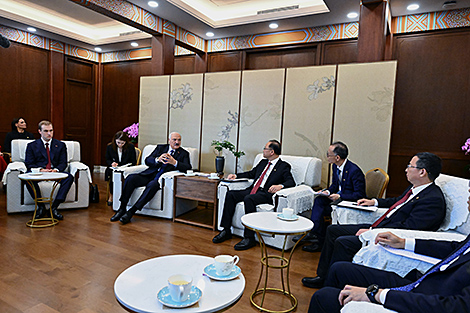
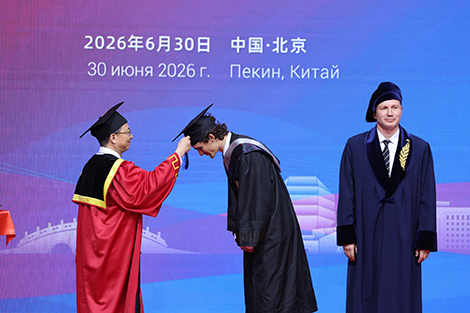
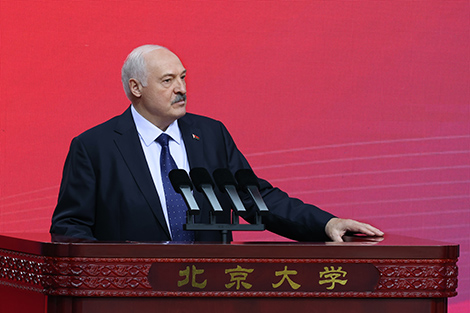
During his working trip to China, Aleksandr Lukashenko visited Peking University. As is known, Belarusian and Chinese universities launched a joint educational program in biotechnology back in 2022. This was, in a sense, a unique case in which two different traditions and educational systems were successfully aligned. This year saw the first graduating class of specialists.
“We want the groundwork laid here to expand and thrive. For Belarus, these programs must be substantive, wide ranging and rooted in real world application. Otherwise, what purpose does this education serve if it is not squarely focused on practice and fails to deliver tangible benefits to both our countries?” Aleksandr Lukashenko said at a solemn ceremony of presenting diplomas.
The president stressed that Belarusian specialists will work in Belarus, despite drawing strong interest from Russian and Chinese companies. “These are unique and talented individuals whom many outside of Belarus are eager to employ. They have already been offered lucrative positions in big countries like China and Russia, and I am sure the West would welcome them too. But my condition is non-negotiable: we did everything possible to ensure you studied here for the benefit of Belarus,” he said. “However, science knows no borders. It cannot belong to any single nation or exist in isolation. We are ready to work from the territory of Belarus, primarily to advance the well-being of the Chinese people and everyone else who wishes to cooperate with us.”
Specialists trained under the joint Belarusian-Chinese program will use Chinese technologies to develop high-value and essential solutions for cancer treatment, Aleksandr Lukashenko emphasized, adding that these are products “urgently needed worldwide.”
During a meeting with the leadership of Peking University, Aleksandr Lukashenko proposed deepening educational cooperation between Minsk and Beijing. “Even when I was here ten years ago, I understood that something meaningful should come out of our educational cooperation with your university. Over these ten years, we have developed a joint program for training our young people at this university,” Aleksandr Lukashenko stressed. “But I would like you to understand how I see it: these are only the first steps. Our program needs improvement; we must go deeper so that the experience and knowledge of the young people who will study here spread widely across Belarus.”
The issue of Belarusian Chinese relations remained very much alive after the head of state’s visit. Just days later, the first Belarus China Forum of Regions got underway in the city of Lanzhou in Gansu Province. It brought together more than 270 participants from 23 regions of China and representatives from all the regions of Belarus and the city of Minsk.
On the sidelines of the forum, contracts totaling about $1 billion in investment were signed. As Nikolai Snopkov noted, this aligns with a direct requirement from the president, reflected in the directive on developing cooperation with China, namely the shift from a “center to center” model to a “region to region” one. “Indeed, all the real work gets done not in government buildings but in the regions,” the first deputy prime minister emphasized.
Indonesia: A bet on Southeast Asia’s largest economy
After wrapping up his visit to China, the Belarusian leader headed to Indonesia, the undisputed giant of Southeast Asia, a nation of more than 280 million people and the largest economy in ASEAN.
Indonesia is a unique country even by Asian standards. Its geographic location, between the Indian and Pacific Oceans, makes it a key transport hub in global trade. That allows Minsk and Jakarta to view each other not only as bilateral partners but also as bridges between regions, Eastern Europe and Southeast Asia. Indonesia’s political weight also plays a special role. It is one of the leaders of the Association of Southeast Asian Nations and has traditionally pursued strategic autonomy, seeking to maintain ties with different centers of power simultaneously. For Belarus, such a partner is particularly attractive: Indonesia carries influence in Asia and is not part of any rigid military political blocs.
A turning point in relations between Minsk and Jakarta came in 2013, when Aleksandr Lukashenko made a state visit to Indonesia. At the time, bilateral trade stood at about $130 million. In previous years, the figures had fluctuated. In 2011, for instance, the two countries posted $220 million in trade. But even those numbers, the president of Belarus believed, clearly did not match the potential of the two nations.
In July 2025, Indonesian President Prabowo Subianto visited Belarus. Aleksandr Lukashenko invited his Indonesian counterpart to his home, and in an informal setting they discussed a broad range of topics. “After the renovations (this house used to be a military residence), only President Putin was here. A very, very long time ago, before the renovations, Xi Jinping with his family visited me here. Therefore, I hosted three such great people here,” the Belarusian leader said while receiving his Indonesian guest. In turn, Prabowo Subianto expressed hope that the president of Belarus would soon find an opportunity to visit his home in Indonesia as well. “With great pleasure. I think we will find the right time, prepare thoroughly and do something so that there will be plenty to talk about. And I would be very happy to come to Indonesia again,” Aleksandr Lukashenko replied.
Despite the geographical distance, Minsk and Jakarta have established close partnership in a number of areas. In 2025, mutual trade in goods and services grew to almost $640 million. But, as they say, there is no limit to perfection. And the current official visit of Aleksandr Lukashenko was aimed at developing key areas of cooperation.
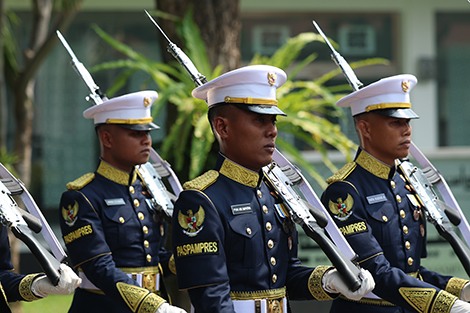
Belarusian aircraft number one landed in Jakarta on 1 July. At the airport,the head of state was welcomed with national colors. Indonesian music, dances, an honor guard unit, a motorcycle escort: everything was at the highest level. Something unusual was the flyover of military aircraft in honor of Aleksandr Lukashenko’s arrival. Indonesian Air Force fighters escorted the president’s plane even as it approached Jakarta.
The Belarusian leader stayed at the palace located within the residence complex of the president of Indonesia. This is a sign of special respect and a unique case in Indonesian protocol practice.
On the first day of the visit, Aleksandr Lukashenko met with members of the Indonesian Government to discuss joint investment projects. “I would like you to know: if there is anything we can do for you, please you are welcome in Belarus. Take a look at our manufacturing companies and our enterprises. If anything catches your interest, consider it all achievable. No topics are off limits in cooperation with Indonesia. On the contrary, we want to expand our cooperation. So let’s make agreements,” the Belarusian leader stated. “If you wish to invest in any enterprises, we will consider any of your proposals. Reciprocally, we would like issues to be resolved without any red tape or delays (if we are to establish joint production facilities here for goods of interest to you). Any areas of cooperation are possible. Please, just tell us what you need. I’d like to emphasize once again: the best way to understand our capabilities is to visit Belarus and see what we have to offer.”
Participants of the meeting shared some insights from the negotiations. According to Belarusian Deputy Prime Minister Viktor Karankevich, the meeting touched upon various sectors and areas of activity from agriculture and food supplies to deeper industrial cooperation. The discussion concerned supplies of Belarusian machinery for agricultural mechanization. A comprehensive approach will be applied, which includes the establishment of service centers for machinery maintenance, personnel training, and later the creation of assembly facilities, not only for agricultural machinery, but also for other types of equipment, including cargo and mining.
Healthcare, production of medical and veterinary drugs, both in Belarus and in Indonesia, were also discussed. “The key task is to involve the maximum number of partners in these projects,” the deputy prime minister said.
President Director of state-owned oil company Pertamina Simon Aloysius Mantiri said that besides technologies, personnel training is also very important. “We emphasized the importance for us of developing human resources. Therefore, we would like to see strong cooperation in technology and technology transfer, but also in training our people in Indonesia,” Simon Aloysius Mantiri stated.
Business circles of both countries had the opportunity to hold negotiations with counterparts at a joint business forum that took place in Jakarta ahead of the Belarusian leader’s visit. Companies signed contracts worth several tens of millions of dollars, and that is only for already established agreements. Ahead lie new arrangements, supplies, and projects.
On 2 July, a meeting between Belarusian President Aleksandr Lukashenko and Indonesian President Prabowo Subianto took place in Jakarta. The talks were preceded by an official welcome ceremony featuring a guard of honor company, the playing of the national anthems of the two countries, gun salutes, and folk dances. Aleksandr Lukashenko’s motorcade on the way to the Independence Palace in Jakarta was escorted by motorcyclists, followed by more than a hundred cavalrymen on horseback.
“During the preparations for this visit, and being in Indonesia for the second time during my presidential service, I made sure that there is enough work for Belarusians in Indonesia, and we are committed to working seriously to help you to achieve the goals that you have set before your people and vast country,” the Belarusian president said during narrow-format talks.
Aleksandr Lukashenko recalled that the day before, he had also had a good conversation with Prabowo Subianto, which will serve as a foundation for further steps to improve and develop Belarusian-Indonesian relations.
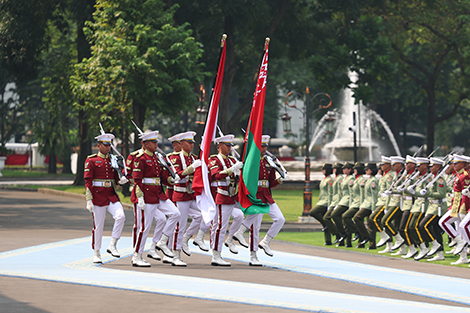
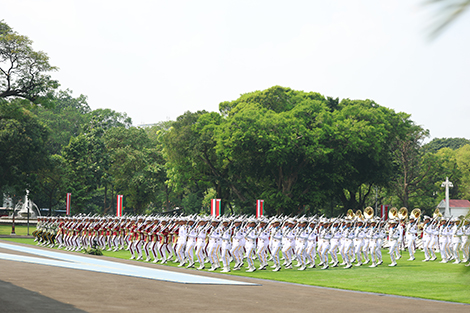
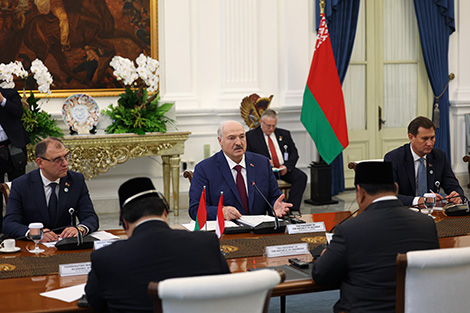
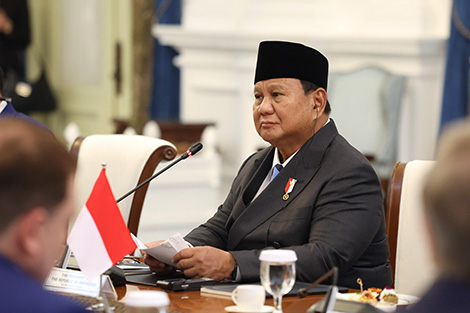
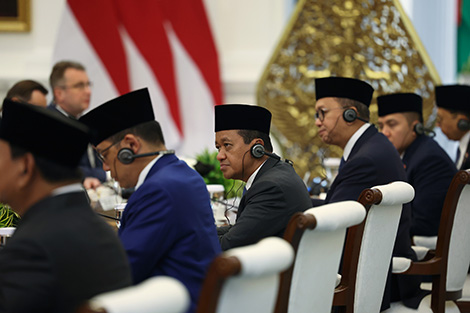
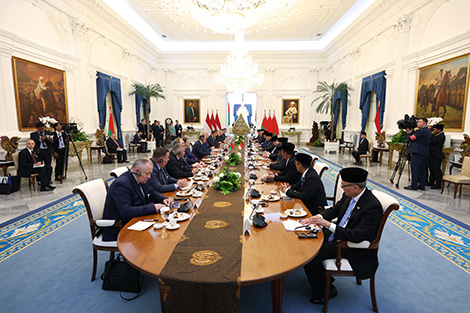
During expanded-format talks, the Belarusian head of state drew historical parallels between Belarus and Indonesia, whose peoples know the true value of sovereignty and independence. “Since your election in 2024, political dialogue and economic ties between our countries have noticeably intensified, thanks to the active and independent stance you have taken. Our guiding principles of cooperation are mutual respect and a willingness to support one another, including on the international stage. Despite the geographical distance, Belarusians and Indonesians have much in common,” the Belarusian leader said.
He noted that Indonesia has successfully embodied the motto “Unity in Diversity”, which is inscribed on the country’s national emblem. “In that unity lies the strength of your people,” Aleksandr Lukashenko emphasized.
For Belarusians, in turn, the motto “Together for a Strong and Prosperous Belarus!” has become an important historical guiding principle. “Our peoples know the value of sovereignty and independence. Both Indonesians and Belarusians defended their sovereignty and independence in the most brutal struggle against foreign invaders,” the Belarusian president said. “The experience gained in the fight for the right to determine their own future and govern their own land has been laid at the foundation of the peaceful, yet firm and consistent policy of the Belarusian state at the present stage.”
Aleksandr Lukashenko welcomed Indonesia’s decision to open an embassy in Minsk. “I am confident that this diplomatic mission will work hand in hand with the Belarusian embassy in Jakarta and will help increase the intensity of contacts between our countries,” the head of state said.
The potential of our cooperation is significant. It is not about the fact that Indonesia is a giant country in comparison with Belarus. “But we possess the technologies and competencies that you need. In this regard, we are ready to work with you. In this respect, no topics are off limits. We are not afraid of anyone, just as you in Indonesia are not, because we are doing this not against anyone, but we are doing this for the benefit of our countries and peoples,” the Belarusian leader emphasized.
The Belarussian president expressed confidence that there is every opportunity to see cars and other machinery produced in Indonesia using Belarusian technologies appearing in large numbers on the streets of Jakarta and other cities of Indonesia. “We do not want to only trade with you. That is not bad either. But we understand that this is not the right path in the modern world. Therefore, having come to you with our products, we are ready to train a sufficient number of your people here in Indonesia,” the head of state said. He noted that while training Indonesian specialists at Belarusian educational institutions is certainly an option, it is a time-consuming process. A more efficient approach, one that Belarus has already successfully employed in other countries, involves hands-on training for engineers directly at local factories, on the shop floors and assembly lines.
Aleksandr Lukashenko highlighted Belarus’ strategic geographic position in the center of Europe, which serves as a gateway for Indonesian goods to European markets. “You can always rely on us. You can use Belarus as a gateway to Europe, and we will give you our full backing. We are friends, and we will go to every length to ensure that you never look back on this partnership with regret,” the president stated.
Following the official negotiations, the parties signed several international documents. The major one is the roadmap for the development of key areas of cooperation for 2026-2030.
“Belarusians are not just taking a closer look at Indonesia as a very interesting tourist destination. Many have already discovered it for themselves. Our delegations paid special attention to the topic of mutual travel,” Aleksandr Lukashenko noted. “Therefore, the opening of an embassy, the lifting of visa restrictions, and the introduction of visa waiver for Belarusians to Indonesia, just as it works for Indonesian citizens [traveling to Belarus], is a major step forward.”
The head of state noted that he and his Indonesian counterpart had planned this visit a year ago. “We in Belarus are happy that in implementing your ambitious plans (and they are enormous) you have taken notice of Belarus. For us, there is a vast field of work here. I want to assure you once again: we will implement everything we have agreed upon. Yes, we are not a giant country like Indonesia. But we have what you need,” Aleksandr Lukashenko emphasized.
The Indonesian president, for his part, expressed the hope that the partnership between Belarus and Indonesia would become even stronger. “This visit underscores our friendship, which is growing stronger. In the global dynamic that is constantly changing, Belarus is Indonesia’s key partner in Eurasia, and we greatly value our relationship, which develops on the basis of mutual benefit. I hope that the partnership between Belarus and Indonesia will become even stronger and that our cooperation will bring real benefits to the peoples of both countries,” the Indonesian leader said.
The Belarusian delegation traveling to Indonesia comprised the ministers of foreign affairs, industry, agriculture and food, and healthcare, along with the president of the National Academy of Sciences of Belarus and the heads of the Belneftekhim and Belgospishcheprom concerns. Prior to the top-level meetings, they had sectoral discussions with their Indonesian counterparts and finalized concrete avenues for cooperation.
Belarus’ Agriculture and Food Minister Yuri Gorlov reported that Indonesia is prepared to purchase up to 100,000 tonnes of dry dairy products from Belarus. “Our exports of these products have exceeded $18 million, and we are continuing our work this year. But those volumes do not meet the interest of our Indonesian colleagues,” Yuri Gorlov said. “As of today, contracts for the delivery of dry milk to Indonesia worth over $76 million have already been signed. That amounts to roughly 20,000 tonnes of dry dairy products. I spoke with my counterpart, and they are willing to buy up to 100,000 tonnes from us at competitive prices.”
The parties also agreed that Belarus would provide assistance in setting up and expanding dairy processing facilities in Indonesia. “They aim to ensure their nation’s food security, and we are ready to help them achieve that," Yuri Gorlov declared.
Belarus is likewise prepared to help Indonesia with land reclamation for rice cultivation as the country is actively increasing its rice-growing acreage to meet domestic demand. “We have specialists who could provide both consulting and hands-on assistance to our Indonesian partners,” the agriculture and food minister said.
Indonesia, too, has taken an interest in Belarusian healthcare. “We are pursuing cooperation in education and pharmaceuticals. We discussed this area of cooperation with officials from Indonesia's Ministry of Health and with companies looking to bring their products to the Belarusian market. At the same time, our representatives reached out to them to present our homemade medicines and work toward agreements on promoting our drugs,” said Belarusian Healthcare Minister Aleksandr Khodzhayev. He added that Belarus is eager to welcome Indonesian partners for on-site visits to demonstrate the country’s pharmaceutical manufacturing potential and to give a full picture of what its medical education sector has to offer.
Myanmar: A new chapter in bilateral cooperation
After Jakarta, the Belarusian president headed to Myanmar for a working visit. Prabowo Subianto accompanied Aleksandr Lukashenko to the airport to see him off. “I'll be waiting for you in Minsk,” Aleksandr Lukashenko said. “I'll come!” the Indonesian president said in response.
Myanmar is a highly sought-after prize for both Asian and Western players, given its resources and strategic influence in the region. In recent times, contacts between Minsk and Naypyidaw have noticeably intensified. In March 2025, Aleksandr Lukashenko held official talks with Chairman of the State Administration Council and Prime Minister of Myanmar [now President of Myanmar] Min Aung Hlaing, which gave fresh momentum to bilateral relations. In November, the Belarusian leader made his first return visit to Naypyidaw. Additionally, the two heads of state met on several occasions over the past year on the sidelines of international events, including the EAEU summit in Minsk.
The latest meeting between Aleksandr Lukashenko and Min Aung Hlaing served as a kind of progress review of how the previously reached agreements are being implemented. During the Belarusian president’s prior trip to Myanmar, the parties had put their signatures to some 30 documents, the most significant being a cooperation roadmap for 2026-2028 and a mutual visa-waiver agreement. The leaders also reached another important decision: to elevate Myanmar’s diplomatic mission in Minsk to embassy status.
Building on the high-level agreements, the parties are continuing their work on joint cooperation projects. Among other things, preparations are moving forward to set up assembly lines in Myanmar for Belarusian MTZ tractors and MAZ vehicles. Pharmaceutical cooperation is also gaining momentum.
“I simply could not pass up the opportunity to come see you today, especially since I was already in this geographically distant region,” the Belarusian head of state said.
Aleksandr Lukashenko noted that he and Min Aung Hlaing are well acquainted, having met and talked on many occasions over the years. A solid track record of bilateral engagement is already in place. Still, he stressed, this visit and the talks that come with it are important in their own right.
“What makes this moment in Myanmar-Belarus relations special, in my view, is that we are poised to usher in a whole new level of cooperation,” the president stated. “Our goal is to forge a relationship between our two countries that will stand as an example for others in the region. The cornerstone of our partnership will be the prosperity of our peoples. This is not a friendship directed against anyone. We are building our friendship and developing our relations for the benefit of our nations.”
As for the agenda of the current working visit, Aleksandr Lukashenko explained that several issues and topics were planned for discussion, including the implementation of previously reached agreements. “We need to pick up the pace. You see what is happening in the world. The world is evolving very rapidly, very often unpredictably. We see that too. We must counter this unpredictability in the world with proactive action,” the Belarusian leader emphasized.
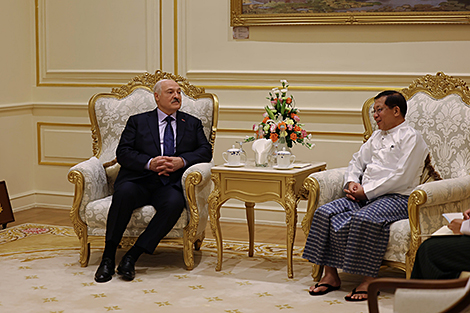
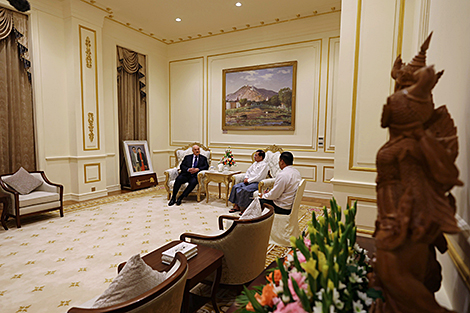
Min Aung Hlaing warmly welcomed the Belarusian head of state and thanked him for the visit. “I am glad to see you in our country. This is our second meeting here,” Min Aung Hlaing said.
He stressed that the Belarusian president’s current visit is a clear sign of the rapidly growing cooperation between the two nations and the high level their bilateral ties have reached. Min Aung Hlaing also took the occasion to thank Aleksandr Lukashenko for sending Belarusian officials to attend his presidential inauguration ceremony.
The Myanmar leader further highlighted the expanding exchanges between the parliaments and political parties of both countries. Notably, a delegation headed by Khin Yi, Speaker of the House of Representatives of the Union Assembly of the Republic of the Union of Myanmar, traveled to Belarus this past June.
“We need to broaden our engagement not just at the top leadership level, but also between our parliaments and, most importantly, between our people,” Min Aung Hlaing stressed.
On 3 July Min Aung Hlaing celebrated his 70th birthday. In his congratulatory message, Aleksandr Lukashenko expressed his hope for continued support from the president of Myanmar in implementing previously reached agreements and in creating conditions for new mutually beneficial economic and humanitarian projects.
“Our meetings have convinced me of your sincere desire to develop long-term cooperation between Minsk and Naypyidaw aimed at strengthening the sovereignty and independence of both states and improving the well-being of our citizens,” the Belarusian leader said.
The Belarusian government also recently prepared a fitting gift for the Myanmar president, adopting a resolution to open an embassy in Naypyidaw by 1 November 2026. This is one of the first tangible results of Aleksandr Lukashenko’s November visit to Myanmar and marks a new chapter in the advancement of Belarusian-Myanmar ties.
 print version
 make home page
 add to bookmarks