



News & Events in Belarus
Lukashenko seeks biotech cooperation with Russia
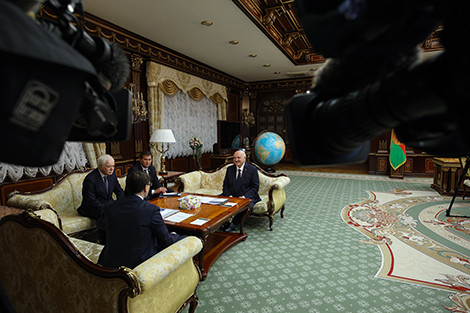
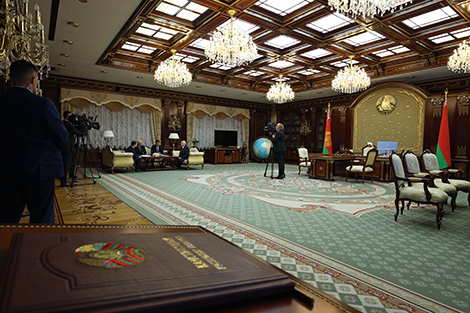
MINSK, 27 July (BelTA) – Belarusian President Aleksandr Lukashenko has invited Russia to unite efforts in the field of biotechnology, with an emphasis on collaboration between the Belarusian National Biotechnology Corporation (BNBC) and similar Russian enterprises. He made the proposal on 27 July during a meeting with Igor Shchegolev, the Russian Presidential Plenipotentiary Envoy to the Central Federal District, BelTA has learned.
It was noted that during his visit to Belarus, Igor Shchegolev visited the BNBC and positively assessed Belarus’ achievements in this field.
“I am glad you had the opportunity to visit the BNBC. I would like to ask you to help us combine our efforts, as much has already been achieved in this field in your district,” the Belarusian leader said. “All the developments in this field, whether in your district, in Russia more broadly, or in Belarus, should be aligned and working together.”
The head of state noted that the BNBC was established in cooperation with China, and Belarus is grateful for the assistance in its construction and the provision of modern technologies.
In the field of biotechnology, the Belarusian side had previously lagged somewhat behind, but many of the Soviet-era solutions have been maintained and built upon in Russia. “We did fall behind somewhat. We made some headway during the Soviet years, but that legacy stayed in Russia, and we are thankful for it,” Aleksandr Lukashenko said.
The process of building the BNBC was not always easy, according to the president, but the enterprise now stands on its own feet and is ready to collaborate with Russia within the Union State framework.
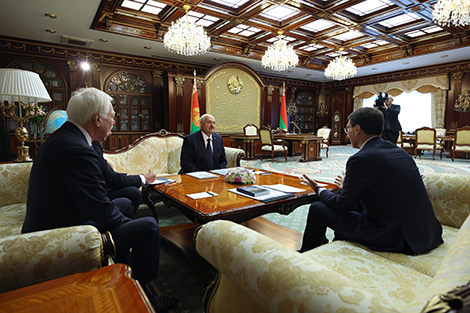
The first and second phases of the enterprise development have been completed, and work is now underway on the third phase, which involves deeper microbiological processing of grain. “We created the BNBC, completed two phases, and now the third, deeper one is underway. With Russia, we can achieve something worthwhile on this foundation,” the head of state believes.
Deep grain processing technologies make it possible to create high-value-added products that can be exported with a good profit and used for domestic industrial needs, reducing the need for imports. Igor Shchegolev drew attention to this during the meeting.
“That is exactly what we want,” Aleksandr Lukashenko said. “We want deep processing. Not just of grains, but perhaps of corn as well.”
“I know that you [in Russia] have already accumulated certain experience. We need to join forces and work together,” the president emphasized.
In this regard, the Belarusian side also has something to offer. For example, when Russia faced problems with feed supplies for its fish farming industry, Belarus stepped in: the production of such feeds has been developed at the BNBC to a high standard, ensuring both domestic supply and significant shipments to Russia.
The head of state made a particular point of the need to develop direct ties between enterprises and regions of Belarus and Russia, which could significantly improve their efficiency, accelerate project implementation, and put into practice decisions made at the leadership level. “You can see that we [the leadership of Belarus and Russia] have excellent relations and friendly contacts, but bureaucracy still gets in the way. That is why it is better to work directly. We learned this from our cooperation with China and Kazakhstan, and we are now scaling up our experience of regional cooperation,” Aleksandr Lukashenko said.
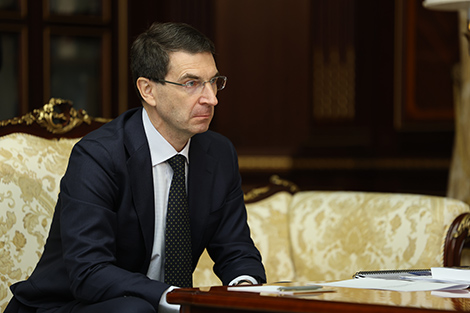
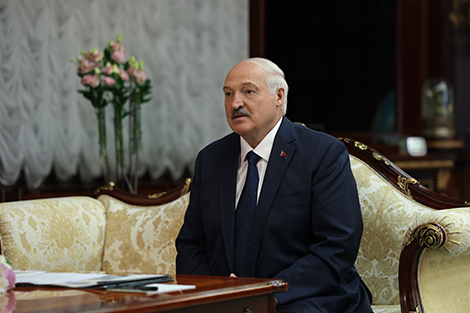
Recently, for example, the Russia-Kazakhstan Interregional Cooperation Forum was held, during which Presidents Vladimir Putin and Kassym-Jomart Tokayev held talks. In Belarus-Russia relations, such events have long become a tradition. “We have been doing this for a long time. Belarus and Russia are the trendsetters in this regard,” the head of state remarked.
Another example is cooperation with Kaluga Oblast, whose governor the president had met with earlier the same day. Interaction with Russian regional leaders takes place on a regular basis. “We need to stay on this course and develop in unison. I very much hope, Igor Olegovich, that with your help we will be able to overcome these challenges [as Kaluga Oblast is part of the Central Federal District],” the Belarusian leader said. “We need to work directly. I am glad you came. This is a promising start, since our cooperation usually involves individual regions, whereas here we are dealing with a group of regions, and a key one.”
In turn, Igor Shchegolev also highlighted the great potential for cooperation with Belarus in the field of biotechnology. The visit to the BNBC left the Russian presidential envoy with the most positive impressions. He noted the qualified and motivated staff as well as the high quality of the products. “This gives confidence that food security in Belarus and the Union State is in safe hands in this area. There is indeed enormous potential for cooperation,” Igor Shchegolev agreed.
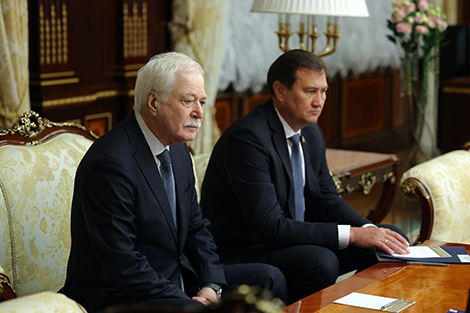
Incidentally, the Russian presidential envoy, as a young TASS journalist, once came to BelTA for an internship, so Minsk is quite familiar to him. “On the one hand, everything is recognizable, but on the other, the city is constantly changing,” Igor Shchegolev shared his impressions of his visit to the Belarusian capital.
During his current visit, he also visited the All Saints Memorial Church. “A tremendous amount of work has been done there. It is very valuable both for the nation’s memory and for educating the younger generation. I believe it deserves to be included in the program for all incoming delegations,” Igor Shchegolev added.
 print version
 make home page
 add to bookmarks