




News & Events in Belarus
Lukashenko outlines key priorities for Vitebsk Oblast, its leadership
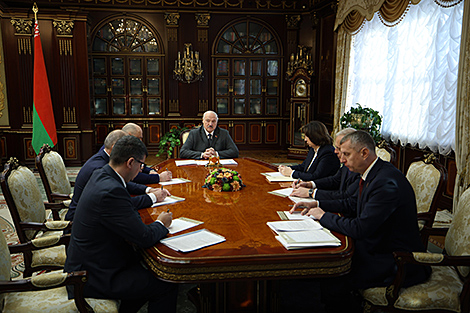
MINSK, 15 January (BelTA) – While appointing Aleksandr Rogozhnik as Vitebsk Oblast Governor, Belarusian President Aleksandr Lukashenko outlined key tasks both for the region as a whole and for the officials responsible, BelTA has learned.
“I want to say right away to the people of Vitebsk: this is not an emergency,” the head of state explained his decision to change the region’s leadership. “But the region needs some kind of breakthrough.”
Attending the meeting with the head of state were also Head of the Belarus President Administration Dmitry Krutoi, Chairwoman of the Council of the Republic of the National Assembly Natalya Kochanova, Chairman of the House of Representatives of the National Assembly Igor Sergeyenko (who also serves as the president’s authorized representatives in Vitebsk Oblast), and deputy chairpersons of the Vitebsk Oblast Executive Committee.
The president stressed that a meeting to discuss the development of the region, which is currently in a difficult situation, took place in Vitebsk on 24 October 2025. Following that meeting, senior officials “took a very close look at this region, studied the situation and monitored what is happening, primarily in agriculture and manufacturing,” the head of state said. Aleksandr Lukashenko expects the local personnel to mobilize and implement what was given special attention.
“We were simply working the old-fashioned way, and this has already been discussed many times. A fresh look is needed at the problems that exist there, and action must be taken,” the head of state emphasized.
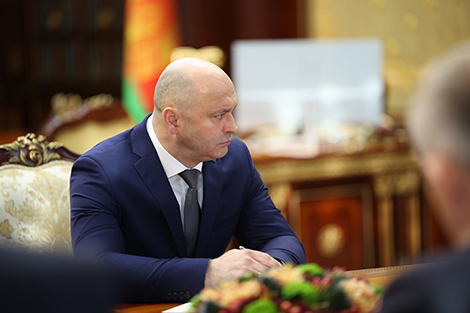
He emphasized that Vitebsk Oblast cannot be left without proper attention or “abandoned” in any way, even though, from an economic standpoint, the volumes of agricultural or industrial production it provides are not critical for the country.
“The country can easily manage without the products, especially agricultural, that Vitebsk Oblast produces today. And the ambassador to Russia [previously Aleksandr Rogozhnik served as Belarus’ ambassador to Russia] knows this better than anyone. God willing, we could sell and consume everything we produce today even without Vitebsk Oblast. But Vitebsk Oblast is part of our country, and good people live there,” Aleksandr Lukashenko said. “We cannot afford to lose it. Moreover, enormous resources are concentrated there. We simply need to refocus on these resources, look at the people who work there, solve their problems, those that we must solve, primarily at the regional level, and then demand results from them.”
“We absolutely cannot abandon Vitebsk Oblast. I repeat: even if, from an economic standpoint, we could manage without it, this does not mean the authorities should forget about our northern land,” the president added.
Why Rogozhnik and what the president expects from him
Regarding the candidacy of the new governor, the president noted that for Aleksandr Rogozhnik, the appointment to the new position did not come as news. “We met and discussed it,” the head of state said. “I understand it's not an easy step; I was aware of that, which was why I met with him beforehand to discuss these issues.”
"But what I like about him is a trait of his character: he is a man with a strong backbone, disciplined. And what is lacking today in Vitebsk Oblast? Only discipline," the president noted.
He once again said that his authorized representative for the region and the first vice governor together with the governor bear primary responsibility for what happens in Vitebsk Oblast. The head of state expects swift and effective actions. “There is no time to waste. There simply isn't any. Starting today, you need not to think, but to act,” Aleksandr Lukashenko emphasized.
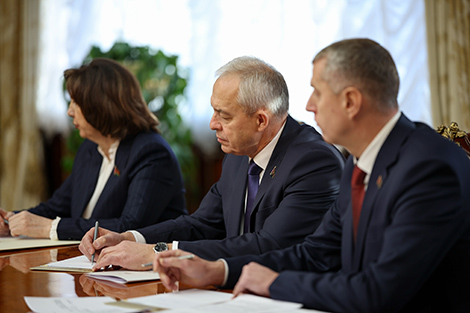
“There is no time for a slow start, Aleksandr Nikolaevich. You've already had an idea of how things were as you served as a minister [Aleksandr Rogozhnik was Industry Minister in 2022-2024]. You've observed Belarus from outside, from the perspective of our main market [during his tenure as Belarus’ Ambassador to Russia]. The ball is now in your court,” the president said.
He emphasized that high-level officials responsible for the region’s development would provide full support. “No one will hinder you. They will only help,” the head of state said. “No pressure. I promised we would not interfere.” Aleksandr Lukashenko specifically noted the assistance that should be provided by the State Control Committee. “Let them work together to identify bottlenecks and eliminate them,” the president tasked.
“Take action, it’s all in your hands,” the head of state advised the new Vitebsk Oblast governor.
Warning against agricultural mishaps
If local authorities are managing the current tasks in the housing and utilities sector, even amidst heavy snowfall, there is still work to be done in other areas that are priorities for the country.
“You see, the Lord is testing us (and rightfully so). He is testing our endurance and resilience. We’ve handled these snowdrifts (I’m confident we have). Well, you’ll sort it out there in Vitebsk Oblast. I’ll take a look myself soon. But the preservation of livestock, especially young stock - this is something you need to focus on properly,” the head of state’s outlined tasks for the near future. “I want to warn you: God forbid I hear reports of young livestock loss.”
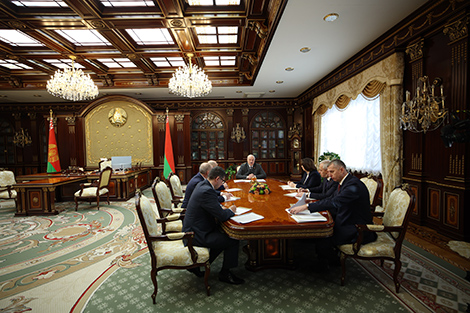
Aleksandr Lukashenko also said that the government is planning to hold a meeting, including on the situation in agriculture. “We will examine the situation in all regions. We have plenty of problems in Mogilev Oblast, Vitebsk Oblast, Brest Oblast, and Grodno Oblast, and in Minsk. These problems occur everywhere. But in Vitebsk Oblast, they are flourishing and multiplying.”
“Therefore, I warn you right away: God forbid I receive a report or I see, no matter how you try to hide it, the loss of young animals. Distribute them among households, do whatever it takes, but you must save and protect the foundation of your future salaries and incomes,” the head of state stressed.
According to him, the prime minister has been instructed to provide Vitebsk Oblast with everything necessary to organize proper conditions for keeping calves, which is of particular importance during the winter frosts. Calves should not be kept in plastic boxes out in the open, but at least under a roof.
For now, as the president noted, there are plenty of examples of heartless treatment of animals in agriculture. The head of state instructed the responsible officials to pass on information about these and other previously identified shortcomings to the new head of the region. “As a person who has worked in industry, he will be horrified when he sees such instances,” Aleksandr Lukashenko said.
A task for three
Among the priority tasks in the agricultural industry for Vitebsk Oblast, the president identified the construction of dairy farms, as well as beef and pig breeding and fattening complexes. “If I remember correctly, we used to produce up to half a million tons there. Today we should plan for a little more,” Aleksandr Lukashenko said.
In this regard, Vitebsk Oblast can fully count on assistance from the state. “We will help, but we must know where the state funds will be directed and, most importantly, what the returns will be,” the president emphasized. “It is unacceptable that we built complexes (hundreds have been built across the country) and they are not filled with good cattle. And if some complexes are filled, the cows there produce as much milk as goats. One has to ask, why did we build these complexes?”
“Therefore, it is correct that the targets for the complexes have been set: seven thousand kilograms of milk per cow and above. There is no other way,” the head of state added. In this context, he warned against attempts to inflate figures and falsify data: “I warn you that lying is unacceptable. Aleksandr Nikolayevich [Rogozhnik], there must be no lying. It is unacceptable.”
“Here’s a task for the three of you. Can you handle it? Demand and ask for, including from me, whatever you consider necessary,” the president said. “If you fail, it’s a disaster. There’s nowhere further to retreat.”
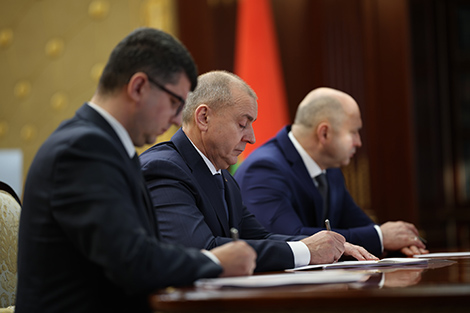
Aleksandr Lukashenko drew attention to the fact that representatives of the local authorities and, in general, all residents of the region must be involved in the implementation of the tasks. In this sense, the new governor needs to build a competent personnel policy. "Decide who you will work with. Invite, first of all, the chairmen of the district executive committees. Get the regional executive committee apparatus working," the president advised. "And start working. The tasks have been communicated and defined."
Industrial potential and local alternative to natural gas
The head of state also touched upon the development of the industrial sector of Vitebsk Oblast, where there are also some problems. Aleksandr Lukashenko sees the need to make greater use of the potential of woodworking enterprises and the linen mill.
In this regard, he mentioned the use of local fuels and the production of solid fuel boilers in Gomel that run on pellets, which are fed automatically. “This is good for us. Especially since we have so much forest rotting, we process it into pellets,” the president noted. “So let's do it ourselves. I installed a boiler, a bunker, it loads automatically... Boilers are produced both small and large, and for a whole village. We need to do this. This is the cost price. No matter how cheap natural gas is from Russia, it will still be three to five times more expensive than our own wood. Look for where to make money.”
 print version
 make home page
 add to bookmarks