



News & Events in Belarus
Agriculture, foreign ties: Key takeaways from Lukashenko’s regional visits
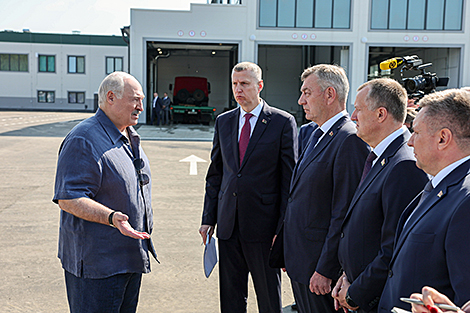
Regional development, livestock innovations, and the upcoming harvest campaign were the central themes of the working trips made by Belarusian President Aleksandr Lukashenko earlier this week. On 13 July, the head of state visited Shklov District, a region he knows inside out. This very fact proved decisive in selecting the territory to create a model for the entire country. The following day, Aleksandr Lukashenko traveled to neighboring Orsha District, where a farm under the National Academy of Sciences of Belarus (NASB) has been working for several years on breeding a unique dairy cattle breed for Belarus.
However, the key to implementing any plans is human resources, and a number of Belarusian regions are clearly facing a labor shortage. BelTA’s special report explores how the country is addressing the issue, what the president hailed as a “miracle” during his Shklov visit, and what makes the unique red dairy cattle so special.
When it comes to Shklov District, chosen to serve as a national benchmark, the secret of success is quite simple: a solid production base combined with a full range of service organizations, ensuring that the head of the district has real levers of control in hand.
“It is not because I used to work here and this is my homeland. It is simply because I know everything here down to every single meter. That is why we are establishing such a model district here in Shklov and partly in Orsha,” the head of state said. “We need Shklov District to be a role model, so that we don’t have to lecture everyone. You just bring them here and say: look how it should be done, and do it.”
On an agro-service center that can strike fear
Aleksandr Lukashenko considers the district agro-service to be among the basic organizations in a region (along with the mobile construction unit, agrochemical service, and others) without which effective work and management are impossible. Indeed, year after year, agricultural machinery is only becoming more sophisticated, requiring high-quality maintenance and, at times, repair. Transporting such equipment to distant locations is impractical. Furthermore, there are hundreds of simpler units that also require professional maintenance.
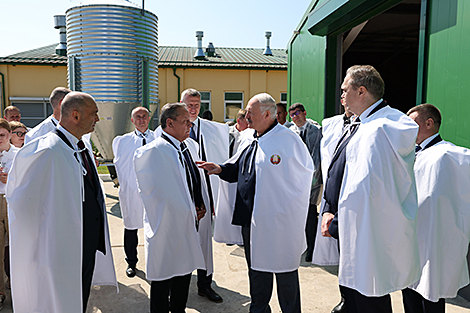
Projects to restore and develop the network of such enterprises are being implemented in many regions, but in Shklov, the initial goal was to create a model. New repair workshops have literally risen from the ruins of the old ones – just a year ago, outdated buildings over half a century old were being cleared away. Managed by the Belarus President Property Management Directorate, the facility now boasts a completely transformed look. The modern building was essentially constructed around a precisely engineered technology.
“Well done! You did a good job. However, it is ‘scary’ for those who will have to replicate this in other districts. They might get intimidated, because it is done exceptionally well here. But let them step up to the plate and do it,” Aleksandr Lukashenko noted, addressing Head of the Belarus President Property Management Directorate Yuri Nazarov. “The major work is complete, with only finishing touches left. We need to put it all in order. Order and discipline must be flawless. This is a model.”
Aleksandr Lukashenko asked Yuri Nazarov whether the project was too expensive, noting that every penny counts. “Half-measures will never yield results,” the head of the President Property Management Directorate replied. In terms of cost, the district agro-service center was equivalent to building one dairy farm complex.
“For us, it will be a miracle if we build such repair workshops [in other districts],” the Belarusian leader emphasized.
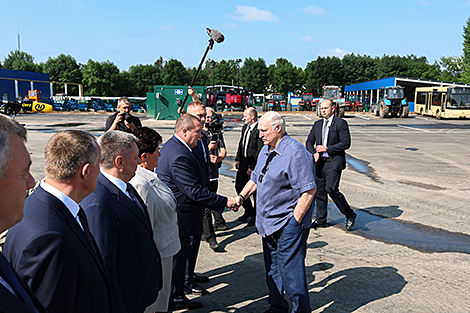
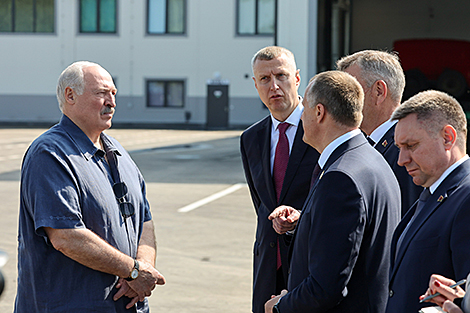
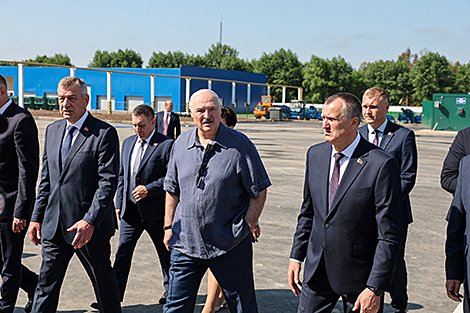
“The most important thing, which concerns the country as a whole, is that these should be support hubs for our plants,” the president said. “You sold the machinery here, so you must service it here. We need to ensure that they [district agro-service centers] are not sidelined by our plants – MTZ, MAZ, and others. They must be treated like their own. First of all, they should receive spare parts and everything else.”
The head of state was informed that 31 district agro-service centers across the country already operate under this model. They include the enterprise in Shklov.
Another important instruction from the president is that the prices for services must be kept under control. Naturally, this should not be to the detriment of the agro-service itself, but the rates must remain affordable for agricultural organizations.
And prices, as is well known, also depend on minimizing one’s own costs. For example, the boiler house of the new agro-service operates on wood fuel pellets – a local raw material. Aleksandr Lukashenko dictates that such a cost-effective approach should be implemented everywhere, with gas and other fossil fuel sources used only as a backup.
On Danish red cattle bred in Belarus
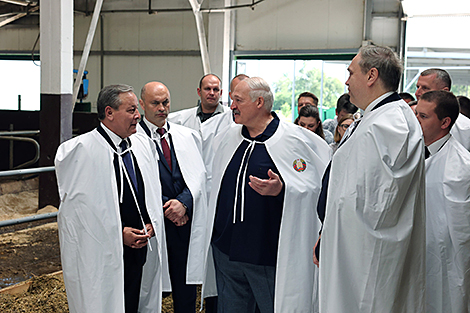
During his working trip to Orsha District, the head of state visited the Ustensky Dairy Complex of the Ustye enterprise, managed by the National Academy of Sciences of Belarus. The facility is currently working on breeding a new, high-yielding domestic red dairy cattle breed, which is designed to serve as an alternative and a complement to the Holstein and Black-and-White breeds.
So what makes this red breed so special? Milk yields aren’t the main selling point here, though they’re certainly nothing to scoff at, with each cow at the dairy complex averaging 23 liters of milk per day, and some even hitting 50 liters. The real draw is the quality: the milk has elevated levels of fat, protein, and vitamins, making it ideally suited for cheese production. What’s more, it’s hypoallergenic. So it’s suitable for people with lactose intolerance.
The project at Ustye kicked off several years ago. Using government funds, at the request of farmers and researchers, 1,200 heifers were purchased in Denmark and brought to Belarus, with a state‑of‑the‑art dairy complex built specifically for them. The long‑term goal was to develop a new breed, based on the Danish stock but optimally adapted to Belarusian conditions.
Scientists insist that progress is being made, though over the past five years the herd has less than doubled, and there is still no homegrown breed to speak of. But Vladimir Karanik, Chairman of the Presidium of the National Academy of Sciences, expects that goal to be reached by 2030.
Aleksandr Lukashenko came to see things for himself and clear up any lingering questions. “So what’s really going on, especially here, where we built a complex for researchers and created ideal conditions? Where's the truth?” the president inquired about the key issue.
Belarusian Agriculture and Food Minister Yuri Gorlov reported that the country currently has nearly 2,300 pedigree cows of the red breed. They are primarily based at Ustye, which has been designated as a first‑tier farm. “In 2028, another dairy complex for 1,000 head will be built here specifically for breeding the red Danish cow,” the minister said. Farms have been designated in Grodno Oblast, Minsk Oblast, and Brest Oblast that are already raising the same breed.
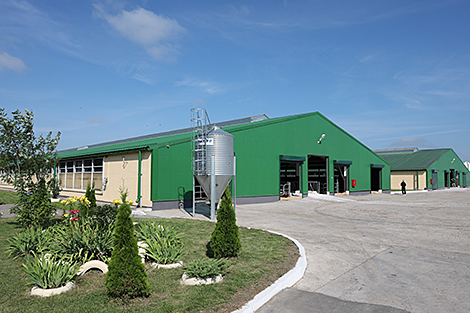
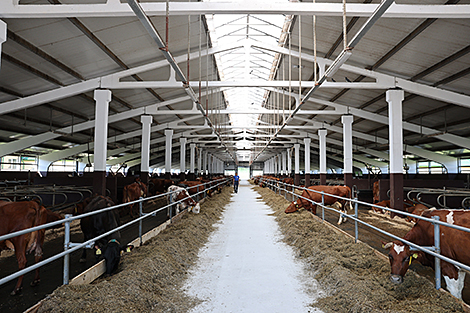
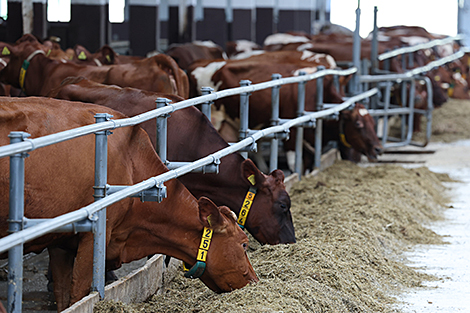
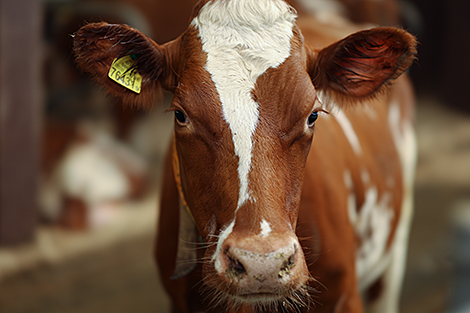
The head of the Academy of Sciences, for his part, gave a detailed account of the breeding work and the intricacies of building a solid genetic foundation, which, by 2030, should make it possible to speak of a genuinely Belarusian breed.
After hearing all the reports, Aleksandr Lukashenko instructed Head of the President Administration Dmitry Krutoi to find specialists who would clearly outline the task at hand. In other words, the head of state wants more than just assurances and rhetoric from scientists. He wants clear benchmarks for each year: “A full-fledged program. So that we can review the results and give our assessment. We need a concrete program that makes it clear what they (our top academician and the minister) are expected to achieve.”
Vladimir Karanik stated that the National Academy of Sciences, together with the Agriculture and Food Ministry, has already prepared such a program following the working meeting.
Aleksandr Lukashenko noted in this connection that those responsible for the project should be given more ambitious assignments, which back in the day used to be called socialist commitments.
The discussion on livestock farming also provided a good opportunity to remind everyone of the importance of addressing a long‑standing problem in this sector, namely the insufficient measures to ensure the preservation of livestock. According to Agriculture and Food Minister Yuri Gorlov, there is a downward trend in cattle mortality rates. But the results, so far, can hardly be called satisfactory. “You’ve been treading water. You’ve reduced it by less than one percent over six months. We’ll see where things stand at the end of the year,” Aleksandr Lukashenko remarked.
On the harvest outlook and the situation in agriculture
During his working trips, the head of state reminded everyone of the tasks that lie ahead before the start of the mass harvest campaign. Just a few days ago, heavy rains were hampering the winter rapeseed harvest effort, but now the weather is generally good. Importantly, farmers are currently running ahead of last year’s levels in terms of forage grass volumes.
Overall, in January-June 2026, the gross agricultural output rose by 4.9%, with livestock production going up by 3.6% and crop production surging by 15.3%.
The president stressed that it is essential to start the mass harvest campaign having resolved two key issues: the readiness of equipment and the availability of skilled operators to run, as well as fully functional grain drying facilities. “Grain must be passed through a dryer at least once, if not twice. So drying capacity is a must,” the Belarusian leader emphasized. “The harvesters too, of course. I believe we should have at least one operator per harvester, if not two.”
“For every harvester, we have the operator assigned to it,” Agriculture and Food Minister Yuri Gorlov assured, addressing the staffing situation.
“The same goes for forage harvesters and tractors. We need capable people for high-power machinery. Even the less powerful equipment is not easier to operate. But that’s the key point,” the Belarusian leader emphasized.
The harvest in the fields looks good, but Aleksandr Lukashenko voiced criticism over some obvious shortcomings. For instance, he spotted several fields that were heavily overgrown with weeds. “You did a poor job. I warned you that with this kind of weather, you need to focus on the right chemical treatments,” the president said.
Vitebsk Oblast may bring a significant addition to the national grain reserves this year. Vitebsk Oblast Governor Aleksandr Rogozhnik reported that the gross grain harvest, including corn and rapeseed, is expected to reach 1.2 million tonnes, compared to just over one million tonnes harvested last year. “God willing, that will be the case,” Aleksandr Lukashenko remarked.
This year, the region has also significantly expanded the area under corn and is harvesting grass fodder well ahead of schedule. Gains have also been reported in livestock production.
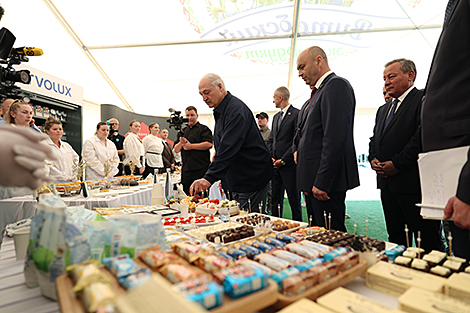
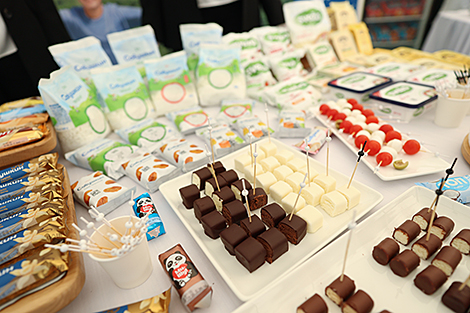
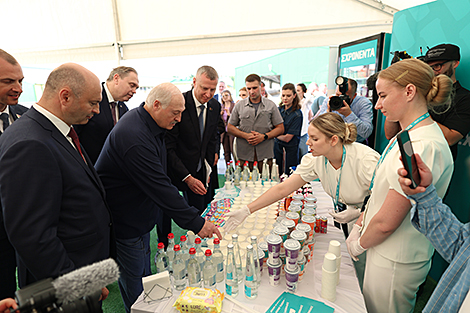
On the billion-ruble investment in Vitebsk Oblast
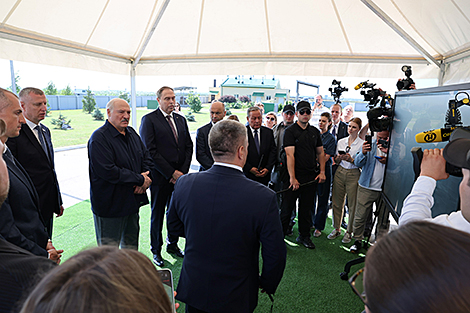
The development of Vitebsk Oblast is a complex issue that the head of state has addressed on multiple occasions. In terms of agriculture, it is one of the country’s most challenging regions. Agricultural enterprises are burdened not only by a harsher climate compared to southern Belarus, but also by accumulated debt, often inefficient management, and a simple lack of discipline, both technological and labor.
Several years ago, attempts were made to address these issues by creating integration structures that combined processing facilities with raw material zones. Struggling operations were placed under the management of more successful enterprises. Some efforts succeeded, others did not. Compounding all this are staffing problems, with a shortage of labor in some areas.
Vitebsk Oblast has decided to take a pragmatic approach, by using not only its own resources in agriculture (to be fair, the region does have some highly successful agricultural producers), but also by attracting outside investors: those who have outgrown their current raw material zones, who want to grow and develop, and, most importantly, who have experience in efficient management and the necessary finances.
Vitebsk Oblast Governor Aleksandr Rogozhnik briefed the head of state on this strategy. The focus is on implementing new projects with total investments of nearly Br1 billion. Among the investors are Agrokombinat Dzerzhinsky, Savushkin Product, Gorki Food Factory, and the Servolux company.
Aleksandr Rogozhnik said: “Agrokombinat Dzerzhinsky already works with Orsha Meat Canning Plant. The economic performance there has become significantly better. Without a doubt, an absolutely right decision has been made.” An additional agreement has been reached on building poultry farming facilities and facilities for cattle fattening.
Savushkin Product is renovating Polotsk Dairy Plant. “The upgrade is in full swing. Equipment is arriving,” the governor reported.
Aleksandr Lukashenko made an important strategic point: “This is good that you have processing capacity. But you should link it up with collective farms on the ground.”
“We intend to launch a strong processing industry. It will ensure a good price for raw materials supplied by agricultural enterprises,” Aleksandr Rogozhnik said.
“They will get good raw materials. But they have to invest in the land. Because everything starts from there: from milk and meat,” the president emphasized.
Another investment project is being implemented by Gorki Food Factory. After modernization, Vitebsk Dairy Plant will be able to produce a highly profitable fermented milk beverage.
Servolux is investing in agricultural enterprises in Dubrovno District, with agreements in place to build several livestock complexes.
This is not a complete list. Discussions on promising projects in the region are also ongoing with other investors.
However, none of this solves the staffing problem mentioned above. Here, Belarus has found common ground with Uzbekistan, which, on the other hand, has a surplus of labor resources and is interested in buying Belarusian food products. Just a week ago, Uzbekistan President Shavkat Mirziyoyev paid a visit to Minsk, and the heads of state agreed on cooperation.
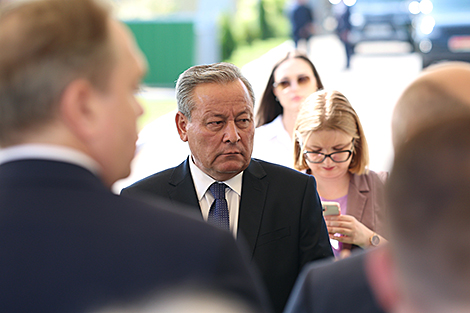
Specifically, Vitebsk Oblast is developing cooperation with Uzbekistan’s Andijan Oblast. The head of the regional administration, Shukhratbek Abdurakhmanov, was invited to a meeting with the Belarusian president in Orsha District.
Aleksandr Lukashenko noted that such investment projects with Belarusian companies could serve as a model for Uzbekistan as well. “These are some of the best companies. They can be used as a model. You will see how we work with our companies. We will work with Uzbekistan in exactly the same way,” the Belarusian leader assured.
On migrant workers and fraternal partnership with Uzbekistan
The topic of migrant workers was raised on both days of Aleksandr Lukashenko’s working trip to the regions. The president addresses it openly, calling it an urgent need shaped by demographic realities. Yes, modern technology, powerful machinery, and robotization are gradually reducing the need for labor, but there are many areas where human hands are still indispensable.
In Shklov District, the head of state addressed journalists to clarify the key points. After all, such trends may raise concerns among some people, and opponents are trying hard to exploit the issue.
Let’s identify the key points right away: labor migrants are being brought to Belarus under tight oversight, including via the Internal Affairs Ministry system. “We need a system. We have one. I have defined it. Only the top executive [of an enterprise] can employ them and he or she will be personally responsible for them,” Aleksandr Lukashenko said. “We need order. Employing just anyone is not what we need.”
“This is why make it selective and goal-oriented. Employ one, two, ten, twenty people. As many as you need. Personal responsibility. Aides will keep an eye on it. Certainly, if everything was done by our people, by Belarusians, it would be nice. But we sometimes lack people and sometimes people don’t want to work. We cannot do without hiring from the outside,” the president stated.
It has been decided that a system has to be worked out and people should be hired from the outside. “Ukrainians have started coming. Many Russians come to work with us. We’ve just held negotiations with Shavkat Mirziyoyev. There is a problem with finding jobs for people in Uzbekistan,” the Belarusian leader noted.
The second aspect Aleksandr Lukashenko talked about is very humane and employs an exceptionally Belarusian approach. To put it in simple terms, the foreigners, who come to Belarus to work, should not feel they are second-rate employees. They should not be artificially isolated. They should not feel they are not wanted in Belarus. They should not feel they are second or third-rate people.
On the contrary, the president insists on equal treatment and invites foreigners to bring families. He promises assistance with dealing with housing problems, access to healthcare and social services on par with Belarusian citizens. The key aspect of the approach is that Belarus respects hard-working individuals instead of representatives of various nationalities.
All of it is true for migrant workers from Uzbekistan that have been mentioned before. For now Vitebsk Oblast where the workforce shortage is at its worst is the priority area for them. Then the practice is supposed to be replicated across Mogilev Oblast’s entire southeast. If necessary, the practice may be applied with pinpoint precision in other regions as well.
The arrangements Belarus has reached with Uzbekistan stipulate that not only workers will come. Uzbekistan citizens will be able to develop their own agribusiness operations in Belarus using local livestock farming facilities and farmlands. Investments and workforce will be provided by the Uzbek side. Belarus will offer agricultural technologies and scientific support, equipment, and seeds. The possibilities were mentioned in Orsha District where Shukhratbek Abdurakhmanov, head of the administration of Uzbekistan’s Andijan Oblast, was present during the meeting with the president.
“I’ve promised to the president of Uzbekistan that we will do it. It is profitable for us. Vitebsk Oblast will be developed in this manner,” Aleksandr Lukashenko said. “You will process milk and meat into what you need. It is also necessary to build a processing enterprise. If you deem it necessary, we will build it together. Or you will build our own. It is up to you. The end price, the economy of the matter will depend on it.”
“We will work like brothers! Have no doubt about that,” the Belarusian leader assured.
Aleksandr Lukashenko also talked about housing availability for workers from Uzbekistan. “We have housing that is more or less normal in our villages. We will spruce it up together. And we will build everything for the people. For Uzbeks and for Belarusians. There will be no difference. Your kids will go to kindergartens and schools on the same terms Belarusians enjoy,” the Belarusian leader stressed. “If they come here, they have to know that they are not strangers for us. We will do it all. The only thing is that they have to work.”
Uzbekistan citizens will be employed not only in agriculture but also in civil engineering, manufacturing sector, the sphere of services, and as junior medical staff. So far the parties have agreed that over 5,000 people from Andijan Oblast will come stage by stage.
“It is necessary to keep an eye on the economy: what Vitebsk Oblast will get from it. It should be calculated with precision,” the head of state said.
Prospects of cooperation have been sketched out in woodworking as well. A location has been selected for building a modern woodworking enterprise using Uzbek investments. Apart from that, the partners are intent on making wood fuel pellets and shipping the products to Uzbekistan. “It is necessary to start doing it without delay,” Aleksandr Lukashenko remarked.
An agreement has been reached that the Uzbek side will set up a civil engineering company and will staff it with its own people. Among other things the company will take care of construction and repair of all its installations.
Apart from that, a trading house has already started working in Vitebsk to sell goods from Uzbekistan. Premises have been selected to open an Uzbek cuisine restaurant. Plans have been made to hand over a former sanatorium school in the town of Bogushevsk, Senno District for the sake of converting it into a recreational compound.
 print version
 make home page
 add to bookmarks