



Business news
Lukashenko names those responsible for domestic demand
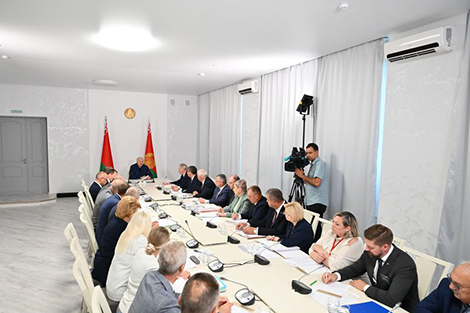
VILEIKA DISTRICT, 7 August (BelTA) - The share of Belarusian products on the domestic market is one of the key indicators of trade efficiency, which so far is failing to promote Belarusian goods effectively, Belarusian President Aleksandr Lukashenko said at a meeting on providing rural communities with a full and diverse range of goods to cover all their needs, BelTA has learned.
The president emphasized that the share of Belarusian products on the domestic market is one of the key indicators of trade efficiency. “And retail chain owners also bear responsibility for shaping demand in favor of domestic products. But so far, you are not coping with this task,” Aleksandr Lukashenko stated, adding that district executive committee chairpersons also share this responsibility.
According to statistics, in the first half of 2026, the share of Belarusian goods sold is generally growing. “But the growth is within the margin of error - 0.1%,” the president said.
The share of domestic products on store shelves currently stands at just over half (54.6%). “But let’s be honest: even this modest growth is not a sign of trade’s success, but rather a result of increased sales of cars from our homegrown brand BELGEE. That is, it’s not so much that trade has done a good job, but rather the state, which provided people with affordable loans,” Aleksandr Lukashenko said.
However, sales of domestic food products are declining. “By half a percent, but it is a trend,” the president said.
Against this backdrop, from January to May of this year alone, Belarus imported $7.5 billion worth of consumer goods, nearly a third more than in the same period last year. “Where are we heading?” the head of state asked. “If trade sees a shortage of certain goods, do not stay silent. Work with domestic producers, inform those responsible, and inform the government.”
Aleksandr Lukashenko noted with regret that in 2026 Belarus imported goods that domestic producers already make. In January-May 2026, compared to the same period in 2025, the share of imports increased for refrigerators and freezers (from 33% to 56%), corsetry products (from 55% to 62%), hosiery (from 15% to 17%), and household clocks (from 39% to 46%).
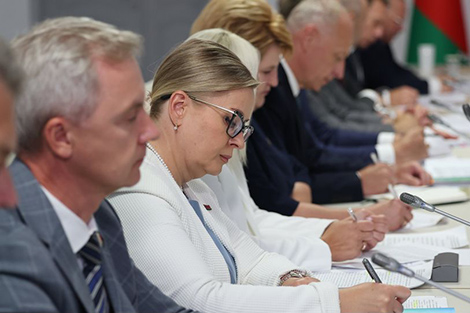
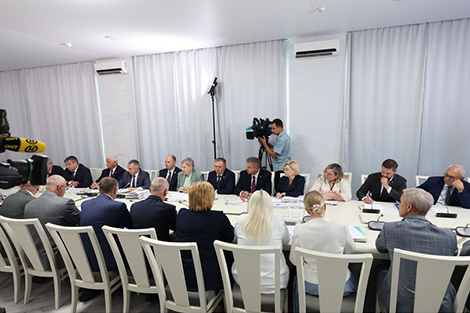
“What is lacking? What is getting in the way? Is it a lack of quality marketing? Product quality itself? Flexible pricing and credit support?” the president asked.
“In your reports, you say the situation is due to the rapid growth of online trade, especially marketplaces. But they are growing without state support. And you are losing your own market! So learn from them,” Aleksandr Lukashenko remarked.
At the same time, the operation of marketplaces has not yet been regulated by law. “What are we waiting for, Yuri Vitoldovich?” the head of state asked Deputy Prime Minister Yuri Shuleiko.
“The money that could have stayed in Belarus, with domestic producers, is flowing out of our economy abroad,” the president said.
He demanded that the government, oblast executive committees, producers, and trade enterprises pay attention to Belarusian goods - there must be enough of them to meet domestic demand.
One example is the situation with Belarusian sugar, demand for which traditionally rises during jam-making and winter preserving season.
Domestic sugar is cheaper than in all CIS countries. The factory gate prices, net of VAT, are $650 per tonne in Belarus, $820 in Uzbekistan, $775 in Kazakhstan, and $745 in Russia.
“We cannot allow domestic sugar to be exported through gray export schemes to neighboring countries. So far, everything is in order. But we will keep watching,” said Aleksandr Lukashenko.
 print version
 make home page
 add to bookmarks