



Business news
Belarus persistently increases export to remote countries
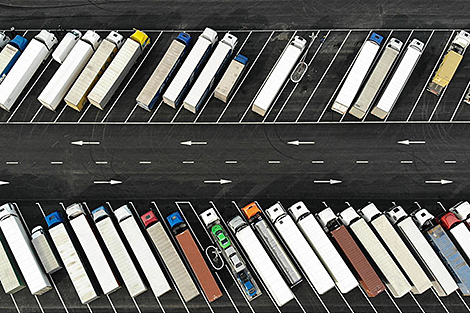
An archive photo
MINSK, 28 June (BelTA) – Belarus persistently increases export to remote countries. Belarusian Economy Minister Yuri Chebotar made the statement on the air of the TV channel Belarus One, BelTA has learned.
Minsk and Minsk Oblast have hosted the 13th Forum of Regions of Belarus and Russia this week. Yuri Chebotar emphasized its productiveness. He explained that trade and economic relations with any country become stable only thanks to investment cooperation. “As soon as there is a joint venture, the mutual penetration of capital – such ties definitely cannot be broken by any sanctions regimes or any other methods,” the economy minister noted.
In his words, mutual investments between Belarus and Russia exceed $10 billion. “Even comparing the size of the Russian economy and ours, we invest on roughly equal terms: $5 billion by Belarus in Russia and by Russia in Belarus, as a matter of principle. And this is truly good. Our country has more than 2,000 organizations with Russian capital. And this is what stability means. Because they do not just trade. These are all production and technological chains,” Yuri Chebotar explained. In particular, some projects of the “One district – one project” initiative have been implemented by using Russian capital.
Belarus also aims for close cooperation with countries of the Commonwealth of Independent States (CIS) and for developing and consolidating its presence in the markets of remote countries. “We see progressive results. This year the Asian region is key, showing export growth of more than 30%. On the whole, there are results in all remote countries, including the Latin American and African regions, as a matter of principle. But this is thanks to the fact that we are systematically shaping an export program for all our line government agencies,” the minister stressed.
He drew attention to the fact that working in the markets of remote countries is not easy, as they are all different. For example, when cooperating with partners in the Middle East, it is necessary to take into account that foods must always be halal. Enterprise operating procedures, requirements, certification, and other aspects must adapt to this peculiarity. Work on the African continent looks completely different.
“Therefore, the key task for the government and the economic bloc is to create institutional conditions to support this export. Today we are working in a number of such areas. The first is support for logistics activities to deliver goods there. Second, we have changed the principle after all: the farther you sell, the greater the support. Our colleagues are working on delivering cargo in consolidated shipments, thereby saving on logistics,” Yuri Chebotar concluded.
 print version
 make home page
 add to bookmarks