


Opinions & Interviews
Sergeyenko: 17 September lives on in people’s memory and in street names
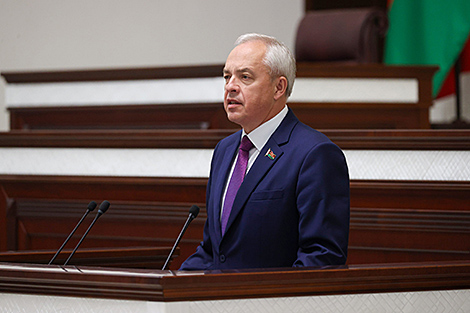
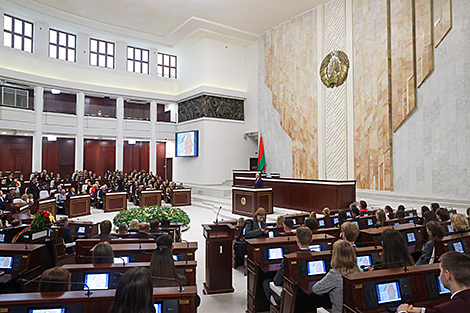
MINSK, 16 September (BelTA) - The date of 17 September has always lived and lives in people’s memory, in the names of streets and avenues, Chairman of the House of Representatives of the National Assembly of Belarus Igor Sergeyenko said at an event marking People’s Unity Day in the Oval Hall of the Government House on 16 September, BelTA has learned.
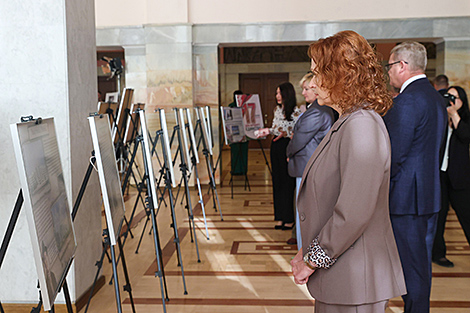
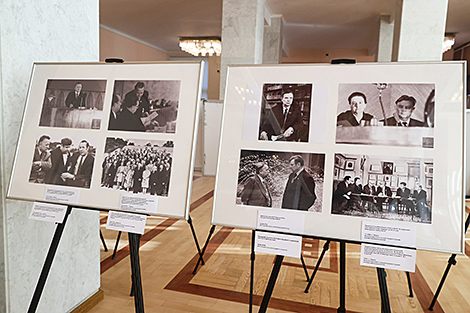
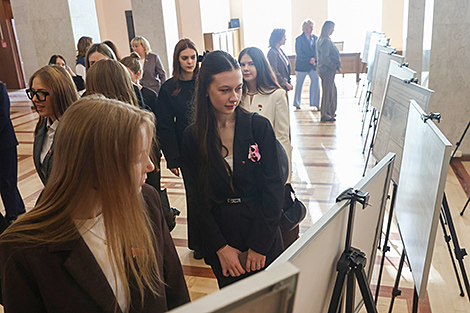
The event became part of the civic-patriotic campaign Faces of Memory initiated by the House of Representatives and was dedicated to the memory of the organizers of the liberation movement in Western Belarus. Along with MPs, the participants included cadets of the Border Service Institute, cadets of the Minsk City Cadet School, officers of the border outpost named after G. I. Kofanov of the Brest Red Banner Border Group, representatives of the veterans’ organization, the BRSM Youth Union, and students.
“Tomorrow our country will solemnly mark the most important state holiday – People’s Unity Day, which has firmly entered the history of our country thanks to the decision taken by the head of state. In fact, this holiday was restored from oblivion. On 17 September 1939, as a result of the liberation campaign of the Red Army, the lands of Western Belarus were returned to the Belarusian Soviet Socialist Republic. At that time it was decided to mark this day as the liberation of the working people of Western Belarus from the oppression of Polish landlords. That was what it was called. It was last marked in 1949. And in 2021 we unanimously came to the decision that it was precisely this date that should become People’s Unity Day. All the more so because this date is alive in people’s memory, has always lived and lives in the names of streets, avenues and agricultural enterprises in a number of regions across our country,” Igor Sergeyenko emphasized.
“You have seen the map of how Belarus was divided in two. Today it is hard to imagine that Grodno and Brest, Pinsk and Baranovichi, Vileika and Molodechno were on the other side of the border,” the speaker turned to the pages of history.
The Polish authorities pursued a policy of genuine ethnocide, he stated. “Ethnocide is the destruction of culture, history and language. The Polish authorities pursued a policy of destroying the language, closed schools, closed Orthodox churches, and carried out a policy of Polonization, that is, forcing everyone to become Poles,” the chairman of the House of Representatives emphasized, noting that the Belarusian people were assigned the lowest roles, industry was not developed, and settler colonization flourished.
The speaker also drew attention to such an aspect as the organization of the underground struggle waged by the Communist Party of Western Belarus, the Komsomol of Belarus and partisan detachments. He also recalled that local residents greeted the Red Army in 1939 joyfully, with flowers.
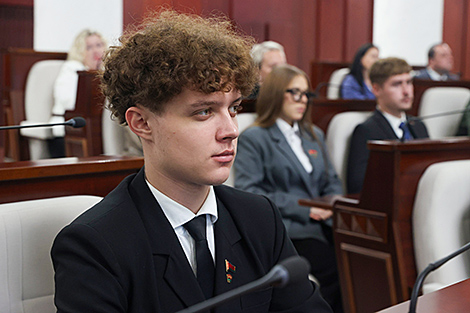
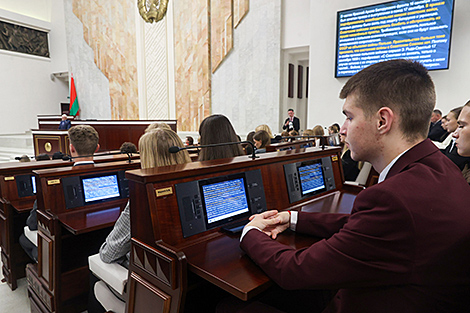
“What is the greatness of this day [People’s Unity Day]? In the fact that the people were reunited and have the opportunity to value their history, develop their language, develop their culture and their economy. And on the eve of the holiday, I would like to say to young people: the most important thing for you is to learn the lessons of history, to study and to take your worthy place in the life of our country,” Igor Sergeyenko stressed.
Vyacheslav Danilovich, Deputy Chairman of the Standing Commission on Education, Culture, and Science of the House of Representatives of the National Assembly and Doctor of Historical Sciences, recalled that Belarus has always been a geopolitical crossroads. While this generated trade revenues, it also brought a constant threat of war. “Our ancestors faced attempts to erase them from history thousands of times. Yet, they endured. Why? Simply because they stood united in their desire to live on this land and to live as they saw fit. And that is what true sovereignty is all about,” he emphasized.
Vyacheslav Danilovich also presented hard facts about Warsaw’s policy of ethnocide in Western Belarus.
“Nothing happens by accident in history. The tragedy of our people’s division is the ultimate lesson in why unity must be cherished as the apple of our eye,” he said.
Participants in the campaign gathered “bouquets of unity.” Everyone who came to the Oval Hall today brought flowers: daisies, roses, and chrysanthemums. These were arranged into three massive bouquets and laid at the base of sites that hold deep significance for every Belarusian. The first stop was Minsk’s Eastern Cemetery, where a bouquet of unity was placed at the grave of Sergei Pritytsky, who fought his entire life for a unified, strong, and independent Belarus. The memorial route also included the Minsk Hero City stele and the monument to the border guards of the legendary 17th Timkovichi Border Detachment in Kopyl District. It was the soldiers of this unit who guarded the frontiers and took part in the events of autumn 1939.
 print version
 make home page
 add to bookmarks