



Opinions & Interviews
Senko: Belarus has already achieved the goals the ILO wants the global community to reach
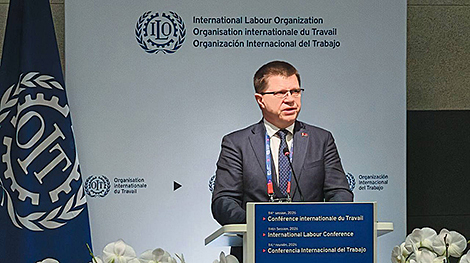
Yuri Senko. Image credit: The Federation of Trade Unions of Belarus
MINSK, 5 June (BelTA) – Belarus has already achieved the global goals that the International Labor Organization (ILO) is only calling on the global community to reach. The relevant statement was made by Chairman of the Federation of Trade Unions of Belarus (FTUB) Yuri Senko at a plenary session of the 114th session of the ILO’s International Labor Conference, which brought together representatives of more than 180 states, BelTA has learned.
One of the central themes of the global forum is the impact of artificial intelligence on the labor market. Which professions may disappear under the influence of new digital technologies, and which ones will require fundamentally new skills? How to ensure the protection of workers when labor processes are managed by digital technologies rather than a human? There are no clear answers yet to these and many other questions caused by labor market changes resulting from the rapid spread of artificial intelligence. But it is obvious to everyone that large-scale changes lie ahead, which will affect all states. Even today it is necessary to develop preventive measures that will ensure a smooth and fair transition.
In this matter many states can draw on Belarus’ experience of protecting the interests of workers. “As a result of an effective social dialogue, our country has implemented in practice a number of global goals that the ILO and other United Nations institutions are only calling on the global community to achieve,” Yuri Senko emphasized. “I am convinced that the Belarusian experience in this field can be useful to representatives of many states, including for the fair transformation of the labor market amid the rapid spread of digital technologies.”
In particular, adaptation to new professional requirements largely depends on the population’s access to quality education and retraining. In this regard, unlike many other states, Belarus has built a system that allows everyone not only to receive quality general education, but also to upgrade their skills and undergo retraining throughout their lives. The system of collective bargaining relations also contributes to this: guarantees for retraining and professional development are spelled out in most collective labor agreements.
“In practice, trade unions together with employers and authorities, seeing the upcoming transformations, organize in advance the training of employees to work in new fields and with new knowledge, thereby ensuring effective employment for everyone and stable operation of enterprises,” Yuri Senko noted.
The interaction of the parties makes it possible to effectively resolve another issue: protecting the interests of the most vulnerable categories of workers. The ILO emphasized that the introduction of artificial intelligence, like many other technological transformations, may primarily have a negative impact on youth, women, and people close to retirement. In this connection Belarus’ experience in introducing preventive protective measures for these workers is of particular value. A number of such measures have already been implemented in the legislation and collective labor agreements of our country. In particular, these include the mandatory assignment of the first job after graduation, and special employment guarantees for women and elderly people.
The head of the national trade union federation also drew attention to the fact that changes in the economy require the adaptation of legislation. In Belarus trade unions actively participate in the development of labor legislation and social policy. It is this approach that makes it possible, in the case of introducing new regulations, to take into account the opinions of different parties and provide for measures to protect the interests of workers. “For example, upon the FTUB’s initiative solutions are being worked out to regulate platform employment. In this connection we highly appreciate the ILO’s initiative to develop recommendations regarding platform employment. We are ready to cooperate, study, and implement the best practices in this field,” the FTUB chairman said.
Yuri Senko drew the ILO’s attention to another global issue: the need for the International Labor Organization to take concrete measures that will facilitate equal access of all states to new technologies, thereby ensuring a reduction in global inequality, which is reaching colossal proportions today.
“Every year more and more various economic barriers and sanctions appear in the world, which affect the exchange of technologies among other things. This is why we call on the ILO to launch an initiative aimed at a comprehensive assessment of the impact of sanctions as well as at the consolidation of trade unions to prevent the negative impact of economic restrictions on the working person. This will become a significant contribution of the organization to reducing global inequality. Belarus is ready to take an active part in the implementation of this initiative,” Yuri Senko emphasized.
 print version
 make home page
 add to bookmarks