

Opinions & Interviews
Safety, freedom, pride: Belarusians reflect on what citizenship means to them
An archive photo
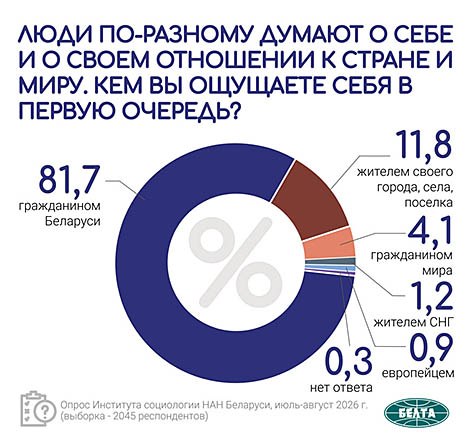
The Institute of Sociology of the National Academy of Sciences of Belarus conducted a comprehensive nationwide sociological survey and presented its second part, focusing on social and political topics. Respondents were asked: “People think differently about themselves and their attitude toward their country and the world. Who do you feel you are first and foremost?” A total of 81.7% of respondents said they primarily felt they were citizens of Belarus. Meanwhile, 11.8% identified themselves as residents of their city, village or settlement, 4.1% as citizens of the world, 1.2% as residents of the CIS and 0.9% as Europeans. BelTA correspondents found out what being a citizen of their country means to Belarusians themselves.
A sense of belonging to one’s country is a value
Alina Veremeichik, Deputy Dean for Ideological and Educational Work at the Faculty of History of Belarusian State University, Candidate of Historical Sciences and Associate Professor, noted that the survey figures clearly demonstrate the maturity of Belarusian society and the resilience of the country’s state model. “The fact that 81.7% of respondents primarily identify themselves as citizens of Belarus is a natural result of the long-term process of strengthening sovereignty and historical continuity. Such a predominance of national identity is based on several key factors: historical experience and the value of sovereignty, continuity between generations and upbringing, and a balance between national and local identity,” Alina Veremeichik said.
The expert emphasized that over the centuries the Belarusian people have gone through serious historical trials on their path toward building an independent state. “Today, a sense of belonging to one’s country is perceived by citizens not as an abstract concept but as a concrete value that ensures peace, security, and social stability,” she said.
In her view, the educational and awareness-building environment plays a crucial role in this process. Systematic work with young people, preserving the historical memory of the Great Patriotic War, and respect for state symbols foster conscious patriotism.
Commenting on the respondents who identified themselves as ‘citizens of the world,’ ‘residents of the CIS’, and ‘Europeans,’ Alina Veremeichik added: “Here it is important to understand the modern context. This is by no means an indication that they are detached from their roots. In the overwhelming majority of cases, these are our citizens who are open to the world, active professionals and young people who love traveling and discovering other cultures while genuinely taking pride in the fact that a passport of a citizen of the Republic of Belarus gives them the opportunity to explore the world freely while remaining Belarusians and returning home. The small shares of those identifying as a ‘resident of the CIS’ and a ‘European’ only confirm that the era of blurred supranational orientations is a thing of the past. Belarusian society firmly stands up for its own national dignity, clearly aware of its national interests and its own place on the world map.”
An intangible sense of pride
Polina Vavulo, a fifth-year student at Belarusian State Medical University, shared her view of the role of a citizen. “When you are asked who you feel you are, you may come up with many answers, but if we speak in global terms, I primarily feel Belarusian,” the student said. “When you travel and discover other countries, you become even more aware that we have our own unique culture and rich history. During an exchange internship in China, I had the opportunity to meet colleagues and tell them about our country and its achievements. Every time, it was incredibly pleasant to hear warm and respectful words about Belarus and our development. It creates a deep sense of pride in your heart.” “For me, being a citizen of Belarus is an intangible sense of pride in having been born in this beautiful land, where there is independence, freedom, and support from the state. We truly are a country of opportunities, and everything is done for the people. One of the main proofs of this is our healthcare system. Unlike a number of foreign countries, every citizen here can receive quality medical care regardless of their social status. In the future, I would like to contribute to the development of international ties, and I dream of a Belarusian-Chinese hospital being established in Belarus, where specialists could exchange advanced expertise and technologies,” Polina Vavulo said.
The student drew attention to an important trend of recent years: young people’s genuine interest in patriotism and the values of their home country. “I really like the trend toward patriotism that has developed. Of course, you cannot suddenly become a patriot; it comes through understanding and upbringing in the family, at school, and at university. It is encouraging when you see elements of our state symbols on everyday items, such as phone cases. If someone from outside tries to make us ashamed of this, our young people, on the contrary, proudly show that we are part of this country.”
Fostering responsibility in students and children
Olga Logvinova, a mathematics teacher at a Minsk school, associates civic identity with a sense of security, respect for traditions, and responsibility for the younger generation.
“As a teacher and a mother of two children, I feel like a citizen of Belarus. This feeling is absolutely fundamental and unquestionable because I know that I am safe anywhere in our country, I feel connected to its history and culture, I identify myself with the people who live here, and their traditions and views are close and understandable to me. I am also genuinely proud of the achievements of Belarusian school students at international academic competitions. When I talk to my former students, I often hear that our education system is the best,” the teacher said.
She believes that patriotic education begins with personal example and knowledge of one’s roots. “I want to develop this country and I feel responsible for future generations. I teach my students and my own children to have a responsible attitude toward their work and the people around them. I often use successful people from Belarus as examples so that they are motivated to achieve the highest possible results. All my students know the traditions of our country, and together we actively visit historical sites and museums.”
Olga also said that feeling like a citizen primarily means taking pride in one’s country and ordinary people. According to her, Belarusians are distinguished by special traits of character: the ability to accept another person’s point of view and a different culture, prudence, resourcefulness, insight, a sharp mind, and unfailing politeness.
Freedom, work, and the family home
For Vasily, a resident of Mogilev, the concept of citizenship is associated with respect for work, spiritual, and family values. “Although I live in Mogilev and this city gives me every opportunity to live my life, first and foremost I feel like a citizen of Belarus. These words contain a multifaceted concept. When I say them, I feel physical and mental freedom. I am free to make decisions and choose where to live and work. Like any resident of our country, I am not afraid of any kind of work; I love and value work, both my own and that of others. The person who works in the fields, cleans the streets, builds houses or raises children is doing an important job. Preserving the family home so that the family is like a temple and children feel safe is an essential value,” he said.
The Mogilev resident follows the principle “Where you were born is where you are needed” and emphasizes the value of a simple human life in one’s native land.
“Some people endlessly search for a better life without noticing that the truth is right nearby: directly under their feet. You just need to be able to see it and let it into your heart. My home is special to me also because here I can freely go to church and practice the Christian faith. Here I have my home, my family and the confidence that I will receive help if necessary. The city is perfectly suited to raising children, working and looking to the future with confidence.”
Proudly saying: “I am from Belarus!”
Particular affection for Belarusian soil is also expressed by those for whom Belarus became home half a century ago. Pensioner Polina Katsuba was born in the Altai Territory and moved to Minsk in 1977.
“I have lived in Belarus for almost half a century and consider myself an Orthodox Christian. My husband is Belarusian and asked me to bring the children here because this is where our roots are. I remember arriving in Minsk for the first time early in the morning and immediately going on an excursion to Khatyn. As soon as we left the city, I saw the Logoisk forest and told myself: ‘That’s it, I’m staying here.’ I returned home, quit my job, and moved. I was treated wonderfully in Belarus: I was immediately given a good job, and my children were enrolled in school. What impressed me most was that you can find both a forest and a lake near your home. I especially love the softness and melodiousness of the Belarusian language. After so many years of living in this country, I can firmly say that Belarusians are a wonderful people; they will even share a piece of bread when it is needed.”
Despite her advanced age, Polina Katsuba actively participates in the country’s life, sings, dances, and sets an example for the younger generation. “I run together with young people and take part in triathlons. Wherever I am invited - to lay flowers at Victory Square, dance at a festival or recite a poem - I always go. I don’t have the words ‘I can’t’ or ‘I don’t want to.’ When I took part in international competitions and was asked where I had come from, I proudly answered: ‘I am from Belarus!’ And I am genuinely proud to live in such a beautiful, kind and peaceful country.”
 print version
 make home page
 add to bookmarks