


Opinions & Interviews
FM: Belarus-Russia cooperation model can contribute to new security system
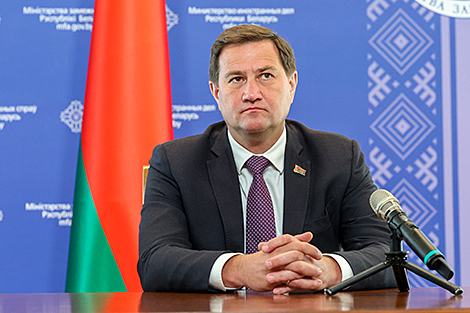
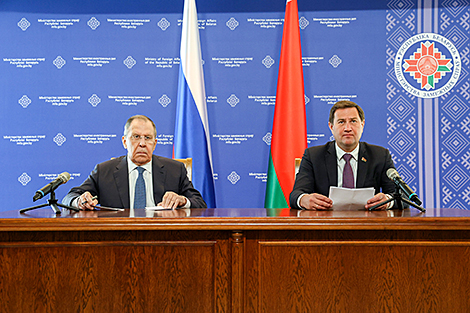
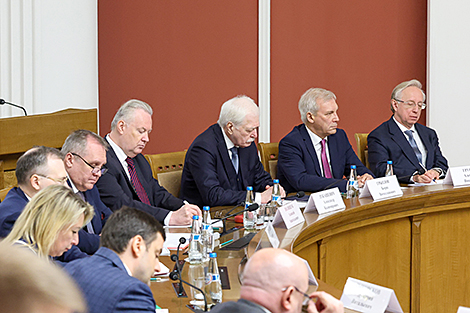
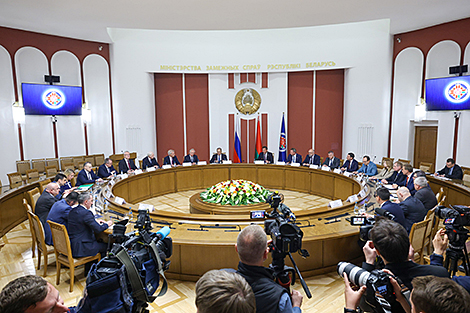
MINSK, 15 June (BelTA) – The world needs a new security system, and Belarus and Russia are ready to share their experience of cooperation within the framework of the Union State, Belarusian Minister of Foreign Affairs Maxim Ryzhenkov told journalists after a meeting with Russian Foreign Minister Sergey Lavrov in Minsk on 15 June, BelTA has learned.
The minister noted with regret that geopolitical instability has become a constant backdrop to meetings between the foreign ministers of the two countries. “The tragic events in Ukraine, the Middle East, Venezuela and Iran confirm that the world needs a new security system based on equality, mutual respect and trust,” Maxim Ryzhenkov said. “Without a responsible dialogue, there is a risk of an arms race that could become humanity’s last.”
He expressed confidence that the Belarusian-Russian model of cooperation could serve as a growth point for a stable system of international relations across Eurasia. “Over more than three decades of intensive and open dialogue, our countries, despite obvious differences in economic and military potential, have managed to build effective mechanisms for taking each other’s national interests into account, create a functioning system of common and indivisible security and, most importantly, ensure growing prosperity for our citizens through these efforts,” he said. “It is precisely these principles and approaches, tested through our own experience, that we propose as a basis for resolving crises in the region and building a renewed Eurasian and global security system.”
According to Maxim Ryzhenkov, cross-border trade, industrial cooperation and investment - rather than arms races and the construction of barriers - benefit the entire population of Eurasia rather than military-industrial elites.
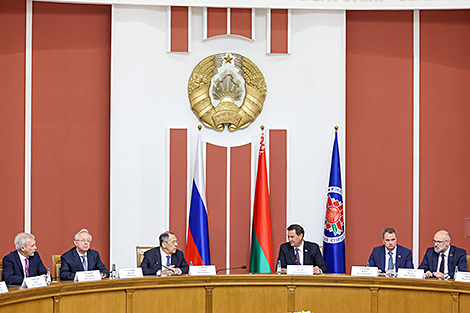
Maxim Ryzhenkov said that during talks with Russian Foreign Minister Sergey Lavrov, the two sides exchanged views on key international issues, discussed relations with third countries and blocs, and paid particular attention to global and regional security developments, sanctions-related issues, and negotiations on the Eurasian Charter of Diversity and Multipolarity in the 21st Century.
 print version
 make home page
 add to bookmarks