


Opinions & Interviews
Expert points out Belarus history events subjected most frequently to distortion, falsification

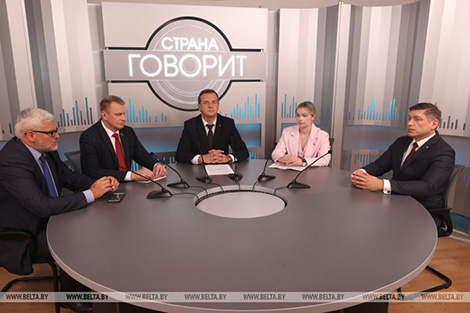
MINSK, 9 September (BelTA) – Which events from Belarus’ history are most frequently subjected to distortion and falsification has been revealed by Vyacheslav Danilovich, Deputy Chairman of the Education, Culture, and Science Commission of the House of Representatives of the National Assembly, in a recent episode of BelTA’s project The Nation Speaks.
“History must be treated very carefully, adhering to the principle of objectivity. Speaking of the history of Belarus, unfortunately, it has to be stated that the events of the Great Patriotic War [of 1941-1945] and World War Two are distorted and falsified most frequently. This is why our Constitution stipulates the importance of preserving historical truth and memory of the heroism of the Belarusian people in the Great Patriotic War as well as the historical memory of our people as a whole,” Vyacheslav Danilovich said.
Apart from that, in his words, attempts are made to distort the events of the autumn of 1939. Allegedly, the conclusion of the non-aggression treaty between Germany and the Soviet Union [the Molotov-Ribbentrop Pact signed on 23 August 1939] untied Germany’s hands to attack Poland, even though back in the spring of 1939 Hitler made the corresponding decision and methodically prepared for this attack. Moreover, on 22 August 1939 it became known that, regardless of the signing of the non-aggression treaty, the decision was made and Germany would attack Poland on 1 September.
“Everything was predetermined even before that. If we talk about an earlier period of history, active attempts are made to distort and falsify the period of the Polish-Lithuanian Commonwealth. But what was gentry democracy? In fact, it was gentry anarchy. And the gentry itself brought the Polish-Lithuanian Commonwealth to ruin. Its actions became effectively the cause of the weakening of this state and its partition. We must not forget this. Let me remind you about another point: after the collapse of the Soviet Union, we were urged to actively take pride in the fact that during the period of the Polish-Lithuanian Commonwealth the first European constitution was adopted – the Constitution of 1791. But what kind of document was it? First, it was not called a Constitution, it was called the Government Act. Throughout the text, it clearly stated ‘Polish people’, ‘Polish Commonwealth’. This constitution finally eliminated the division of the Polish-Lithuanian Commonwealth into the Grand Duchy of Lithuania and the Kingdom of Poland. What were we urged to be proud of? A document that finally eliminated the sovereignty of the Grand Duchy of Lithuania and anchored Polonization, which was in full swing at that time. As the saying goes, you become what you look up to. Therefore, it is very important to see these historical connections and underlying reasons. History is a double-edged weapon. Any facts can be plucked out from different periods and twisted. This is why it is important to have one’s own understanding of history based on objectivity,” the historian stated.
 print version
 make home page
 add to bookmarks