



Opinions & Interviews
Belarus’ MFA slams Germany for politicizing WWII memory
An archive photo
MINSK, 9 May (BelTA) – The attempts by German authorities and memorial sites officials to prevent Belarusian diplomats from participating in commemorative events marking the liberation from fascism are met with deep confusion and outrage, Belarusian Deputy Foreign Minister Igor Sekreta said in an interview with the German newspaper Berliner Zeitung, BelTA has learned.
“Attempts by German authorities and memorial sites officials to prevent Belarusian diplomats from participating in commemorative events marking the liberation from fascism have been met with deep confusion and outrage for several years now. It’s a disgrace,” Igor Sekreta emphasized.
The diplomat noted that the Belarusian side is denied the opportunity to lay flowers at memorials to the liberators who gave their lives in the fight against fascism. Yet at the same time, Germany sees no problem in investing billions in building up armaments and deploying troops near Belarus’ borders.
“Where is the repentance? We are told of a desire to avoid, so to speak, the political instrumentalization of memory. Yet, the German side is doing exactly that – artificially linking the memory of World War II to the current situation and using history to serve short-term political ambitions. These discriminatory approaches are absolutely unacceptable. The actions of the German side are extremely painful for Belarusian society and cause irreparable harm to the long-standing joint efforts toward reconciliation between our peoples,” he said.
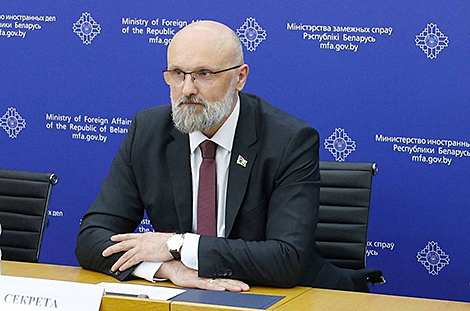
The deputy foreign minister stressed that Belarusian diplomats need neither invitations nor permissions to duly honor the memory of millions of innocent victims of German concentration camps – children, the elderly and women who were subjected to inhuman experiments, burned in ovens, gassed – as well as those who gave their lives for their liberation.
“We have done this before and will always do so – with all due respect to the laws of the host country,” Igor Sekreta added.
In his opinion, the approach of the German authorities is fundamentally wrong and dangerous for the future of Belarus and, above all, for Germany and all of Europe, because it is the suppression of memory and the distortion of history that lead to the glorification of Nazism and attempts to return to the most unthinkable methods of domination.
“Today, initiatives and practical steps aimed at restoring trust are more relevant than ever. I am deeply convinced that the memory of the tragedy of World War II should unite us with the Germans, not divide us. That is not only our view. This is evidenced by numerous appeals to our embassy in Berlin, in which German citizens expressed sincere support for the Belarusian side,” the diplomat shared. “We are grateful to all Germans who have not remained indifferent to the clumsy attempt by politicians to tear apart our shared memory.”
 print version
 make home page
 add to bookmarks