




Press releases
Total aortic replacement performed in Belarus for the first time
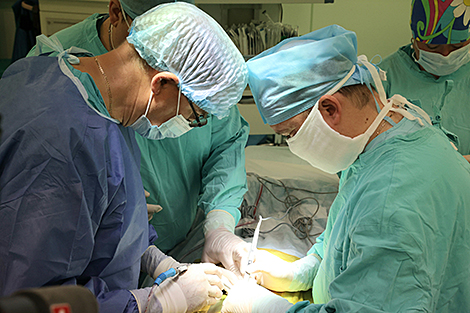
An archive photo
MINSK, 11 July (BelTA) – For the first time in Belarus, physicians at the National Research and Treatment Center Cardiology have performed a landmark surgical intervention for chronic aortic dissection, Ruslan Zhmailik, a cardiovascular surgeon and research fellow at the Center’s Laboratory of Cardiovascular Surgery, told BelTA.
The surgery, unprecedented for Belarus, involved treating Type 1 chronic aortic dissection that has progressed to a thoracoabdominal aortic aneurysm in a patient with connective tissue dysplasia.
“Prior to this case, no patient in Belarus had ever received a total aortic replacement from the aortic valve to the iliac bifurcation,” Ruslan Zhmailik explained. “Such patients were usually referred to the Petrovsky Russian Research Center of Surgery, which has accumulated the most extensive experience in treating these conditions anywhere in the CIS.”
Interventions on individual segments of the thoracic aorta, including the ascending aorta, the aortic arch, and the descending aorta, had been performed in Belarus for many years as a preparatory step toward performing a full-scale procedure. However, to master a total aortic replacement surgery, Belarusian specialists traveled to the Petrovsky Institute for training.
The country’s first total aortic replacement surgery was carried out by a multidisciplinary team of specialists from the National Research and Treatment Center Cardiology under the leadership of Deputy Director for Surgical Care Sergei Spiridonov.
As for the patient, her aorta has now been completely treated, and no further surgical interventions are required.
“Given that she has a genetic disorder that led to reduced production of a protein called fibrillin, she may later face complications involving other vessels, such as the subclavian and visceral arteries,” Ruslan Zhmailik noted. “The disease causes changes in the inner layer of blood vessels, which can periodically impair their normal function and, under elevated blood pressure, lead to linear tears that may develop into aneurysms.”
He emphasized that Belarusian cardiac surgeons have fully developed treatment protocols for the remaining arteries, and these do not present the same level of complexity as treating conditions of the thoracoabdominal aorta.
On average, about 15 patients per year who may require total aortic replacement are seen at the center. Statistics indicate that 1 to 2 patients per 100,000 population need open surgical treatment rather than endovascular or hybrid procedures.
Furthermore, in the post-COVID period, with increased access to computed tomography, the condition is being detected more frequently at early stages, when the risk of serious progression is still high.
“Having gained a certain amount of experience and recognizing the relevance of this type of treatment for Belarus, we decided to develop this specialty and perform such interventions using our own specialists,” the cardiovascular surgeon concluded. “With these new competencies, we are offering patients a chance for a successful outcome, achieved through total aortic replacement.”
 print version
 make home page
 add to bookmarks