



Press releases
Second Slavianski Bazaar in Vitebsk: ‘cornflower’ currency and the birth of a star
An archive photo
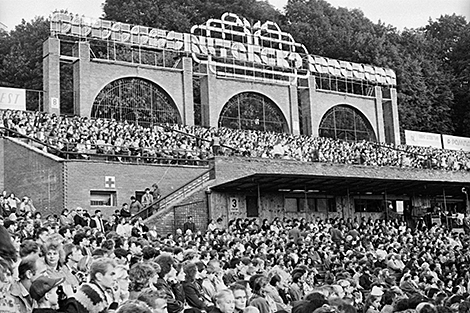
MINSK, 12 June (BelTA) - The second Slavianski Bazaar arts festival took place in Vitebsk on 22-28 July 1993. The festival directorate told BelTA what made it so surprising for guests.
In 1993, the Slavianski Bazaar became a member of the International Federation of Festival Organizations (FIDOF). This was an act of recognition of the festival’s international standing. For the first time, the festival venues included the Palace of Culture of Trade Unions [now the Cultural and Business Center], the Marc Chagall Art Center [today the Marc Chagall Museum], and the Spartak Cinema. As at the first festival, performers from Belarus, Russia, Ukraine, and Poland took part in the event. Additionally, for the first time this year, the flags of Bulgaria, Kyrgyzstan, Lithuania, Slovakia, Türkiye, and Yugoslavia were raised on the flagpoles.
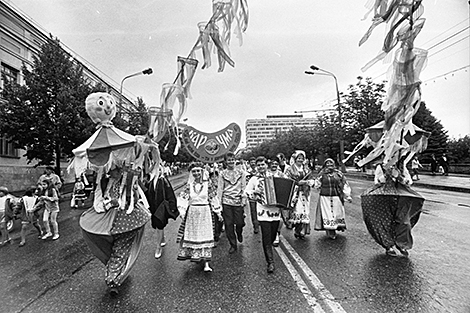
The festival program featured many new elements. It included group interviews with pop stars, which quickly became a favorite among journalists. A presentation of the Marc Chagall Art Center took place, which hosted festival art exhibitions in subsequent years. A new entertainment event for young people, Disco Bazaar, was also introduced, with its premiere held on 21 July.
For the first time, a press competition was organized. The prizes for the best journalists and editors were original ceramic vases with flowers. An award called the Golden Pen was established for the most active and highly professional promotion of the festival’s ideas. It was crafted by Vitebsk artists and took the form of a stylized bronze pen dipped into an inkwell, finished with nickel silver.
It was at this forum that the famous festival currency, the ‘cornflowers’, made its appearance. The banknotes featured the flower of the same name growing on a musical staff - the festival’s emblem. Festival participants and guests received cornflowers to avoid problems with exchanging national currency for Belarusian rubles.
For the first time, the Town of Artisans pitched its tents and pavilions - a unique fair of folk arts and crafts. Seventy folk craftsmen from the Dvina region came to Vitebsk to take part in the fair.
The 1993 young pop singers competition featured 36 participants. The jury was chaired by People’s Artist of Russia Nadezhda Babkina. The jury also included People’s Artist of Belarus Vladimir Mulyavin, artistic director of the Pesniary State Ensemble, as well as performers and composers from Ukraine and Yugoslavia. The jury was truly a people’s jury. The first Grand Prix in the competition’s history was won by Taisia Povaliy. This victory gave a new boost to her career. The singer herself has noted on several occasions that it was in Vitebsk that the star of Taisia Povaliy was born, and Belarus became her true creative homeland and a source of strength.
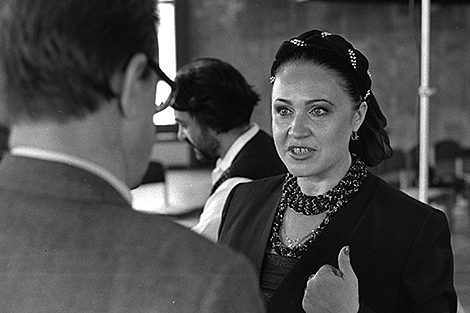

“I am proud of my victory. I am pleased to have gone down in the history of the Slavianski Bazaar as the first Grand Prix winner. When I come here, I feel like I’m coming home. You know, there is a point from which something important in life begins, a special turn in one’s destiny, that’s how it is for me. I always remember Belarus and the Slavianski Bazaar when I return,” Taisia Povaliy shared after the opening of the festival in 2024.
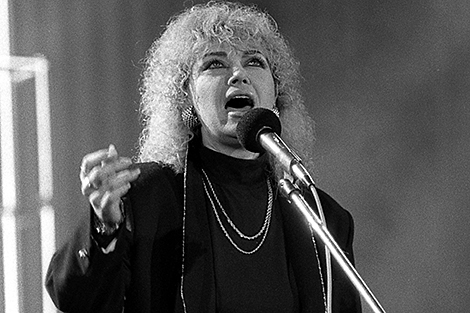
Taisia Povaliy
In an interview, the singer recalled that she had caught a severe chill in the concert hall, could not turn her neck, and even lacked the strength to attend the awards ceremony. But the pain disappeared as if by magic once she received the joyful news of her victory.
According to Taisia Povaliy, Vitebsk opened the doors to the big stage for her, and her triumph in the competition brought her true fame: “When I stepped onto the platform in Kiev, I understood what victory really means. All the TV channels came to meet me, and my song was playing on every radio station.”
Since then, the singer has become a regular guest at the Slavianski Bazaar, returning almost every year. During a conversation with journalists, the artist confessed that, besides career success, Vitebsk gave her the chance to meet her future husband, producer Igor Likhuta. “One day at the Slavianski Bazaar, I saw the man of my dreams. It was Igor. We later got married. So at the festival, my heart skipped a beat. There were many other emotions too. The atmosphere here helps feelings develop,” Taisia Povaliy recounted.
In 2019, she received the Belarusian President’s Through Art to Peace and Understanding Award, and the singer’s name star appeared on the Walk of Fame near the Summer Amphitheater. She became the 15th laureate in history to receive this honor.
 print version
 make home page
 add to bookmarks