




Press releases
New discoveries at Berezovets hillfort shed light on medieval defensive architecture in Belarus
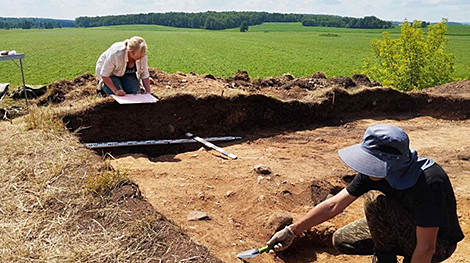
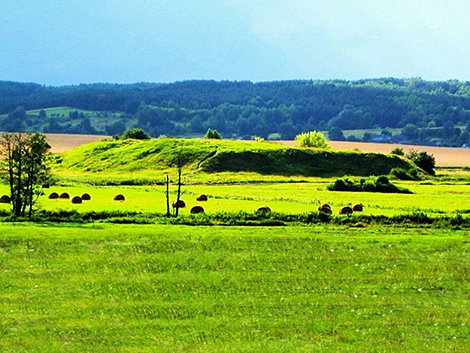
Near the town of Korelichi, research continues on the 16th-century Kmita Castle, the hillfort of Berezovets. During previous excavations, the entrance gate and a bridge leading to the castle were discovered. This year, archaeologists have uncovered a section of the wooden wall of the 16th-century hillfort. The findings and the conclusions drawn were shared by Natalya Pochobut, Head of the Department for the Preservation and Use of Archaeological Heritage at the Institute of History of the National Academy of Sciences of Belarus, Candidate of Historical Sciences, Associate Professor, archaeologist, museologist.
During the excavation of the Berezovets hillfort, wall structures were found beneath the defensive rampart. The wall that once stood on the rampart and protected the privately owned feudal estate of Kmita Stretovich of Berezovets. “The excavations have confirmed our hypothesis that the wooden castle was built precisely in the first decades of the 16th century,” Natalya Pochobut noted.
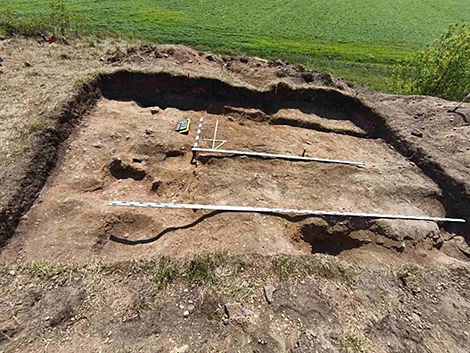
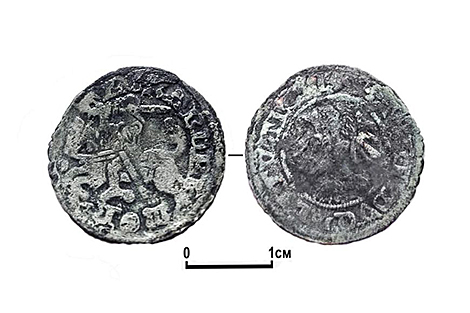
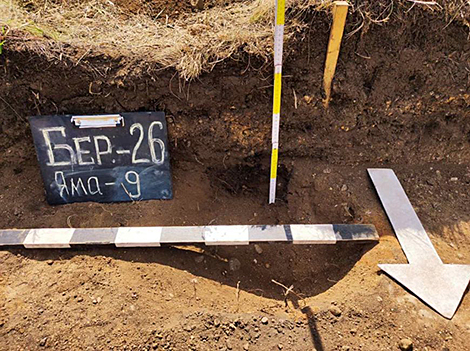
“We studied in detail the description of the Berezovets castle, and explained and interpreted several phrases describing the castle wall. As a result, this year’s expedition has for the first time uncovered remains of the wooden wall foundation on a section of the defensive rampart that was destroyed during World War I. These structures were originally covered by the sandy fill of the rampart. As we know from the castle inventory (and have now confirmed archaeologically) the walls were built ‘from piles’ (vertically driven posts), with wedge-shaped beams inserted into longitudinal grooves. Part of the wall was in the form of a palisade made of logs (‘dylis’) 19 and 24 cm in diameter. This was shown by a recent clearing of the virgin soil. They had a rectangular cross-section, according to written sources,” Natalya Pochobut said. “The excavation was taken down to the virgin soil, and a coin was uncovered: a half-groat of Sigismund I the Old, which dates to the beginning of the construction of the defensive wall (1508–1519) by the owner of the Berezovets estate, Pan Kmita Stretovich."
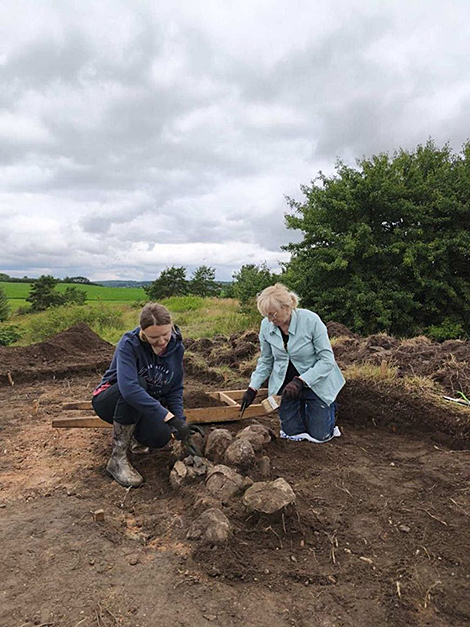
Natalya Pochobut added that two rows of posts connected by ‘dylis’ were revealed in the excavation. “As a result, the wall within the base of the rampart had a thickness of about 1.7 meters. The logs used ('dylis') had a diameter of about 0.24 meters, while the posts were 0.5 meters. We believe that the distance between the posts ('palis') could have been at least 4 meters, but this remains to be determined in future work. On the outside, in the center, the wall was reinforced with an additional wooden post,” she explained.
“The fortified settlement has a large area. I chose a spot where the defensive rampart was leveled and destroyed during the 1915 battles. That’s exactly why we were able to find the wooden base of the wall pretty close to the surface, right on the original ground,” the archeologist said.
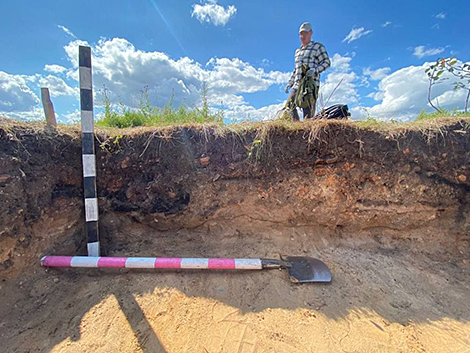
According to Natalya Pochobut, the Berezovets estate was purchased in 1636 by Zygmunt Karol Radziwill, the fourth Ordynat of Nesvizh. “The wooden castle, situated on a naturally high hill in the valley of the Servech River, a tributary of the Neman, fell into decay no later than the 1680s. Interestingly, after World War II, local residents from the village of Berezovets searched the site for valuables, and some even sold them to survive the difficult postwar period,” the historian added.
The Berezovets estate offers fantastic archaeological insights into the agricultural past of Korelichi District, with a collection of domestic animal bones and hunting trophies totaling several thousand pieces. The Berezovets manor farm sat just below the castle and featured numerous outbuildings: livestock barns, granaries, calf and cattle sheds, a kitchen, and servants’ housing. People were well-fed, a fact proven by the discovered butchering area where livestock was processed.
“Beyond the 24-square-meter trench on the southwestern edge of the site, we also opened a 4x2-meter test pit on its southeastern side. The finds include 17th-century musket balls, an intact cornice stove tile with multiple fragments from the same 17th-century oven, and a clump of six coins,” Natalya Pochobut said.
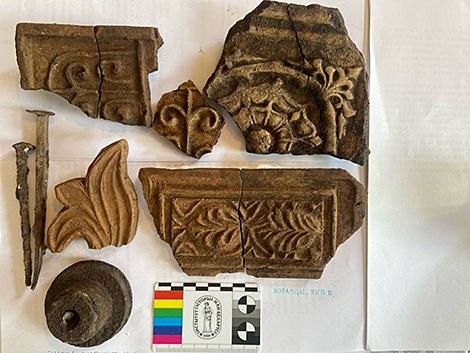
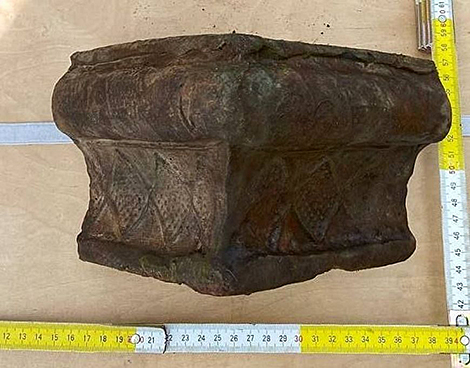
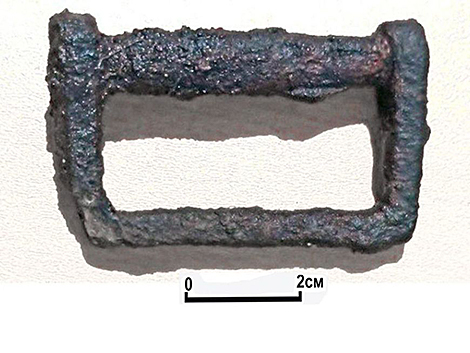
The archaeologists’ discoveries include a massive clay net weight, a boot heel iron, a knife handle, pieces of pottery from the 16th and 17th centuries, and 17th-century stove tiles featuring a “palm branch” pattern. Additionally, they uncovered fragments of Russian 120mm artillery shells that shell-shocked the fortified settlement. The bombardment came from Russian army positions based in Berezovets village during World War I.
Incidentally, next to the hillfort, specifically on its southern side, archaeologists identified a settlement site (the area of a manor farm) back in 2014. “We uncovered extremely valuable and very early materials related to the people who took part in the construction of the wooden castle for Kmita Stretovich of Berezovets in the early 16th century. Therefore, this area should continue to be used only for grass sowing, as it has always been, since this does not damage the Berezovets archaeological site. Deep plowing is unacceptable. The complex includes not only the Berezovets hillfort, which is listed in the State List of Historical and Cultural Values, but also the settlement, the former unfortified manor house and estate farm of the Berezovets property,” Natalya Pochobut stressed.
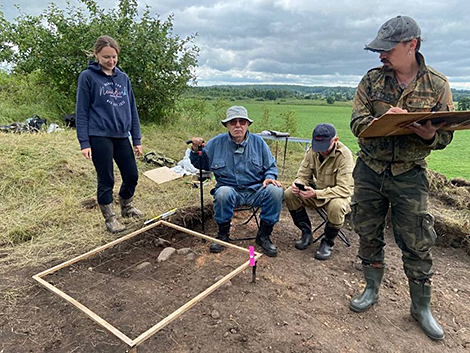
As Korelichi prepares to host Dozhinki 2026 harvest festival, earthworks are underway in the historic center of the town. In furtherance of efforts to identify and preserve Korelichi’s archaeological heritage, the Institute of History of the National Academy of Sciences of Belarus is conducting continuous archaeological monitoring of excavation works on 17 September Street, Sovetskaya Street, 17 September Square, 1 May Lane and other locations. Archaeologists have already recovered artifacts dating from the 17th to the 19th centuries.
“Korelichi had never previously undergone systemic archaeological research, so until recently we knew very little about the nature and preservation of its centuries-old cultural layer. We now know that the cultural layer near the music school is one meter thick, and we have discovered a coin dating back to the reign of Catherine II,” Natalya Pochobut said.
The archaeologists are now working with the Korelichi Regional Museum of Local Lore to prepare a new exhibition for the harvest festival. It will feature large-format photographs of the excavations, a reconstruction of the site, and the preserved foundations of 16th and 17th century stoves uncovered during previous excavations. Visitors will also be able to see photographs of restored ceramic stove tiles depicting angels, the Garden of Eden floral motif, flowers and pomegranates, as well as tiles dating back to the period when the castle was acquired by Zygmunt Karol Radziwiłł. Artifacts discovered this year and in 2025, including household items, farming tools and weapons reflecting everyday life of local residents, will be transferred to the Korelichi Regional Museum of Local Lore.
Photos by Natalya Pochobut/BelTA
 print version
 make home page
 add to bookmarks